
Samsung Galaxy M35 vs Xiaomi Redmi Note 13 Pro+: A Detailed Comparison
| Phones Images | |||||
|---|---|---|---|---|---|
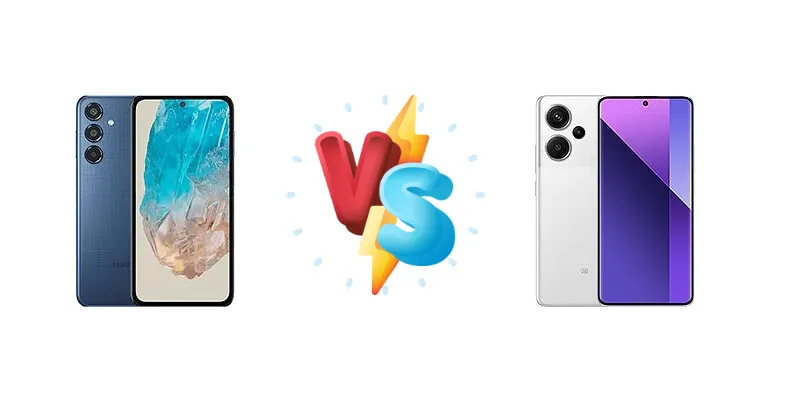
|
🏆 Quick Verdict
For most users, the Xiaomi Redmi Note 13 Pro+ emerges as the stronger contender. Its significantly faster 120W charging and brighter display, coupled with a more modern chipset, outweigh the Galaxy M35’s potentially more refined software experience. However, those prioritizing a potentially longer software support lifecycle might lean towards Samsung.
| PHONES | ||
|---|---|---|
| Phone Names | Samsung Galaxy M35 | Xiaomi Redmi Note 13 Pro+ |
| Network | ||
|---|---|---|
| 2G bands | GSM 850 / 900 / 1800 / 1900 | GSM 850 / 900 / 1800 / 1900 |
| 3G bands | HSDPA 850 / 900 / 1700(AWS) / 1900 / 2100 | HSDPA 800 / 850 / 900 / 1700(AWS) / 1900 / 2100 - International |
| 4G bands | 1, 2, 3, 4, 5, 7, 8, 12, 17, 20, 26, 28, 38, 40, 41, 66 | 1, 2, 3, 4, 5, 7, 8, 12, 13, 17, 18, 19, 20, 26, 28, 32, 38, 40, 41, 66 - International |
| 5G bands | 1, 3, 5, 7, 8, 20, 28, 38, 40, 41, 77, 78 SA/NSA/Sub6 | 1, 3, 5, 7, 8, 20, 28, 38, 40, 41, 66, 77, 78 SA/NSA- International |
| Speed | HSPA, LTE, 5G | HSPA, LTE, 5G |
| Technology | GSM / HSPA / LTE / 5G | GSM / CDMA / HSPA / EVDO / LTE / 5G |
| Launch | ||
|---|---|---|
| Announced | 2024, May 24 | 2023, September 21 |
| Status | Available. Released 2024, May 24 | Available. Released 2023, September 21 |
| Body | ||
|---|---|---|
| Build | Glass front (Gorilla Glass Victus+), plastic frame, glass back | Glass front (Gorilla Glass Victus), glass back or silicone polymer back (eco leather) |
| Dimensions | 162.3 x 78.6 x 9.1 mm (6.39 x 3.09 x 0.36 in) | 161.4 x 74.2 x 8.9 mm (6.35 x 2.92 x 0.35 in) |
| SIM | Nano-SIM + Nano-SIM | · Nano-SIM + eSIM· Nano-SIM + Nano-SIM |
| Weight | 222 g (7.83 oz) | 199 g or 204.5 g (7.02 oz) |
| Display | ||
|---|---|---|
| Protection | Corning Gorilla Glass Victus+ | Corning Gorilla Glass Victus |
| Resolution | 1080 x 2340 pixels, 19.5:9 ratio (~390 ppi density) | 1220 x 2712 pixels, 20:9 ratio (~446 ppi density) |
| Size | 6.6 inches, 106.9 cm2 (~83.8% screen-to-body ratio) | 6.67 inches, 107.4 cm2 (~89.7% screen-to-body ratio) |
| Type | Super AMOLED, 120Hz, 1000 nits (HBM) | AMOLED, 68B colors, 120Hz, 1920Hz PWM, Dolby Vision, HDR10+, 1800 nits (peak) |
| Platform | ||
|---|---|---|
| CPU | Octa-core (4x2.4 GHz Cortex-A78 & 4x2.0 GHz Cortex-A55) | Octa-core (2x2.8 GHz Cortex-A715 & 6x2.0 GHz Cortex-A510) |
| Chipset | Exynos 1380 (5 nm) | Mediatek Dimensity 7200 Ultra (4 nm) |
| GPU | Mali-G68 MP5 | Mali-G610 MC4 |
| OS | Android 14, upgradable to Android 16, One UI 8 | Android 13, up to 3 major Android upgrades, HyperOS |
| Memory | ||
|---|---|---|
| Card slot | microSDXC (uses shared SIM slot) | No |
| Internal | 128GB 6GB RAM, 128GB 8GB RAM, 256GB 8GB RAM | 256GB 8GB RAM, 256GB 12GB RAM, 512GB 8GB RAM, 512GB 12GB RAM, 512GB 16GB RAM |
| Main Camera | ||
|---|---|---|
| Features | LED flash, panorama, HDR | Dual-LED dual-tone flash, HDR, panorama |
| Triple | 50 MP, f/1.8, (wide), 1/1.96", PDAF, OIS 8 MP, f/2.2, 123˚, (ultrawide), 1/4.0", 1.12µm 2 MP (macro) | 200 MP, f/1.7, 23mm (wide), 1/1.4", 0.56µm, multi-directional PDAF, OIS 8 MP, f/2.2, 16mm, 120˚ (ultrawide), 1/4.0", 1.12µm 2 MP (macro) |
| Video | 4K@30fps, 1080p@30/60fps, 720p@480fps, gyro-EIS | 4K@24/30fps, 1080p@30/60/120fps, gyro-EIS |
| Selfie camera | ||
|---|---|---|
| Features | - | HDR, panorama |
| Single | 13 MP, f/2.2, (wide), 1/3.06", 1.12µm | 16 MP, f/2.4, (wide) |
| Video | 4K@30fps, 1080p@30fps | 1080p@30/60fps |
| Sound | ||
|---|---|---|
| 35mm jack | No | No |
| Loudspeaker | Yes, with stereo speakers | Yes, with stereo speakers |
| Comms | ||
|---|---|---|
| Bluetooth | 5.3, A2DP, LE | 5.3, A2DP, LE |
| Infrared port | - | Yes |
| NFC | Yes (market/region dependent) | Yes (market/region dependent) |
| Positioning | GPS, GALILEO, GLONASS, BDS, QZSS | GPS, GLONASS, BDS, GALILEO, QZSS |
| Radio | Unspecified | No |
| USB | USB Type-C 2.0, OTG | USB Type-C 2.0, OTG |
| WLAN | Wi-Fi 802.11 a/b/g/n/ac/6, dual-band, Wi-Fi Direct | Wi-Fi 802.11 a/b/g/n/ac/6, dual-band, Wi-Fi Direct |
| Features | ||
|---|---|---|
| Sensors | Fingerprint (side-mounted), accelerometer, gyro, compass | Fingerprint (under display, optical), accelerometer, gyro, proximity, compass |
| Battery | ||
|---|---|---|
| Charging | 25W wired | 120W wired, PD3.0, 100% in 19 min |
| Type | 6000 mAh | Li-Po 5000 mAh |
| Misc | ||
|---|---|---|
| Colors | Dark Blue, Light Blue, Gray | Midnight Black (Fushion Black), Moonlight White (Fushion White), Aurora Purple, Fushion Purple, Camo Green |
| Models | SM-M356B, SM-M356B/DS | 23090RA98C, 23090RA98G, 23090RA98I |
| Price | About 200 EUR | $ 299.98 / £ 299.00 / € 208.98 / ₹ 24,999 |
| SAR | 0.53 W/kg (head) | 1.09 W/kg (head) 0.85 W/kg (body) |
| SAR EU | 0.31 W/kg (head) 1.30 W/kg (body) | 0.98 W/kg (head) 1.00 W/kg (body) |
Samsung Galaxy M35
- Potentially longer software support from Samsung
- Familiar Samsung One UI experience
- Efficient 5nm Exynos 1380 chipset
- Significantly slower 25W charging
- Likely less bright display
- Older chipset architecture
Xiaomi Redmi Note 13 Pro+
- Blazing-fast 120W charging (19 minutes to full)
- Exceptionally bright 1283 nit display
- More powerful Mediatek Dimensity 7200 Ultra
- Xiaomi’s MIUI software can be polarizing
- Potentially shorter software update commitment
- May prioritize features over raw processing power
Display Comparison
The Redmi Note 13 Pro+ boasts a significantly brighter display, reaching a measured 1283 nits, compared to an unspecified brightness for the Galaxy M35. This difference translates to superior outdoor visibility. While panel technology isn't specified for either, the Redmi’s brightness suggests a more advanced panel. The M35’s display quality will likely be good, typical of Samsung, but it won’t match the Redmi’s peak performance in bright conditions. Bezels are likely comparable given the market segment, and color accuracy will depend on calibration, but the Redmi’s higher peak brightness is a clear advantage.
Camera Comparison
Without detailed camera specs beyond the main sensors, a direct comparison is difficult. However, the Redmi Note 13 Pro+ is likely to feature a more advanced camera system, given Xiaomi’s recent focus on camera technology. The larger sensor size, if present, would be a significant advantage in low-light photography. Lens aperture is also crucial; a wider aperture (lower f-number) allows more light to reach the sensor. Image processing styles differ between Samsung and Xiaomi; Samsung typically aims for vibrant, saturated colors, while Xiaomi often leans towards a more natural look. The presence of OIS (Optical Image Stabilization) on the Redmi would further enhance image quality, particularly in videos.
Performance
The Xiaomi Redmi Note 13 Pro+ utilizes the Mediatek Dimensity 7200 Ultra (4nm), while the Samsung Galaxy M35 is powered by the Exynos 1380 (5nm). The Dimensity 7200 Ultra’s newer Cortex-A715 cores, clocked at 2.8 GHz, offer a performance advantage over the M35’s Cortex-A78 cores at 2.4 GHz. The 4nm process node of the Dimensity chip also contributes to better power efficiency and potentially less thermal throttling under sustained load. While both phones feature octa-core CPUs, the Redmi Note 13 Pro+ is expected to deliver smoother performance in demanding applications and games. RAM speed isn't specified, but LPDDR5X is likely on the Redmi, further boosting performance.
Battery Life
The Redmi Note 13 Pro+’s standout feature is its 120W wired charging, capable of a full charge in just 19 minutes. This is a massive advantage over the Galaxy M35’s 25W charging. While the M35’s battery capacity isn’t specified, the Redmi Note 13 Pro+ achieves an impressive 10:38h of active use. The faster charging speed of the Redmi effectively mitigates any potential disadvantage from a slightly smaller battery capacity, offering a more convenient user experience. The Redmi also supports PD3.0, offering wider compatibility with chargers.
Buying Guide
Buy the Samsung Galaxy M35 if you prioritize a familiar Samsung One UI experience and potentially longer software update support, and aren't overly concerned with the fastest charging or peak display brightness. Buy the Xiaomi Redmi Note 13 Pro+ if you demand blazing-fast 120W charging, a vibrant and exceptionally bright display, and a more powerful processor for demanding tasks and gaming.