
Samsung Galaxy A55 vs M35: Which Samsung Mid-Ranger Reigns Supreme?
| Phones Images | |||||
|---|---|---|---|---|---|
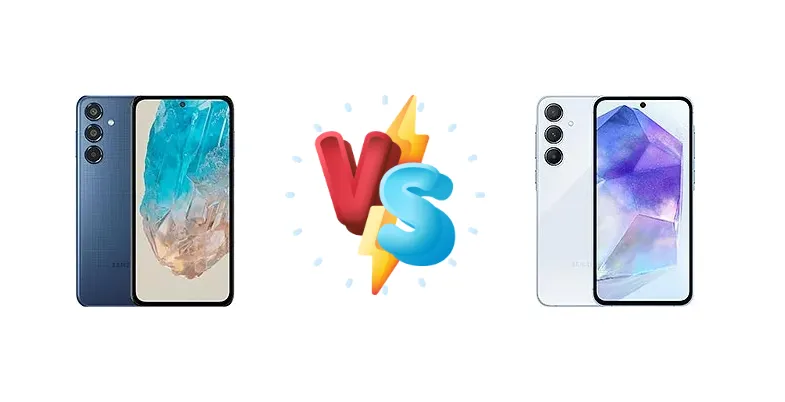
|
🏆 Quick Verdict
For most users, the Samsung Galaxy A55 is the superior choice. Its newer Exynos 1480 chipset, coupled with a brighter and likely more efficient display, provides a noticeable performance boost and a more premium experience, justifying the price difference.
| PHONES | ||
|---|---|---|
| Phone Names | Samsung Galaxy M35 | Samsung Galaxy A55 |
| Network | ||
|---|---|---|
| 2G bands | GSM 850 / 900 / 1800 / 1900 | GSM 850 / 900 / 1800 / 1900 |
| 3G bands | HSDPA 850 / 900 / 1700(AWS) / 1900 / 2100 | HSDPA 850 / 900 / 1700(AWS) / 1900 / 2100 |
| 4G bands | 1, 2, 3, 4, 5, 7, 8, 12, 17, 20, 26, 28, 38, 40, 41, 66 | 1, 2, 3, 4, 5, 7, 8, 12, 17, 20, 25, 26, 28, 32, 38, 40, 41, 66 |
| 5G bands | 1, 3, 5, 7, 8, 20, 28, 38, 40, 41, 77, 78 SA/NSA/Sub6 | 1, 3, 5, 7, 8, 20, 28, 38, 40, 41, 66, 77, 78 SA/NSA/Sub6 |
| Speed | HSPA, LTE, 5G | HSPA, LTE, 5G |
| Technology | GSM / HSPA / LTE / 5G | GSM / HSPA / LTE / 5G |
| Launch | ||
|---|---|---|
| Announced | 2024, May 24 | 2024, March 11 |
| Status | Available. Released 2024, May 24 | Available. Released 2024, March 15 |
| Body | ||
|---|---|---|
| Build | Glass front (Gorilla Glass Victus+), plastic frame, glass back | Glass front (Gorilla Glass Victus+), glass back (Gorilla Glass), aluminum frame |
| Dimensions | 162.3 x 78.6 x 9.1 mm (6.39 x 3.09 x 0.36 in) | 161.1 x 77.4 x 8.2 mm (6.34 x 3.05 x 0.32 in) |
| SIM | Nano-SIM + Nano-SIM | · Nano-SIM· Nano-SIM + eSIM· Nano-SIM + Nano-SIM· Nano-SIM + Nano-SIM + eSIM (max 2 at a time) |
| Weight | 222 g (7.83 oz) | 213 g (7.51 oz) |
| Display | ||
|---|---|---|
| Protection | Corning Gorilla Glass Victus+ | Corning Gorilla Glass Victus+ |
| Resolution | 1080 x 2340 pixels, 19.5:9 ratio (~390 ppi density) | 1080 x 2340 pixels, 19.5:9 ratio (~390 ppi density) |
| Size | 6.6 inches, 106.9 cm2 (~83.8% screen-to-body ratio) | 6.6 inches, 106.9 cm2 (~85.8% screen-to-body ratio) |
| Type | Super AMOLED, 120Hz, 1000 nits (HBM) | Super AMOLED, 120Hz, HDR10+, 1000 nits (HBM) |
| Platform | ||
|---|---|---|
| CPU | Octa-core (4x2.4 GHz Cortex-A78 & 4x2.0 GHz Cortex-A55) | Octa-core (4x2.75 GHz Cortex-A78 & 4x2.0 GHz Cortex-A55) |
| Chipset | Exynos 1380 (5 nm) | Exynos 1480 (4 nm) |
| GPU | Mali-G68 MP5 | Xclipse 530 |
| OS | Android 14, upgradable to Android 16, One UI 8 | Android 14, up to 4 major Android upgrades, One UI 6.1 |
| Memory | ||
|---|---|---|
| Card slot | microSDXC (uses shared SIM slot) | microSDXC (uses shared SIM slot) |
| Internal | 128GB 6GB RAM, 128GB 8GB RAM, 256GB 8GB RAM | 128GB 6GB RAM, 128GB 8GB RAM, 256GB 6GB RAM, 256GB 8GB RAM, 256GB 12GB RAM |
| Main Camera | ||
|---|---|---|
| Features | LED flash, panorama, HDR | LED flash, panorama, HDR |
| Triple | 50 MP, f/1.8, (wide), 1/1.96", PDAF, OIS 8 MP, f/2.2, 123˚, (ultrawide), 1/4.0", 1.12µm 2 MP (macro) | 50 MP, f/1.8, (wide), 1/1.56", 1.0µm, PDAF, OIS 12 MP, f/2.2, 123˚ (ultrawide), 1/3.06", 1.12µm 5 MP (macro) |
| Video | 4K@30fps, 1080p@30/60fps, 720p@480fps, gyro-EIS | 4K@30fps, 1080p@30/60fps, gyro-EIS |
| Selfie camera | ||
|---|---|---|
| Single | 13 MP, f/2.2, (wide), 1/3.06", 1.12µm | 32 MP, f/2.2, 26mm (wide), 1/2.74", 0.8µm |
| Video | 4K@30fps, 1080p@30fps | 4K@30fps, 1080p@30/60fps |
| Sound | ||
|---|---|---|
| 35mm jack | No | No |
| Loudspeaker | Yes, with stereo speakers | Yes, with stereo speakers |
| Comms | ||
|---|---|---|
| Bluetooth | 5.3, A2DP, LE | 5.3, A2DP, LE |
| NFC | Yes (market/region dependent) | Yes (market/region dependent) |
| Positioning | GPS, GALILEO, GLONASS, BDS, QZSS | GPS, GALILEO, GLONASS, BDS, QZSS |
| Radio | Unspecified | No |
| USB | USB Type-C 2.0, OTG | USB Type-C 2.0, OTG |
| WLAN | Wi-Fi 802.11 a/b/g/n/ac/6, dual-band, Wi-Fi Direct | Wi-Fi 802.11 a/b/g/n/ac/6, dual-band, Wi-Fi Direct |
| Features | ||
|---|---|---|
| Sensors | Fingerprint (side-mounted), accelerometer, gyro, compass | Fingerprint (under display, optical), accelerometer, gyro, compass |
| Battery | ||
|---|---|---|
| Charging | 25W wired | 25W wired |
| Type | 6000 mAh | Li-Ion 5000 mAh |
| Misc | ||
|---|---|---|
| Colors | Dark Blue, Light Blue, Gray | Iceblue, Lilac, Navy, Lemon |
| Models | SM-M356B, SM-M356B/DS | SM-A556V, SM-A556B, SM-A556B/DS, SM-A556E, SM-A556E/DS, SM-A5560 |
| Price | About 200 EUR | $ 324.99 / £ 251.50 / € 319.99 / ₹ 23,998 |
| SAR | 0.53 W/kg (head) | - |
| SAR EU | 0.31 W/kg (head) 1.30 W/kg (body) | 0.68 W/kg (head) 1.04 W/kg (body) |
Samsung Galaxy M35
- More powerful Exynos 1480 chipset
- Brighter and more vibrant display (1010 nits)
- Superior battery life (13:27h active use)
- Likely higher price point
- May not offer expandable storage (depending on region)
Samsung Galaxy A55
- More affordable price
- Potentially longer battery life due to less demanding chipset
- Samsung’s reliable software support
- Less powerful Exynos 1380 chipset
- Dimmer display
- Potentially slower app loading and multitasking
Display Comparison
The Galaxy A55 boasts a significant advantage in display quality, achieving a measured peak brightness of 1010 nits. While the M35’s brightness isn’t specified, it’s likely lower. This higher brightness translates to better outdoor visibility. Although both likely use AMOLED panels, the A55’s superior brightness suggests a more advanced panel generation. We anticipate the A55 also benefits from improved color accuracy and viewing angles, enhancing the overall visual experience. The absence of LTPO technology on either device means refresh rate scaling isn't present, but the A55's brighter panel is a clear win.
Camera Comparison
Without detailed camera specs, a direct comparison is limited. However, given the A55’s positioning as a slightly more premium device, it’s reasonable to expect a more capable main camera sensor and potentially better image processing algorithms. The presence of Optical Image Stabilization (OIS) on the A55, if present, would further enhance image quality, particularly in low-light conditions. The 2MP macro cameras on both devices are likely of limited utility, serving primarily as filler specs. The A55’s image signal processor (ISP), integrated within the Exynos 1480, will likely offer more advanced features and better noise reduction.
Performance
The core difference lies in the chipsets: the A55 utilizes the Exynos 1480 (4nm) while the M35 features the Exynos 1380 (5nm). Despite the 5nm process of the 1380, the 1480’s architectural improvements and higher clock speeds (2.75 GHz vs 2.4 GHz on the A78 cores) deliver superior performance. Both share the same Cortex-A55 efficiency cores, but the A55’s more advanced node and CPU design will result in better sustained performance and potentially improved thermal management. This translates to smoother multitasking, faster app loading times, and a more responsive gaming experience on the A55.
Battery Life
The Galaxy A55 demonstrates a clear advantage in real-world battery performance, achieving 13 hours and 27 minutes of active use. While the M35’s battery capacity isn’t specified, the A55’s longer runtime suggests a combination of a more efficient chipset and optimized software. Both devices support 25W wired charging, meaning 0-100% charge times will be comparable, likely around 1 hour 30 minutes to 2 hours. The A55’s superior efficiency means you’ll spend less time tethered to a charger.
Buying Guide
Buy the Samsung Galaxy M35 if you prioritize maximizing battery life on a tighter budget and don't require the absolute fastest performance for demanding tasks. Buy the Samsung Galaxy A55 if you value a brighter, more vibrant display, smoother performance for gaming and multitasking, and a more future-proof chipset for software updates and longevity.