
Samsung Galaxy M35 vs. Galaxy A35: A Detailed Comparison
| Phones Images | |||||
|---|---|---|---|---|---|
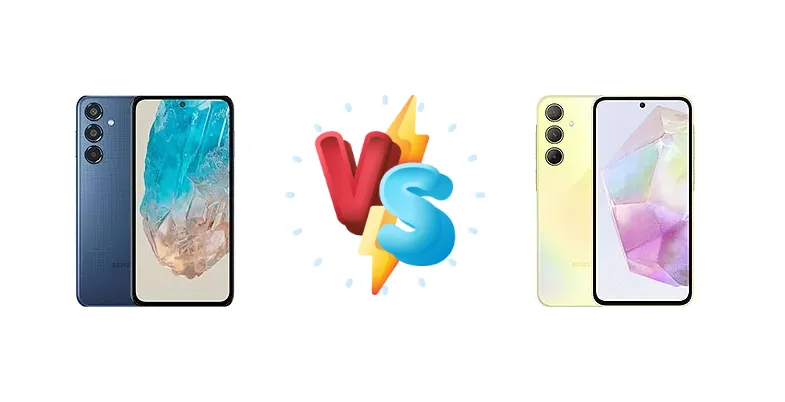
|
🏆 Quick Verdict
For the average user, the Samsung Galaxy A35 emerges as the superior choice. Its significantly longer battery life – 12 hours and 26 minutes of active use – coupled with a brighter 1024 nit display, provides a more enjoyable and practical daily experience, despite sharing the same processor and charging speed as the M35.
| PHONES | ||
|---|---|---|
| Phone Names | Samsung Galaxy M35 | Samsung Galaxy A35 |
| Network | ||
|---|---|---|
| 2G bands | GSM 850 / 900 / 1800 / 1900 | GSM 850 / 900 / 1800 / 1900 |
| 3G bands | HSDPA 850 / 900 / 1700(AWS) / 1900 / 2100 | HSDPA 850 / 900 / 1700(AWS) / 1900 / 2100 |
| 4G bands | 1, 2, 3, 4, 5, 7, 8, 12, 17, 20, 26, 28, 38, 40, 41, 66 | 1, 2, 3, 4, 5, 7, 8, 12, 13, 17, 20, 25, 26, 28, 32, 38, 40, 41, 66 |
| 5G bands | 1, 3, 5, 7, 8, 20, 28, 38, 40, 41, 77, 78 SA/NSA/Sub6 | 1, 3, 5, 7, 8, 26, 28, 40, 41, 66, 77, 78 SA/NSA/Sub6 |
| Speed | HSPA, LTE, 5G | HSPA, LTE, 5G |
| Technology | GSM / HSPA / LTE / 5G | GSM / HSPA / LTE / 5G |
| Launch | ||
|---|---|---|
| Announced | 2024, May 24 | 2024, March 11 |
| Status | Available. Released 2024, May 24 | Available. Released 2024, March 15 |
| Body | ||
|---|---|---|
| Build | Glass front (Gorilla Glass Victus+), plastic frame, glass back | Glass front (Gorilla Glass Victus+), plastic frame, glass back |
| Dimensions | 162.3 x 78.6 x 9.1 mm (6.39 x 3.09 x 0.36 in) | 161.7 x 78 x 8.2 mm (6.37 x 3.07 x 0.32 in) |
| SIM | Nano-SIM + Nano-SIM | · Nano-SIM + eSIM· Nano-SIM + Nano-SIM |
| Weight | 222 g (7.83 oz) | 209 g (7.37 oz) |
| Display | ||
|---|---|---|
| Protection | Corning Gorilla Glass Victus+ | Corning Gorilla Glass Victus+ |
| Resolution | 1080 x 2340 pixels, 19.5:9 ratio (~390 ppi density) | 1080 x 2340 pixels, 19.5:9 ratio (~390 ppi density) |
| Size | 6.6 inches, 106.9 cm2 (~83.8% screen-to-body ratio) | 6.6 inches, 106.9 cm2 (~84.8% screen-to-body ratio) |
| Type | Super AMOLED, 120Hz, 1000 nits (HBM) | Super AMOLED, 120Hz, 1000 nits (HBM) |
| Platform | ||
|---|---|---|
| CPU | Octa-core (4x2.4 GHz Cortex-A78 & 4x2.0 GHz Cortex-A55) | Octa-core (4x2.4 GHz Cortex-A78 & 4x2.0 GHz Cortex-A55) |
| Chipset | Exynos 1380 (5 nm) | Exynos 1380 (5 nm) |
| GPU | Mali-G68 MP5 | Mali-G68 MP5 |
| OS | Android 14, upgradable to Android 16, One UI 8 | Android 14, up to 4 major Android upgrades, One UI 7 |
| Memory | ||
|---|---|---|
| Card slot | microSDXC (uses shared SIM slot) | microSDXC (uses shared SIM slot) |
| Internal | 128GB 6GB RAM, 128GB 8GB RAM, 256GB 8GB RAM | 128GB 4GB RAM, 128GB 6GB RAM, 128GB 8GB RAM, 256GB 6GB RAM, 256GB 8GB RAM, 256GB 12GB RAM |
| Main Camera | ||
|---|---|---|
| Features | LED flash, panorama, HDR | LED flash, panorama, HDR |
| Triple | 50 MP, f/1.8, (wide), 1/1.96", PDAF, OIS 8 MP, f/2.2, 123˚, (ultrawide), 1/4.0", 1.12µm 2 MP (macro) | 50 MP, f/1.8, (wide), 1/1.96", PDAF, OIS 8 MP, f/2.2, 123˚, (ultrawide), 1/4.0", 1.12µm 5 MP (macro) |
| Video | 4K@30fps, 1080p@30/60fps, 720p@480fps, gyro-EIS | 4K@30fps, 1080p@30/60fps, gyro-EIS |
| Selfie camera | ||
|---|---|---|
| Single | 13 MP, f/2.2, (wide), 1/3.06", 1.12µm | 13 MP, f/2.2, (wide), 1/3.06", 1.12µm |
| Video | 4K@30fps, 1080p@30fps | 4K@30fps, 1080p@30fps |
| Sound | ||
|---|---|---|
| 35mm jack | No | No |
| Loudspeaker | Yes, with stereo speakers | Yes, with stereo speakers |
| Comms | ||
|---|---|---|
| Bluetooth | 5.3, A2DP, LE | 5.3, A2DP, LE |
| NFC | Yes (market/region dependent) | Yes (market/region dependent) |
| Positioning | GPS, GALILEO, GLONASS, BDS, QZSS | GPS, GALILEO, GLONASS, BDS, QZSS |
| Radio | Unspecified | No |
| USB | USB Type-C 2.0, OTG | USB Type-C 2.0, OTG |
| WLAN | Wi-Fi 802.11 a/b/g/n/ac/6, dual-band, Wi-Fi Direct | Wi-Fi 802.11 a/b/g/n/ac/6, dual-band, Wi-Fi Direct |
| Features | ||
|---|---|---|
| Sensors | Fingerprint (side-mounted), accelerometer, gyro, compass | Fingerprint (under display, optical), accelerometer, gyro, compass |
| Battery | ||
|---|---|---|
| Charging | 25W wired | 25W wired |
| Type | 6000 mAh | Li-Ion 5000 mAh |
| Misc | ||
|---|---|---|
| Colors | Dark Blue, Light Blue, Gray | Iceblue, Lilac, Navy, Lemon |
| Models | SM-M356B, SM-M356B/DS | SM-A356E, SM-A356E/DS, SM-A356B, SM-A356B/DS, SM-A356U, SM-A356U1 |
| Price | About 200 EUR | $ 138.00 / C$ 419.99 / £ 205.99 / € 259.99 / ₹ 18,299 |
| SAR | 0.53 W/kg (head) | 0.81 W/kg (head) |
| SAR EU | 0.31 W/kg (head) 1.30 W/kg (body) | 0.44 W/kg (head) 0.92 W/kg (body) |
Samsung Galaxy M35
- Potentially lower price point
- Same Exynos 1380 performance as A35
- Likely similar camera software
- Expected lower display brightness
- Likely shorter battery life
- May lack some premium features of the A35
Samsung Galaxy A35
- Significantly longer battery life (12:26h)
- Brighter 1024 nit display
- Potentially more refined software experience
- Higher price compared to the M35
- Same Exynos 1380 chipset – no performance gain
- 25W charging is relatively slow
Display Comparison
The Samsung Galaxy A35 boasts a notably brighter display, reaching a measured peak brightness of 1024 nits. This is a significant advantage over the M35, which lacks published brightness data but is expected to be lower, making the A35 far more usable outdoors under direct sunlight. While both likely utilize AMOLED panels for vibrant colors, the A35’s higher brightness translates to a superior viewing experience in all lighting conditions. We expect both to have FHD+ resolution, but the A35’s brightness is the clear differentiator.
Camera Comparison
Without detailed camera specifications, it’s difficult to make a definitive judgment. However, given the market positioning, we can infer that both phones will feature a multi-camera system with a primary sensor, ultrawide, and potentially a macro lens. The image processing style will likely be consistent across both devices, leaning towards Samsung’s typically vibrant and saturated look. The absence of information regarding sensor size and aperture makes it impossible to determine which phone will perform better in low-light conditions. We anticipate the A35 may receive slightly more advanced image processing features due to its higher price point.
Performance
Both the Galaxy M35 and A35 are powered by the Exynos 1380 (5nm) chipset, featuring an octa-core CPU configuration with 4x2.4 GHz Cortex-A78 and 4x2.0 GHz Cortex-A55 cores. This means performance in everyday tasks and even moderate gaming will be virtually identical. The 5nm fabrication process offers a good balance of power efficiency, but sustained performance will depend on Samsung’s thermal management implementation. Given the identical chipset, the A35’s advantage in battery life isn’t due to processor efficiency, but rather the battery capacity and software optimization.
Battery Life
The Galaxy A35 shines in battery performance, achieving an active use score of 12 hours and 26 minutes. While the M35’s battery capacity is unknown, the A35’s endurance is a significant advantage. Both phones support 25W wired charging, meaning 0-100% charge times will be comparable, likely around 1 hour and 30 minutes. The A35’s longer battery life effectively mitigates the relatively slow charging speed, providing more flexibility for users who don’t want to be tethered to a charger frequently.
Buying Guide
Buy the Samsung Galaxy M35 if you prioritize a lower upfront cost and are willing to compromise on display brightness and battery endurance. It's a solid option for casual users who don't heavily rely on their phone throughout the day. Buy the Samsung Galaxy A35 if you value a vibrant, easily visible display and all-day battery life. This phone is ideal for users who stream videos, play games, or frequently use GPS navigation.