
Samsung Galaxy M35 vs. Nothing Phone (2a) Plus: A Detailed Comparison
| Phones Images | |||||
|---|---|---|---|---|---|
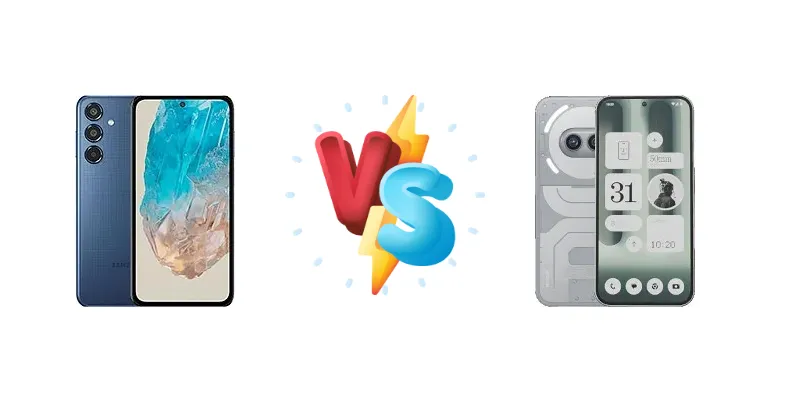
|
🏆 Quick Verdict
For the average user prioritizing fast charging and a brighter display, the Nothing Phone (2a) Plus emerges as the stronger contender. Its 50W charging, achieving a full charge in 56 minutes, and peak brightness of 1097 nits significantly outperform the Galaxy M35’s 25W charging and unspecified display brightness. However, Samsung’s software experience may appeal to some.
| PHONES | ||
|---|---|---|
| Phone Names | Samsung Galaxy M35 | Nothing Phone (2a) Plus |
| Network | ||
|---|---|---|
| 2G bands | GSM 850 / 900 / 1800 / 1900 | GSM 850 / 900 / 1800 / 1900 |
| 3G bands | HSDPA 850 / 900 / 1700(AWS) / 1900 / 2100 | HSDPA 800 / 850 / 900 / 1700(AWS) / 1900 / 2100 |
| 4G bands | 1, 2, 3, 4, 5, 7, 8, 12, 17, 20, 26, 28, 38, 40, 41, 66 | 1, 3, 4, 5, 7, 8, 18, 19, 20, 26, 28, 38, 39, 40, 41, 42, 66 |
| 5G bands | 1, 3, 5, 7, 8, 20, 28, 38, 40, 41, 77, 78 SA/NSA/Sub6 | 1, 3, 5, 7, 8, 20, 28, 38, 40, 41, 66, 77, 78 SA/NSA |
| Speed | HSPA, LTE, 5G | HSPA, LTE, 5G |
| Technology | GSM / HSPA / LTE / 5G | GSM / HSPA / LTE / 5G |
| Launch | ||
|---|---|---|
| Announced | 2024, May 24 | 2024, July 31 |
| Status | Available. Released 2024, May 24 | Available. Released 2024, August 03 |
| Body | ||
|---|---|---|
| Build | Glass front (Gorilla Glass Victus+), plastic frame, glass back | Glass front (Gorilla Glass 5), plastic frame, plastic back |
| Dimensions | 162.3 x 78.6 x 9.1 mm (6.39 x 3.09 x 0.36 in) | 161.7 x 76.3 x 8.5 mm (6.37 x 3.00 x 0.33 in) |
| SIM | Nano-SIM + Nano-SIM | Nano-SIM + Nano-SIM |
| Weight | 222 g (7.83 oz) | 190 g (6.70 oz) |
| Display | ||
|---|---|---|
| Protection | Corning Gorilla Glass Victus+ | Corning Gorilla Glass 5 |
| Resolution | 1080 x 2340 pixels, 19.5:9 ratio (~390 ppi density) | 1080 x 2412 pixels, 20:9 ratio (~395 ppi density) |
| Size | 6.6 inches, 106.9 cm2 (~83.8% screen-to-body ratio) | 6.7 inches, 107.5 cm2 (~87.1% screen-to-body ratio) |
| Type | Super AMOLED, 120Hz, 1000 nits (HBM) | AMOLED, 1B colors, 120Hz, 2160Hz PWM, HDR10+, 700 nits (typ), 1100 nits (HBM), 1300 nits (peak) |
| Platform | ||
|---|---|---|
| CPU | Octa-core (4x2.4 GHz Cortex-A78 & 4x2.0 GHz Cortex-A55) | Octa-core (2x3.0 GHz Cortex-A715 & 6x 2.0 GHz Cortex-A510) |
| Chipset | Exynos 1380 (5 nm) | Mediatek Dimensity 7350 Pro (4 nm) |
| GPU | Mali-G68 MP5 | Mali-G610 MC4 |
| OS | Android 14, upgradable to Android 16, One UI 8 | Android 14, up to 3 major Android upgrades, Nothing OS 3.0 |
| Memory | ||
|---|---|---|
| Card slot | microSDXC (uses shared SIM slot) | No |
| Internal | 128GB 6GB RAM, 128GB 8GB RAM, 256GB 8GB RAM | 256GB 8GB RAM, 256GB 12GB RAM |
| Main Camera | ||
|---|---|---|
| Dual | - | 50 MP, f/1.9, 24mm (wide), 1/1.57", 1.0µm, PDAF, OIS 50 MP, f/2.2, 114˚ (ultrawide), 1/2.76", 0.64µm |
| Features | LED flash, panorama, HDR | LED flash, panorama, HDR |
| Triple | 50 MP, f/1.8, (wide), 1/1.96", PDAF, OIS 8 MP, f/2.2, 123˚, (ultrawide), 1/4.0", 1.12µm 2 MP (macro) | - |
| Video | 4K@30fps, 1080p@30/60fps, 720p@480fps, gyro-EIS | 4K@30fps, 1080p@60/120fps, gyro-EIS |
| Selfie camera | ||
|---|---|---|
| Features | - | HDR |
| Single | 13 MP, f/2.2, (wide), 1/3.06", 1.12µm | 50 MP, f/2.2, (wide), 1/2.76" |
| Video | 4K@30fps, 1080p@30fps | 4K@30fps |
| Sound | ||
|---|---|---|
| 35mm jack | No | No |
| Loudspeaker | Yes, with stereo speakers | Yes, with stereo speakers |
| Comms | ||
|---|---|---|
| Bluetooth | 5.3, A2DP, LE | 5.3, A2DP, LE |
| NFC | Yes (market/region dependent) | Yes, 360˚ |
| Positioning | GPS, GALILEO, GLONASS, BDS, QZSS | GPS, GALILEO, GLONASS, BDS, QZSS |
| Radio | Unspecified | No |
| USB | USB Type-C 2.0, OTG | USB Type-C 2.0, OTG |
| WLAN | Wi-Fi 802.11 a/b/g/n/ac/6, dual-band, Wi-Fi Direct | Wi-Fi 802.11 a/b/g/n/ac/6, dual-band, Wi-Fi Direct |
| Features | ||
|---|---|---|
| Sensors | Fingerprint (side-mounted), accelerometer, gyro, compass | Fingerprint (under display, optical), accelerometer, gyro, proximity, compass |
| Battery | ||
|---|---|---|
| Charging | 25W wired | 50W wired, 50% in 21 min, 100% in 56 min |
| Type | 6000 mAh | 5000 mAh |
| Misc | ||
|---|---|---|
| Colors | Dark Blue, Light Blue, Gray | Black, Grey |
| Models | SM-M356B, SM-M356B/DS | A142P |
| Price | About 200 EUR | € 269.90 / ₹ 22,599 |
| SAR | 0.53 W/kg (head) | - |
| SAR EU | 0.31 W/kg (head) 1.30 W/kg (body) | - |
Samsung Galaxy M35
- Established Samsung brand reputation
- Mature One UI software experience
- Potentially lower price point (depending on region)
- Slower 25W charging
- Older Exynos 1380 chipset
- Likely lower peak display brightness
Nothing Phone (2a) Plus
- Faster 50W charging (full charge in 56 minutes)
- More modern Mediatek Dimensity 7350 Pro chipset
- Brighter 1097 nit display
- Unique and minimalist design
- Less established brand
- Nothing OS may not appeal to all users
- Potential software bugs (early adopter risk)
Display Comparison
The Nothing Phone (2a) Plus boasts a significant advantage in display technology, achieving a measured peak brightness of 1097 nits. While the Galaxy M35’s display specifications are less detailed, it’s reasonable to assume a lower peak brightness. This difference translates to better outdoor visibility for the Nothing Phone (2a) Plus. The absence of LTPO technology in either device suggests both will rely on adaptive refresh rates to conserve battery, but the brighter panel on the Nothing Phone (2a) Plus will likely be more visible in direct sunlight. Bezels are expected to be similar, given the price points, but Nothing’s design language generally prioritizes a streamlined look.
Camera Comparison
Without detailed camera specifications for the Galaxy M35, a direct comparison is challenging. However, both phones likely feature a primary camera as their main selling point. The Nothing Phone (2a) Plus is expected to prioritize image processing for natural colors and detail, aligning with Nothing’s overall aesthetic. The Exynos 1380 in the M35 is a capable ISP, but its image processing style typically leans towards Samsung’s signature vibrant, sometimes oversaturated look. The presence of OIS (Optical Image Stabilization) on the primary sensor of either device would be a significant advantage for low-light photography, but this information is currently unavailable. We can expect both phones to include auxiliary lenses, but their quality is likely to be limited.
Performance
The core performance difference lies in the chipsets. The Nothing Phone (2a) Plus utilizes the Mediatek Dimensity 7350 Pro (4nm), featuring a more modern CPU architecture with 2x3.0 GHz Cortex-A715 cores and 6x 2.0 GHz Cortex-A510 cores. This contrasts with the Samsung Galaxy M35’s Exynos 1380 (5nm), which employs older Cortex-A78 and A55 cores. The 4nm process node of the Dimensity 7350 Pro generally offers better power efficiency and thermal performance compared to the 5nm Exynos 1380, potentially leading to less throttling during sustained workloads. While both utilize octa-core configurations, the architectural improvements in the Dimensity chip should translate to a noticeable performance advantage for the Nothing Phone (2a) Plus, particularly in graphics-intensive tasks.
Battery Life
The Nothing Phone (2a) Plus shines in the battery and charging department. While the exact battery capacity isn’t specified, its active use score of 16:34h demonstrates excellent endurance. Crucially, it supports 50W wired charging, reaching 50% charge in just 21 minutes and a full charge in 56 minutes. The Samsung Galaxy M35 is limited to 25W wired charging, which will take considerably longer to fully replenish the battery. The combination of efficient chipset and fast charging gives the Nothing Phone (2a) Plus a clear advantage for users who prioritize minimizing downtime.
Buying Guide
Buy the Samsung Galaxy M35 if you prioritize a well-established brand with a mature software ecosystem and are comfortable with slower charging speeds. Buy the Nothing Phone (2a) Plus if you value faster charging, a brighter and potentially more efficient display, and a more modern, minimalist design aesthetic. The Dimensity 7350 Pro also offers a performance edge for demanding users.