
Google Pixel 7a vs Samsung Galaxy M35: A Detailed Comparison
| Phones Images | |||||
|---|---|---|---|---|---|
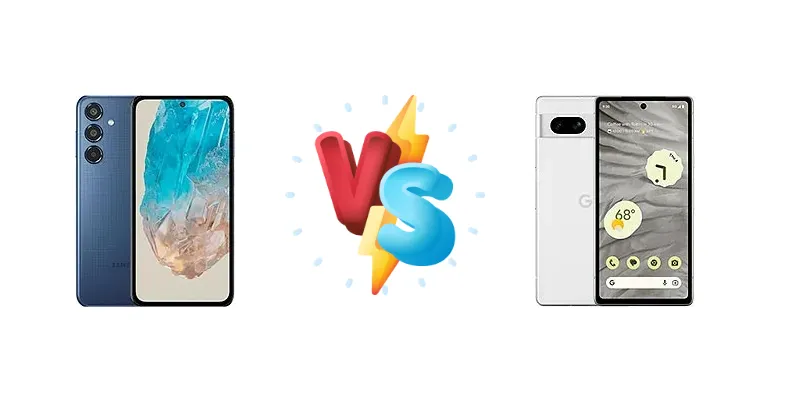
|
🏆 Quick Verdict
For most users, the Google Pixel 7a emerges as the superior choice. Its Tensor G2 chipset delivers a smoother, more responsive experience, and its camera system is in a different league than the M35. While the Galaxy M35 boasts longer battery endurance, the Pixel 7a’s overall refinement and software support justify the slightly higher price.
| PHONES | ||
|---|---|---|
| Phone Names | Samsung Galaxy M35 | Google Pixel 7a |
| Network | ||
|---|---|---|
| 2G bands | GSM 850 / 900 / 1800 / 1900 | GSM 850 / 900 / 1800 / 1900 |
| 3G bands | HSDPA 850 / 900 / 1700(AWS) / 1900 / 2100 | HSDPA 800 / 850 / 900 / 1700(AWS) / 1900 / 2100 |
| 4G bands | 1, 2, 3, 4, 5, 7, 8, 12, 17, 20, 26, 28, 38, 40, 41, 66 | 1, 2, 3, 4, 5, 7, 8, 12, 13, 14, 17, 20, 25, 26, 28, 29, 30, 38, 40, 41, 48, 66, 71 - GWKK3, G0DZQ |
| 5G bands | 1, 3, 5, 7, 8, 20, 28, 38, 40, 41, 77, 78 SA/NSA/Sub6 | 1, 2, 3, 5, 7, 8, 12, 14, 20, 25, 28, 30, 38, 41, 48, 66, 71, 77, 78 SA/NSA/Sub6 - GWKK3 |
| Speed | HSPA, LTE, 5G | HSPA, LTE, 5G |
| Technology | GSM / HSPA / LTE / 5G | GSM / HSPA / LTE / 5G |
| - | 1, 2, 3, 5, 7, 8, 12, 20, 25, 28, 38, 40, 41, 66, 75, 76, 77, 78, 79 SA/NSA/Sub6 - GHL1X, G82U8 | |
| Launch | ||
|---|---|---|
| Announced | 2024, May 24 | 2023, May 10 |
| Status | Available. Released 2024, May 24 | Available. Released 2023, May 10 |
| Body | ||
|---|---|---|
| Build | Glass front (Gorilla Glass Victus+), plastic frame, glass back | Glass front (Gorilla Glass 3), aluminum frame, plastic back |
| Dimensions | 162.3 x 78.6 x 9.1 mm (6.39 x 3.09 x 0.36 in) | 152 x 72.9 x 9 mm (5.98 x 2.87 x 0.35 in) |
| SIM | Nano-SIM + Nano-SIM | Nano-SIM + eSIM |
| Weight | 222 g (7.83 oz) | 193.5 g (6.84 oz) |
| - | IP67 dust/water resistant (up to 1m for 30 min) | |
| Display | ||
|---|---|---|
| Protection | Corning Gorilla Glass Victus+ | Corning Gorilla Glass 3 |
| Resolution | 1080 x 2340 pixels, 19.5:9 ratio (~390 ppi density) | 1080 x 2400 pixels, 20:9 ratio (~429 ppi density) |
| Size | 6.6 inches, 106.9 cm2 (~83.8% screen-to-body ratio) | 6.1 inches, 90.7 cm2 (~81.8% screen-to-body ratio) |
| Type | Super AMOLED, 120Hz, 1000 nits (HBM) | OLED, HDR, 90Hz |
| - | Always-on display | |
| Platform | ||
|---|---|---|
| CPU | Octa-core (4x2.4 GHz Cortex-A78 & 4x2.0 GHz Cortex-A55) | Octa-core (2x2.85 GHz Cortex-X1 & 2x2.35 GHz Cortex-A78 & 4x1.80 GHz Cortex-A55) |
| Chipset | Exynos 1380 (5 nm) | Google Tensor G2 (5 nm) |
| GPU | Mali-G68 MP5 | Mali-G710 MP7 |
| OS | Android 14, upgradable to Android 16, One UI 8 | Android 13, upgradable to Android 15, up to 5 major Android upgrades |
| Memory | ||
|---|---|---|
| Card slot | microSDXC (uses shared SIM slot) | No |
| Internal | 128GB 6GB RAM, 128GB 8GB RAM, 256GB 8GB RAM | 128GB 8GB RAM |
| - | UFS 3.1 | |
| Main Camera | ||
|---|---|---|
| Dual | - | 64 MP, f/1.9, 26mm (wide), 1/1.73", 0.8µm, dual pixel PDAF, OIS 13 MP, f/2.2, 120˚ (ultrawide), 1.12µm |
| Features | LED flash, panorama, HDR | Dual-LED flash, Pixel Shift, Auto-HDR, panorama |
| Triple | 50 MP, f/1.8, (wide), 1/1.96", PDAF, OIS 8 MP, f/2.2, 123˚, (ultrawide), 1/4.0", 1.12µm 2 MP (macro) | - |
| Video | 4K@30fps, 1080p@30/60fps, 720p@480fps, gyro-EIS | 4K@30/60fps, 1080p@30/60/120/240fps, OIS |
| Selfie camera | ||
|---|---|---|
| Features | - | HDR, panorama |
| Single | 13 MP, f/2.2, (wide), 1/3.06", 1.12µm | 13 MP, f/2.2, 20mm (ultrawide), 1.12µm |
| Video | 4K@30fps, 1080p@30fps | 4K@30fps, 1080p@30fps |
| Sound | ||
|---|---|---|
| 3.5mm jack | - | No |
| 35mm jack | No | No |
| Loudspeaker | Yes, with stereo speakers | Yes, with stereo speakers |
| Comms | ||
|---|---|---|
| Bluetooth | 5.3, A2DP, LE | 5.3, A2DP, LE |
| NFC | Yes (market/region dependent) | Yes |
| Positioning | GPS, GALILEO, GLONASS, BDS, QZSS | GPS, GLONASS, GALILEO, BDS, QZSS, NavIC |
| Radio | Unspecified | No |
| USB | USB Type-C 2.0, OTG | USB Type-C 3.2 |
| WLAN | Wi-Fi 802.11 a/b/g/n/ac/6, dual-band, Wi-Fi Direct | Wi-Fi 802.11 a/b/g/n/ac/6e, tri-band |
| Features | ||
|---|---|---|
| Sensors | Fingerprint (side-mounted), accelerometer, gyro, compass | Fingerprint (under display, optical), accelerometer, gyro, proximity, compass, barometer |
| Battery | ||
|---|---|---|
| Charging | 25W wired | 18W wired, PD3.0 7.5W wireless |
| Type | 6000 mAh | Li-Po 4385 mAh |
| Misc | ||
|---|---|---|
| Colors | Dark Blue, Light Blue, Gray | Charcoal, Snow, Sea, Coral |
| Models | SM-M356B, SM-M356B/DS | GWKK3, GHL1X, G0DZQ, G82U8 |
| Price | About 200 EUR | € 179.90 / $ 150.00 / £ 170.00 / ₹ 25,980 |
| SAR | 0.53 W/kg (head) | - |
| SAR EU | 0.31 W/kg (head) 1.30 W/kg (body) | - |
Samsung Galaxy M35
- Superior camera performance, especially in low light
- Faster and more responsive processor (Tensor G2)
- Guaranteed software updates and features from Google
- Wireless charging support
- Potentially shorter battery life than the M35
- Slower wired charging speed (18W)
Google Pixel 7a
- Longer battery life and endurance
- Faster wired charging (25W)
- More affordable price point
- Reliable Samsung build quality
- Less powerful processor (Exynos 1380)
- Inferior camera performance compared to the Pixel 7a
Display Comparison
The Pixel 7a boasts a measured peak brightness of 1070 nits, significantly outshining the likely lower brightness of the Galaxy M35 (Samsung doesn't publish this spec). This translates to better visibility outdoors under direct sunlight. While both likely utilize OLED panels, the Pixel 7a’s higher brightness and Google’s color calibration will provide a more vibrant and accurate viewing experience. The M35’s display specs are currently unknown, but given its market positioning, it likely lacks features like LTPO for adaptive refresh rates, potentially impacting power efficiency.
Camera Comparison
The Pixel 7a’s camera system is a clear standout. While specific sensor details are not provided in the context data, Google’s computational photography prowess, powered by the Tensor G2’s image signal processor (ISP), delivers exceptional image quality, particularly in low-light conditions. The M35’s camera capabilities are less defined. It’s likely to feature a standard multi-camera setup, but without the advanced algorithms and processing power of the Pixel 7a, image quality will likely fall short, especially in challenging lighting scenarios. The Pixel 7a’s video capabilities will also be superior, benefiting from advanced stabilization and dynamic range.
Performance
The Google Tensor G2 (5nm) and Samsung Exynos 1380 (5nm) both utilize a 5nm process, but their architectures differ significantly. The Pixel 7a’s Tensor G2 features 2x2.85 GHz Cortex-X1 cores, designed for peak performance, alongside 2x2.35 GHz Cortex-A78 cores and 4x1.80 GHz Cortex-A55 cores. This configuration prioritizes AI tasks and responsiveness. The Galaxy M35’s Exynos 1380 uses 4x2.4 GHz Cortex-A78 cores and 4x2.0 GHz Cortex-A55 cores. While the M35 has more A78 cores, the Tensor G2’s X1 cores provide a substantial performance advantage in demanding applications. This difference will be noticeable in tasks like video editing and gaming. The Pixel 7a will likely exhibit less throttling under sustained load due to the Tensor G2’s more advanced thermal management.
Battery Life
The Galaxy M35 is positioned as a battery champion. While the exact mAh capacity isn’t specified, its endurance rating suggests a larger battery than the Pixel 7a’s. However, the Pixel 7a’s more efficient Tensor G2 chip and potentially optimized software can partially offset this difference. The M35 supports 25W wired charging, while the Pixel 7a offers 18W wired charging with PD3.0 and 7.5W wireless charging. The M35 will likely charge faster, but the Pixel 7a’s wireless charging adds convenience. The Pixel 7a’s 76-hour endurance rating is a strong baseline, but the M35 is likely to exceed this, offering a full day and a half or more of typical usage.
Buying Guide
Buy the Samsung Galaxy M35 if you prioritize all-day battery life and value a lower upfront cost, and aren't heavily invested in mobile photography. It's ideal for users who primarily browse, consume media, and need a reliable device that won't quit before the end of the day. Buy the Google Pixel 7a if you demand a superior camera experience, a faster and more fluid user interface, and benefit from Google’s timely software updates and AI-powered features. It’s the better choice for photography enthusiasts and those who want a phone that feels consistently responsive.