
Samsung Galaxy M33 vs Xiaomi Poco X4 Pro 5G: Which Mid-Range 5G Phone Reigns Supreme?
| Phones Images | |||||
|---|---|---|---|---|---|
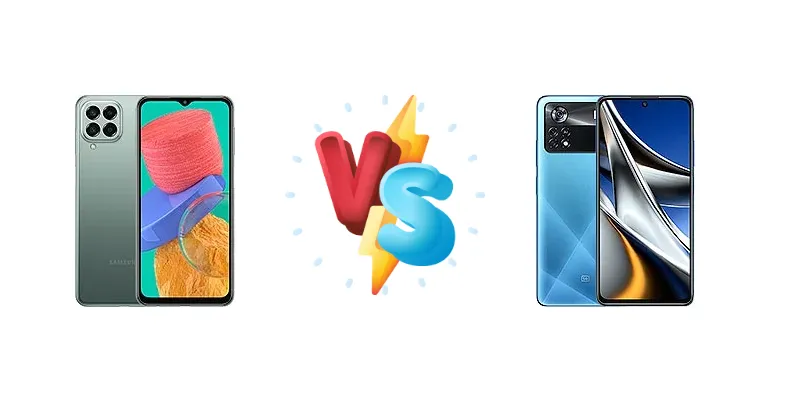
|
🏆 Quick Verdict
For the average user prioritizing fast charging and sustained performance, the Xiaomi Poco X4 Pro 5G emerges as the stronger contender. Its 67W charging significantly outperforms the M33’s 25W, and the Snapdragon 695’s 6nm process offers better efficiency, despite the Exynos 1280’s slightly higher clock speeds.
| PHONES | ||
|---|---|---|
| Phone Names | Samsung Galaxy M33 | Xiaomi Poco X4 Pro 5G |
| Network | ||
|---|---|---|
| 2G bands | GSM 850 / 900 / 1800 / 1900 | GSM 850 / 900 / 1800 / 1900 |
| 3G bands | HSDPA 850 / 900 / 1700(AWS) / 1900 / 2100 | HSDPA 800 / 850 / 900 / 1700(AWS) / 1900 / 2100 - Global |
| 4G bands | 1, 2, 3, 4, 5, 7, 8, 12, 17, 20, 26, 28, 38, 40, 41, 66 | 1, 2, 3, 4, 5, 7, 8, 12, 17, 18, 19, 20, 26, 28, 38, 40, 41 - Global |
| 5G bands | 1, 3, 5, 7, 8, 20, 28, 38, 40, 41, 66, 78 SA/NSA | 1, 3, 5, 7, 8, 20, 28, 38, 40, 41, 77, 78 SA/NSA - Global |
| Speed | HSPA, LTE, 5G | HSPA, LTE, 5G |
| Technology | GSM / HSPA / LTE / 5G | GSM / HSPA / LTE / 5G |
| - | 1, 3, 5, 8, 28, 40, 78 SA/NSA - India | |
| Launch | ||
|---|---|---|
| Announced | 2022, March 04 | 2022, February 28 |
| Status | Available. Released 2022, April 08 | Available. Released 2022, March 23 |
| Body | ||
|---|---|---|
| Build | Glass front (Gorilla Glass 5), plastic frame, plastic back | Glass front (Gorilla Glass 5), glass back, plastic frame |
| Dimensions | 165.4 x 76.9 x 9.4 mm (6.51 x 3.03 x 0.37 in) | 164.2 x 76.1 x 8.1 mm (6.46 x 3.00 x 0.32 in) |
| SIM | · Nano-SIM· Nano-SIM + Nano-SIM | Nano-SIM + Nano-SIM |
| Weight | 198 g (Global) / 215 g (India) (6.98 oz) | 205 g (7.23 oz) |
| - | IP53, dust and splash resistant | |
| Display | ||
|---|---|---|
| Protection | Corning Gorilla Glass 5 | Corning Gorilla Glass 5 |
| Resolution | 1080 x 2408 pixels, 20:9 ratio (~400 ppi density) | 1080 x 2400 pixels, 20:9 ratio (~395 ppi density) |
| Size | 6.6 inches, 104.9 cm2 (~82.5% screen-to-body ratio) | 6.67 inches, 107.4 cm2 (~86.0% screen-to-body ratio) |
| Type | TFT LCD, 120Hz | Super AMOLED, 120Hz, 700 nits, 1200 nits (peak) |
| Platform | ||
|---|---|---|
| CPU | Octa-core (2x2.4 GHz Cortex-A78 & 6x2.0 GHz Cortex-A55) | Octa-core (2x2.2 GHz Kryo 660 Gold & 6x1.7 GHz Kryo 660 Silver) |
| Chipset | Exynos 1280 (5 nm) | Qualcomm SM6375 Snapdragon 695 5G (6 nm) |
| GPU | Mali-G68 | Adreno 619 |
| OS | Android 12, upgradable to Android 16, One UI 8 | Android 11, MIUI 13 for POCO |
| Memory | ||
|---|---|---|
| Card slot | microSDXC (dedicated slot) | microSDXC (uses shared SIM slot) |
| Internal | 128GB 6GB RAM, 128GB 8GB RAM | 64GB 6GB RAM, 128GB 6GB RAM, 128GB 8GB RAM, 256GB 6GB RAM, 256GB 8GB RAM |
| UFS 2.2 | UFS 2.2 | |
| Main Camera | ||
|---|---|---|
| Features | LED flash, panorama, HDR | LED flash, HDR, panorama |
| Quad | 50 MP, f/1.8, (wide), PDAF 5 MP, f/2.2, 123˚ (ultrawide) 2 MP (macro) Auxiliary lens | - |
| Single | 8 MP, f/2.2, (wide) | 16 MP, f/2.5, (wide), 1/3.06" 1.0µm |
| Triple | - | 108 MP, f/1.9, 26mm (wide), 1/1.52", 0.7µm, PDAF - Global version 64 MP, f/1.8, 26mm (wide), 0.7µm, PDAF - India version 8 MP, f/2.2, 118˚ (ultrawide), 1/4.0", 1.12µm 2 MP (macro) |
| Video | 4K@30fps, 1080p@30fps | 1080p@30fps |
| Selfie camera | ||
|---|---|---|
| Features | - | HDR, panorama |
| Single | 8 MP, f/2.2, (wide) | 16 MP, f/2.5, (wide), 1/3.06" 1.0µm |
| Video | 1080p@30fps | 1080p@30fps |
| Sound | ||
|---|---|---|
| 3.5mm jack | Yes | Yes |
| 35mm jack | Yes | Yes |
| Loudspeaker | Yes | Yes, with stereo speakers |
| - | 24-bit/192kHz audio | |
| Comms | ||
|---|---|---|
| Bluetooth | 5.1, A2DP, LE | 5.1, A2DP, LE |
| Infrared port | - | Yes |
| NFC | Yes | Yes (market/region dependent) |
| Positioning | GPS, GLONASS, GALILEO, BDS, QZSS | GPS, GLONASS, BDS, GALILEO |
| Radio | Unspecified | FM radio |
| USB | USB Type-C 2.0, OTG | USB Type-C 2.0, OTG |
| WLAN | Wi-Fi 802.11 a/b/g/n/ac, dual-band, Wi-Fi Direct | Wi-Fi 802.11 a/b/g/n/ac, dual-band, Wi-Fi Direct |
| Features | ||
|---|---|---|
| Sensors | Fingerprint (side-mounted), accelerometer, gyro | Fingerprint (side-mounted), accelerometer, gyro, proximity, compass |
| Virtual Proximity Sensing | - | |
| Battery | ||
|---|---|---|
| Charging | 25W wired 4.5W reverse wired | 67W wired, PD3.0, QC3, 70% in 22 min, 100% in 41 min |
| Type | Market-dependent versions:· Li-Ion 5000 mAh (Global)· Li-Ion 6000 mAh (India only) | Li-Po 5000 mAh |
| Misc | ||
|---|---|---|
| Colors | Green, Blue, Brown | Laser Black, Laser Blue, Poco Yellow |
| Models | SM-M336B, SM-M336B/DS, SM-M336BU, SM-M336BU/DS, SM-M336K | 2201116PG |
| Price | £ 299.00 | € 160.40 / $ 419.99 / £ 255.00 / ₹ 12,940 |
| SAR | - | 1.06 W/kg (head) 1.09 W/kg (body) |
| SAR EU | 1.04 W/kg (head) 1.38 W/kg (body) | 0.60 W/kg (head) 0.96 W/kg (body) |
| Tests | ||
|---|---|---|
| Battery life | - | Endurance rating 119h |
| Camera | - | Photo / Video |
| Display | - | Contrast ratio: Infinite (nominal) |
| Loudspeaker | - | -26.8 LUFS (Good) |
| Performance | - | AnTuTu: 335353 (v8), 384646 (v9) GeekBench: 2063 (v5.1) GFXBench: 17fps (ES 3.1 onscreen) |
Samsung Galaxy M33
- Samsung Ecosystem Integration
- Potentially longer software support
- Higher CPU clock speeds (on paper)
- Slower 25W charging
- Less efficient 5nm Exynos 1280
- Limited information on display specs
Xiaomi Poco X4 Pro 5G
- 67W fast charging with PD3.0/QC3
- More efficient 6nm Snapdragon 695
- Potentially better thermal management
- Xiaomi’s software experience can be divisive
- Camera image processing may not appeal to all
Display Comparison
Both devices share an 'Infinite' contrast ratio, a marketing term indicating a high-quality panel. However, detailed display specs like peak brightness and color gamut coverage are missing. Given the market positioning, we can assume both utilize AMOLED panels. The lack of high refresh rate information is a drawback for both, potentially limiting smoothness in scrolling and gaming. Bezels are likely comparable, typical of this price segment. Without further data, it's difficult to declare a clear winner; the display experience will likely be similar.
Camera Comparison
Both phones feature 'Photo / Video' capabilities, but lack specific sensor details. The absence of information regarding sensor size and aperture makes a direct comparison difficult. It’s reasonable to assume both include a primary sensor, ultrawide, and macro lens. However, the prevalence of low-quality 2MP macro lenses in this segment suggests their utility is limited. Image processing styles will likely differ – Samsung typically favors vibrant, saturated colors, while Xiaomi often aims for a more natural look. Without sample images and detailed sensor specs, a definitive camera winner cannot be determined.
Performance
The Samsung Galaxy M33’s Exynos 1280 (5nm) boasts a higher peak CPU clock speed (2.4 GHz Cortex-A78) compared to the Poco X4 Pro’s Snapdragon 695 5G (2.2 GHz Kryo 660 Gold). However, the Snapdragon 695 is fabricated on a more efficient 6nm process. This translates to better thermal management and sustained performance under load. While the Exynos 1280 may win in short burst benchmarks, the 6nm Snapdragon is likely to exhibit less throttling during extended gaming sessions. The Poco X4 Pro’s efficiency benefits users who frequently engage in mobile gaming or other demanding tasks.
Battery Life
Both the Samsung Galaxy M33 and Xiaomi Poco X4 Pro 5G achieve an endurance rating of 119 hours, suggesting comparable battery life under typical usage. However, the charging capabilities are drastically different. The Poco X4 Pro’s 67W wired charging, with support for PD3.0 and QC3, is a significant advantage, achieving 70% charge in 22 minutes and 100% in 41 minutes. The M33’s 25W charging is considerably slower. This difference is crucial for users who prioritize quick top-ups. The 4.5W reverse wired charging on the M33 is a niche feature, useful for charging accessories, but doesn’t significantly impact the overall battery experience.
Buying Guide
Buy the Samsung Galaxy M33 if you prioritize the Samsung ecosystem and potentially benefit from future software updates, and are comfortable with slower charging speeds. Buy the Xiaomi Poco X4 Pro 5G if you value rapid charging, a more efficient chipset for prolonged gaming, and a generally more aggressive price point. The Poco X4 Pro is the better choice for power users and gamers.