
Samsung Galaxy M33 vs M14: Which Mid-Range Phone Reigns Supreme?
| Phones Images | |||||
|---|---|---|---|---|---|
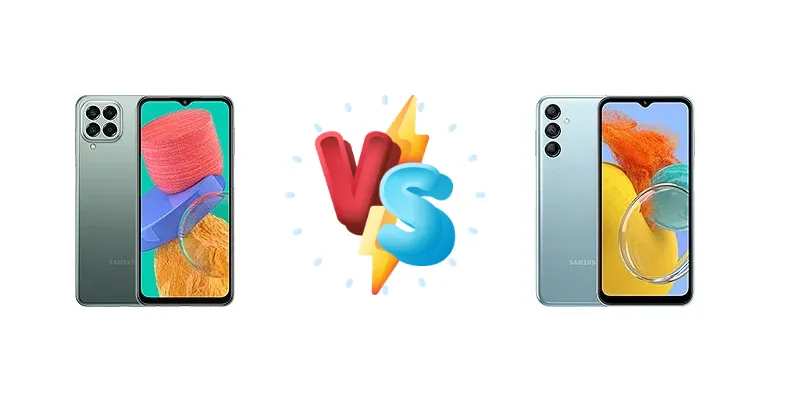
|
🏆 Quick Verdict
The Galaxy M14 edges out the M33 thanks to its improved chipset, larger battery, and generally better value proposition. While the M33 has a slightly better display, the M14's performance and longevity make it the stronger overall choice for most users.
| PHONES | ||
|---|---|---|
| Phone Names | Samsung Galaxy M33 | Samsung Galaxy M14 |
| Network | ||
|---|---|---|
| 2G bands | GSM 850 / 900 / 1800 / 1900 | GSM 850 / 900 / 1800 / 1900 |
| 3G bands | HSDPA 850 / 900 / 1700(AWS) / 1900 / 2100 | HSDPA 850 / 900 / 1700(AWS) / 1900 / 2100 |
| 4G bands | 1, 2, 3, 4, 5, 7, 8, 12, 17, 20, 26, 28, 38, 40, 41, 66 | 1, 2, 3, 4, 5, 7, 8, 12, 17, 20, 26, 28, 38, 40, 41, 66 |
| 5G bands | 1, 3, 5, 7, 8, 20, 28, 38, 40, 41, 66, 78 SA/NSA | 1, 3, 5, 7, 8, 20, 28, 38, 40, 41, 66, 77, 78 SA/NSA |
| Speed | HSPA, LTE, 5G | HSPA, LTE, 5G |
| Technology | GSM / HSPA / LTE / 5G | GSM / HSPA / LTE / 5G |
| Launch | ||
|---|---|---|
| Announced | 2022, March 04 | 2023, March 08 |
| Status | Available. Released 2022, April 08 | Available. Released 2023, March 08 |
| Body | ||
|---|---|---|
| Build | Glass front (Gorilla Glass 5), plastic frame, plastic back | Glass front (Gorilla Glass 5), plastic back, plastic frame |
| Dimensions | 165.4 x 76.9 x 9.4 mm (6.51 x 3.03 x 0.37 in) | 166.8 x 77.2 x 9.4 mm (6.57 x 3.04 x 0.37 in) |
| SIM | · Nano-SIM· Nano-SIM + Nano-SIM | · Nano-SIM· Nano-SIM + Nano-SIM |
| Weight | 198 g (Global) / 215 g (India) (6.98 oz) | 206 g (7.27 oz) |
| Display | ||
|---|---|---|
| Protection | Corning Gorilla Glass 5 | Corning Gorilla Glass 5 |
| Resolution | 1080 x 2408 pixels, 20:9 ratio (~400 ppi density) | 1080 x 2408 pixels, 20:9 ratio (~400 ppi density) |
| Size | 6.6 inches, 104.9 cm2 (~82.5% screen-to-body ratio) | 6.6 inches, 104.9 cm2 (~81.5% screen-to-body ratio) |
| Type | TFT LCD, 120Hz | PLS LCD, 90Hz |
| Platform | ||
|---|---|---|
| CPU | Octa-core (2x2.4 GHz Cortex-A78 & 6x2.0 GHz Cortex-A55) | Octa-core (2x2.4 GHz Cortex-A78 & 6x2.0 GHz Cortex-A55) |
| Chipset | Exynos 1280 (5 nm) | Exynos 1330 (5 nm) |
| GPU | Mali-G68 | Mali-G68 MP2 |
| OS | Android 12, upgradable to Android 16, One UI 8 | Android 13, One UI core 5.1 |
| Memory | ||
|---|---|---|
| Card slot | microSDXC (dedicated slot) | microSDHC (dedicated slot) |
| Internal | 128GB 6GB RAM, 128GB 8GB RAM | 64GB 4GB RAM, 128GB 4GB RAM, 128GB 6GB RAM |
| UFS 2.2 | - | |
| Main Camera | ||
|---|---|---|
| Features | LED flash, panorama, HDR | LED flash, panorama, HDR |
| Quad | 50 MP, f/1.8, (wide), PDAF 5 MP, f/2.2, 123˚ (ultrawide) 2 MP (macro) Auxiliary lens | - |
| Single | 8 MP, f/2.2, (wide) | 13 MP, f/2.0, (wide) |
| Triple | - | 50 MP, f/1.8, (wide), PDAF 2 MP (macro) Auxiliary lens |
| Video | 4K@30fps, 1080p@30fps | 1080p@30fps |
| Selfie camera | ||
|---|---|---|
| Single | 8 MP, f/2.2, (wide) | 13 MP, f/2.0, (wide) |
| Video | 1080p@30fps | 1080p@30fps |
| Sound | ||
|---|---|---|
| 3.5mm jack | Yes | Yes |
| 35mm jack | Yes | Yes |
| Loudspeaker | Yes | Yes |
| Comms | ||
|---|---|---|
| Bluetooth | 5.1, A2DP, LE | 5.2, A2DP, LE |
| NFC | Yes | Yes |
| Positioning | GPS, GLONASS, GALILEO, BDS, QZSS | GPS, GLONASS, GALILEO, BDS, QZSS, NavIC |
| Radio | Unspecified | Unspecified |
| USB | USB Type-C 2.0, OTG | USB Type-C 2.0 |
| WLAN | Wi-Fi 802.11 a/b/g/n/ac, dual-band, Wi-Fi Direct | Wi-Fi 802.11 a/b/g/n/ac, dual-band, Wi-Fi Direct |
| Features | ||
|---|---|---|
| Sensors | Fingerprint (side-mounted), accelerometer, gyro | Fingerprint (side-mounted), accelerometer, gyro, proximity, compass |
| Virtual Proximity Sensing | - | |
| Battery | ||
|---|---|---|
| Charging | 25W wired 4.5W reverse wired | 15W wired - international 25W wired - India |
| Type | Market-dependent versions:· Li-Ion 5000 mAh (Global)· Li-Ion 6000 mAh (India only) | Li-Po 6000 mAh |
| Misc | ||
|---|---|---|
| Colors | Green, Blue, Brown | Navy Blue, Light Blue, Silver |
| Models | SM-M336B, SM-M336B/DS, SM-M336BU, SM-M336BU/DS, SM-M336K | SM-M146B, SM-M146B/DS, SM-M146B/DSN |
| Price | £ 299.00 | ₹ 10,990 |
| SAR EU | 1.04 W/kg (head) 1.38 W/kg (body) | 0.48 W/kg (head) 1.53 W/kg (body) |
Samsung Galaxy M33
- 120Hz Display
- Slightly better main camera in good light
- Sleek design
- Older chipset
- Shorter battery life
- Slower charging (25W)
Samsung Galaxy M14
- Improved Exynos 1330 chipset
- Massive 6000mAh battery
- Better value for money
- Faster charging in India (25W)
- 90Hz display (less smooth)
- Camera processing can be inconsistent
- Design is less premium
Display Comparison
The M33 boasts a 120Hz refresh rate, offering a smoother scrolling experience compared to the M14's standard 90Hz. Both phones feature FHD+ AMOLED displays, providing vibrant colors and deep blacks. However, the M33's higher refresh rate gives it a slight edge in perceived fluidity.
Camera Comparison
Both phones feature a 50MP main camera, but the M33 generally produces slightly more detailed and vibrant photos in good lighting conditions. The M14's camera software has been improved, offering better image processing. Low-light performance is comparable on both devices.
Performance
The Exynos 1330 in the M14 offers a noticeable performance boost over the Exynos 1280 in the M33. Expect snappier app loading times, smoother multitasking, and better gaming performance on the M14. While both handle everyday tasks well, the M14's chipset is the clear winner.
Battery Life
The M14's significantly larger 6000mAh battery provides substantially longer battery life than the M33's 5000mAh battery. Expect the M14 to easily last a full day of heavy use, while the M33 may require a top-up before the end of the day.
Buying Guide
The Samsung Galaxy M33 is ideal for users prioritizing a vibrant display and slightly better camera performance. The Galaxy M14 is a better fit for those seeking longer battery life, smoother performance, and a more budget-friendly option.