
Samsung Galaxy M33 vs A53 5G: A Detailed Comparison of Samsung's Mid-Range Contenders
| Phones Images | |||||
|---|---|---|---|---|---|
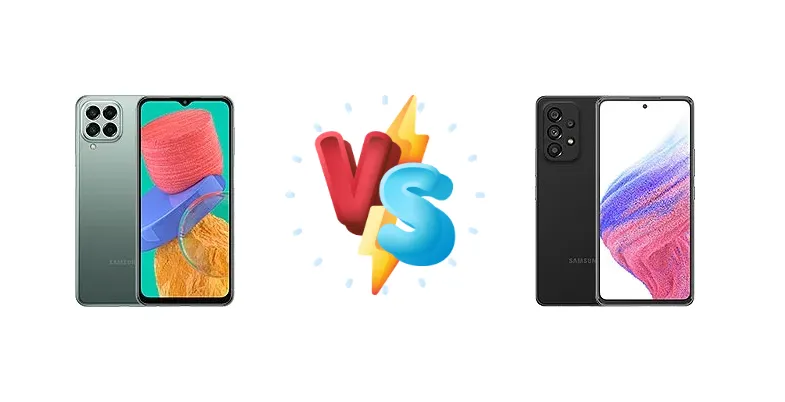
|
🏆 Quick Verdict
For the average user prioritizing a brighter, more vibrant display and a potentially more refined software experience, the Samsung Galaxy A53 5G is the better choice. However, the M33 offers comparable performance at a potentially lower price point, making it a strong contender for budget-conscious buyers.
| PHONES | ||
|---|---|---|
| Phone Names | Samsung Galaxy M33 | Samsung Galaxy A53 5G |
| Network | ||
|---|---|---|
| 2G bands | GSM 850 / 900 / 1800 / 1900 | GSM 850 / 900 / 1800 / 1900 |
| 3G bands | HSDPA 850 / 900 / 1700(AWS) / 1900 / 2100 | HSDPA 850 / 900 / 1700(AWS) / 1900 / 2100 |
| 4G bands | 1, 2, 3, 4, 5, 7, 8, 12, 17, 20, 26, 28, 38, 40, 41, 66 | 1, 2, 3, 4, 5, 7, 12, 14, 20, 29, 30, 38, 39, 40, 41, 46, 48, 66 - SM-A536U |
| 5G bands | 1, 3, 5, 7, 8, 20, 28, 38, 40, 41, 66, 78 SA/NSA | 2, 5, 41, 66, 77, 78 SA/NSA/Sub6/mmWave - SM-A536U |
| Speed | HSPA, LTE, 5G | HSPA, LTE, 5G |
| Technology | GSM / HSPA / LTE / 5G | GSM / HSPA / LTE / 5G |
| - | 2, 5, 48, 66, 77, 78, 260, 261 SA/NSA/Sub6/mmWave - SM-A536V | |
| Launch | ||
|---|---|---|
| Announced | 2022, March 04 | 2022, March 17 |
| Status | Available. Released 2022, April 08 | Available. Released 2022, March 24 |
| Body | ||
|---|---|---|
| Build | Glass front (Gorilla Glass 5), plastic frame, plastic back | Glass front (Gorilla Glass 5), plastic frame, plastic back |
| Dimensions | 165.4 x 76.9 x 9.4 mm (6.51 x 3.03 x 0.37 in) | 159.6 x 74.8 x 8.1 mm (6.28 x 2.94 x 0.32 in) |
| SIM | · Nano-SIM· Nano-SIM + Nano-SIM | · Nano-SIM· Nano-SIM + Nano-SIM |
| Weight | 198 g (Global) / 215 g (India) (6.98 oz) | 189 g (6.67 oz) |
| - | IP67 dust/water resistant (up to 1m for 30 min) | |
| Display | ||
|---|---|---|
| Protection | Corning Gorilla Glass 5 | Corning Gorilla Glass 5 |
| Resolution | 1080 x 2408 pixels, 20:9 ratio (~400 ppi density) | 1080 x 2400 pixels, 20:9 ratio (~405 ppi density) |
| Size | 6.6 inches, 104.9 cm2 (~82.5% screen-to-body ratio) | 6.5 inches, 102.0 cm2 (~85.4% screen-to-body ratio) |
| Type | TFT LCD, 120Hz | Super AMOLED, 120Hz, 800 nits (HBM) |
| Platform | ||
|---|---|---|
| CPU | Octa-core (2x2.4 GHz Cortex-A78 & 6x2.0 GHz Cortex-A55) | Octa-core (2x2.4 GHz Cortex-A78 & 6x2.0 GHz Cortex-A55) |
| Chipset | Exynos 1280 (5 nm) | Exynos 1280 (5 nm) |
| GPU | Mali-G68 | Mali-G68 |
| OS | Android 12, upgradable to Android 16, One UI 8 | Android 12, up to 4 major Android upgrades, One UI 8 |
| Memory | ||
|---|---|---|
| Card slot | microSDXC (dedicated slot) | microSDXC (uses shared SIM slot) |
| Internal | 128GB 6GB RAM, 128GB 8GB RAM | 128GB 4GB RAM, 128GB 6GB RAM, 128GB 8GB RAM, 256GB 6GB RAM, 256GB 8GB RAM |
| UFS 2.2 | - | |
| Main Camera | ||
|---|---|---|
| Features | LED flash, panorama, HDR | LED flash, panorama, HDR |
| Quad | 50 MP, f/1.8, (wide), PDAF 5 MP, f/2.2, 123˚ (ultrawide) 2 MP (macro) Auxiliary lens | 64 MP, f/1.8, 26mm (wide), 1/1.7X", 0.8µm, PDAF, OIS 12 MP, f/2.2, 123˚ (ultrawide), 1.12µm 5 MP (macro) Auxiliary lens |
| Single | 8 MP, f/2.2, (wide) | 32 MP, f/2.2, 26mm (wide), 1/2.8", 0.8µm |
| Video | 4K@30fps, 1080p@30fps | 4K@30fps, 1080p@30/60fps; gyro-EIS |
| Selfie camera | ||
|---|---|---|
| Features | - | HDR |
| Single | 8 MP, f/2.2, (wide) | 32 MP, f/2.2, 26mm (wide), 1/2.8", 0.8µm |
| Video | 1080p@30fps | 4K@30fps, 1080p@30fps |
| Sound | ||
|---|---|---|
| 3.5mm jack | Yes | No |
| 35mm jack | Yes | No |
| Loudspeaker | Yes | Yes, with stereo speakers |
| Comms | ||
|---|---|---|
| Bluetooth | 5.1, A2DP, LE | 5.1, A2DP, LE |
| NFC | Yes | Yes (market/region dependent) |
| Positioning | GPS, GLONASS, GALILEO, BDS, QZSS | GPS, GLONASS, GALILEO, BDS |
| Radio | Unspecified | No |
| USB | USB Type-C 2.0, OTG | USB Type-C 2.0, OTG |
| WLAN | Wi-Fi 802.11 a/b/g/n/ac, dual-band, Wi-Fi Direct | Wi-Fi 802.11 a/b/g/n/ac, dual-band, Wi-Fi Direct |
| Features | ||
|---|---|---|
| Sensors | Fingerprint (side-mounted), accelerometer, gyro | Fingerprint (under display, optical), accelerometer, gyro, compass, barometer (market/region dependent) |
| Virtual Proximity Sensing | Virtual proximity sensing | |
| Battery | ||
|---|---|---|
| Charging | 25W wired 4.5W reverse wired | 25W wired |
| Type | Market-dependent versions:· Li-Ion 5000 mAh (Global)· Li-Ion 6000 mAh (India only) | Li-Po 5000 mAh |
| Misc | ||
|---|---|---|
| Colors | Green, Blue, Brown | Black, White, Blue, Peach |
| Models | SM-M336B, SM-M336B/DS, SM-M336BU, SM-M336BU/DS, SM-M336K | SM-A536B, SM-A536B/DS, SM-A536U, SM-A536U1, SM-A5360, SM-A536E, SM-A536E/DS, SM-A536V, SM-A536W, SM-A536N, SM-S536DL |
| Price | £ 299.00 | $ 151.42 / £ 185.00 / € 169.14 |
| SAR | - | 0.75 W/kg (head) 1.58 W/kg (body) |
| SAR EU | 1.04 W/kg (head) 1.38 W/kg (body) | 0.89 W/kg (head) 1.60 W/kg (body) |
| Tests | ||
|---|---|---|
| Battery life | - | Endurance rating 113h |
| Camera | - | Photo / Video |
| Display | - | Contrast ratio: Infinite (nominal) |
| Loudspeaker | - | -26.5 LUFS (Good) |
| Performance | - | AnTuTu: 329802 (v8), 379313 (v9) GeekBench: 1891 (v5.1) GFXBench: 19fps (ES 3.1 onscreen) |
Samsung Galaxy M33
- Potentially lower price point
- Comparable performance to A53 5G
- Similar battery endurance
- Likely lower display brightness
- Potentially less refined camera system
Samsung Galaxy A53 5G
- Brighter, more vibrant display (830 nits)
- Potentially better camera system
- Likely longer software support
- Higher price point
- Similar performance to M33
Display Comparison
The Samsung Galaxy A53 5G boasts a significant advantage in display quality, achieving a measured peak brightness of 830 nits. While both phones lack high refresh rate displays, the A53’s higher brightness translates to better visibility outdoors and a more vibrant viewing experience. The 'Infinite' contrast ratio, while a marketing term, suggests deeper blacks and a more dynamic image. The M33’s display specifications are not provided, implying a potentially lower peak brightness and contrast, making the A53 the clear winner for media consumers.
Camera Comparison
Both devices are listed as having 'Photo / Video' capabilities, but lack specific details regarding sensor size, aperture, or optical image stabilization (OIS). Given the market positioning, the A53 5G likely features a more sophisticated camera system with a larger main sensor and potentially OIS, resulting in better low-light performance and image stabilization. The inclusion of a 2MP macro camera on both devices is largely a marketing tactic, offering limited practical benefit due to the small sensor size and lack of detail. Without further specifications, it’s reasonable to assume the A53 5G offers a more versatile and capable camera experience.
Performance
Both the Galaxy M33 and A53 5G are powered by the Exynos 1280 (5nm) chipset, featuring an octa-core CPU configuration with 2x2.4 GHz Cortex-A78 and 6x2.0 GHz Cortex-A55 cores. This means raw processing power will be nearly identical for most tasks. The 5nm fabrication process contributes to reasonable thermal efficiency, but sustained workloads could still lead to throttling. The absence of LPDDR5x RAM specifications for either device suggests they likely utilize LPDDR4x, which is adequate but not cutting-edge. Therefore, performance differences will likely be negligible in real-world usage.
Battery Life
Both the M33 and A53 5G share an endurance rating of 113 hours, indicating similar battery life under typical usage scenarios. Both support 25W wired charging, and 4.5W reverse wired charging. The identical endurance rating suggests that despite potential differences in battery capacity (not specified for the M33), software optimization and power efficiency are comparable. The 25W charging speed is relatively slow compared to competitors, meaning a full charge will take over an hour. The 4.5W reverse wired charging is useful for topping up accessories but isn’t a fast charging solution.
Buying Guide
Buy the Samsung Galaxy M33 if you need a reliable performer for everyday tasks and media consumption, and prioritize value for money above all else. You'll get the same core processing power as the A53, potentially at a significantly lower cost. Buy the Samsung Galaxy A53 5G if you prefer a brighter, more visually appealing display, and appreciate a potentially more polished software experience and longer-term software support, even if it comes at a premium.