
Samsung Galaxy M33 vs OnePlus Nord CE 2 5G: Which Mid-Range 5G Phone Reigns Supreme?
| Phones Images | |||||
|---|---|---|---|---|---|
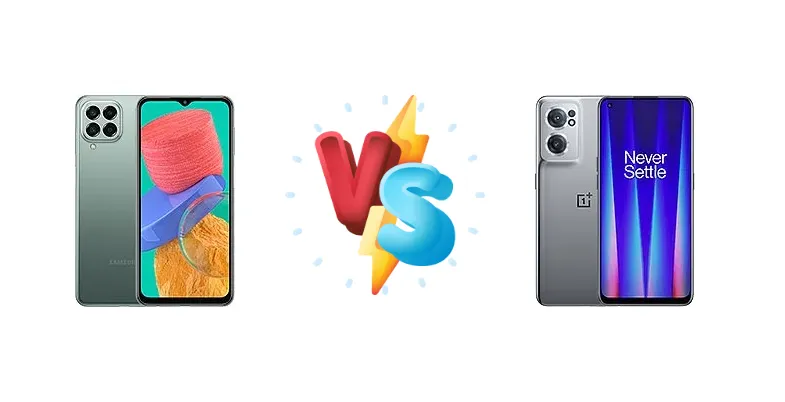
|
🏆 Quick Verdict
For the average user prioritizing speed and convenience, the OnePlus Nord CE 2 5G is the better choice. Its 65W charging dramatically reduces downtime, and the Dimensity 900, fabricated on a 6nm process, offers comparable performance to the M33’s Exynos 1280, with potentially better efficiency. However, Samsung’s software ecosystem and potentially longer software support are considerations.
| PHONES | ||
|---|---|---|
| Phone Names | Samsung Galaxy M33 | OnePlus Nord CE 2 5G |
| Network | ||
|---|---|---|
| 2G bands | GSM 850 / 900 / 1800 / 1900 | GSM 850 / 900 / 1800 / 1900 |
| 3G bands | HSDPA 850 / 900 / 1700(AWS) / 1900 / 2100 | HSDPA 850 / 900 / 1700(AWS) / 1900 / 2100 |
| 4G bands | 1, 2, 3, 4, 5, 7, 8, 12, 17, 20, 26, 28, 38, 40, 41, 66 | 1, 2, 3, 4, 5, 7, 8, 12, 17, 18, 19, 20, 26, 28, 38, 39, 40, 41, 66 - Europe |
| 5G bands | 1, 3, 5, 7, 8, 20, 28, 38, 40, 41, 66, 78 SA/NSA | 1, 3, 5, 7, 8, 20, 28, 38, 40, 41, 66, 77, 78 SA/NSA - Europe |
| Speed | HSPA, LTE, 5G | HSPA 42.2/5.76 Mbps, LTE Cat18 1200/150 Mbps, 5G |
| Technology | GSM / HSPA / LTE / 5G | GSM / HSPA / LTE / 5G |
| - | 1, 3, 5, 8, 40, 41, 77, 78 SA/NSA - India | |
| Launch | ||
|---|---|---|
| Announced | 2022, March 04 | 2022, February 17 |
| Status | Available. Released 2022, April 08 | Available. Released 2022, February 22 |
| Body | ||
|---|---|---|
| Build | Glass front (Gorilla Glass 5), plastic frame, plastic back | - |
| Dimensions | 165.4 x 76.9 x 9.4 mm (6.51 x 3.03 x 0.37 in) | 160.6 x 73.2 x 7.8 mm (6.32 x 2.88 x 0.31 in) |
| SIM | · Nano-SIM· Nano-SIM + Nano-SIM | Nano-SIM + Nano-SIM |
| Weight | 198 g (Global) / 215 g (India) (6.98 oz) | 173 g (6.10 oz) |
| Display | ||
|---|---|---|
| Protection | Corning Gorilla Glass 5 | Corning Gorilla Glass 5 |
| Resolution | 1080 x 2408 pixels, 20:9 ratio (~400 ppi density) | 1080 x 2400 pixels, 20:9 ratio (~409 ppi density) |
| Size | 6.6 inches, 104.9 cm2 (~82.5% screen-to-body ratio) | 6.43 inches, 99.8 cm2 (~84.9% screen-to-body ratio) |
| Type | TFT LCD, 120Hz | AMOLED, 90Hz, HDR10+ |
| Platform | ||
|---|---|---|
| CPU | Octa-core (2x2.4 GHz Cortex-A78 & 6x2.0 GHz Cortex-A55) | Octa-core (2x2.4 GHz Cortex-A78 & 6x2.0 GHz Cortex-A55) |
| Chipset | Exynos 1280 (5 nm) | Mediatek Dimensity 900 (6 nm) |
| GPU | Mali-G68 | Mali-G68 MC4 |
| OS | Android 12, upgradable to Android 16, One UI 8 | Android 11, upgradable to Android 13, OxygenOS 13 |
| Memory | ||
|---|---|---|
| Card slot | microSDXC (dedicated slot) | microSDXC (dedicated slot) |
| Internal | 128GB 6GB RAM, 128GB 8GB RAM | 128GB 6GB RAM, 128GB 8GB RAM |
| UFS 2.2 | UFS 2.2 | |
| Main Camera | ||
|---|---|---|
| Features | LED flash, panorama, HDR | LED flash, HDR, panorama |
| Quad | 50 MP, f/1.8, (wide), PDAF 5 MP, f/2.2, 123˚ (ultrawide) 2 MP (macro) Auxiliary lens | - |
| Single | 8 MP, f/2.2, (wide) | 16 MP, f/2.4, 27mm (wide), 1.0µm |
| Triple | - | 64 MP, f/1.8, 26mm (wide), 1/1.97", 0.7µm, PDAF 8 MP, f/2.2, 119˚ (ultrawide) 2 MP (macro) |
| Video | 4K@30fps, 1080p@30fps | 4K@30fps, 1080p@30/60/120fps, gyro-EIS |
| Selfie camera | ||
|---|---|---|
| Features | - | HDR |
| Single | 8 MP, f/2.2, (wide) | 16 MP, f/2.4, 27mm (wide), 1.0µm |
| Video | 1080p@30fps | 1080p@30/60fps, gyro-EIS |
| Sound | ||
|---|---|---|
| 3.5mm jack | Yes | Yes |
| 35mm jack | Yes | Yes |
| Loudspeaker | Yes | Yes |
| Comms | ||
|---|---|---|
| Bluetooth | 5.1, A2DP, LE | 5.2, A2DP, LE, aptX HD |
| NFC | Yes | Yes |
| Positioning | GPS, GLONASS, GALILEO, BDS, QZSS | GPS, GLONASS, GALILEO, BDS, QZSS |
| Radio | Unspecified | Unspecified |
| USB | USB Type-C 2.0, OTG | USB Type-C 2.0, OTG |
| WLAN | Wi-Fi 802.11 a/b/g/n/ac, dual-band, Wi-Fi Direct | Wi-Fi 802.11 a/b/g/n/ac/6, dual-band, Wi-Fi Direct |
| Features | ||
|---|---|---|
| Sensors | Fingerprint (side-mounted), accelerometer, gyro | Fingerprint (under display, optical), accelerometer, gyro, proximity, compass |
| Virtual Proximity Sensing | - | |
| Battery | ||
|---|---|---|
| Charging | 25W wired 4.5W reverse wired | 65W wired |
| Type | Market-dependent versions:· Li-Ion 5000 mAh (Global)· Li-Ion 6000 mAh (India only) | Li-Po 4500 mAh |
| Misc | ||
|---|---|---|
| Colors | Green, Blue, Brown | Gray Mirror, Bahama Blue |
| Models | SM-M336B, SM-M336B/DS, SM-M336BU, SM-M336BU/DS, SM-M336K | IV2201 |
| Price | £ 299.00 | £ 99.00 / € 182.18 |
| SAR EU | 1.04 W/kg (head) 1.38 W/kg (body) | - |
Samsung Galaxy M33
- Samsung’s software ecosystem and potential for longer software updates.
- Reverse wireless charging for accessories.
- Potentially more feature-rich software experience.
- Slower 25W charging.
- Exynos 1280 on a 5nm process may throttle more under sustained load than the Dimensity 900.
- Likely similar camera performance to the Nord CE 2 without further specs.
OnePlus Nord CE 2 5G
- 65W SuperVOOC charging for incredibly fast top-ups.
- MediaTek Dimensity 900 on a 6nm process offers potentially better efficiency.
- Cleaner, more streamlined software experience (OxygenOS).
- Potentially better thermal management for gaming.
- Shorter potential software support lifecycle compared to Samsung.
- Lacks reverse wireless charging.
- OxygenOS is evolving and may not appeal to all users.
Display Comparison
Neither device boasts a standout display. Both likely utilize LCD panels, a common cost-saving measure in this segment. While specific display specs (resolution, refresh rate) are missing, the focus here is on the underlying processors. Display quality will likely be similar, with color accuracy and brightness being key differentiators not specified in the provided data.
Camera Comparison
Without detailed camera specs, a direct comparison is difficult. Both phones likely feature multi-camera setups, but the quality will depend heavily on sensor size, lens aperture, and image processing algorithms. The presence of a 2MP macro camera on either device is unlikely to significantly impact image quality; these are often included for marketing purposes rather than practical use. The larger the primary sensor, the better the low-light performance will be, but this information is unavailable.
Performance
The core of the difference lies in the chipsets: Samsung’s Exynos 1280 (5nm) versus MediaTek’s Dimensity 900 (6nm). Both CPUs share the same core configuration – 2x2.4 GHz Cortex-A78 and 6x2.0 GHz Cortex-A55 – meaning raw CPU performance will be very close. However, the 6nm fabrication process of the Dimensity 900 generally translates to improved power efficiency and potentially better sustained performance under load, reducing thermal throttling during extended gaming sessions. The Exynos 1280’s 5nm process is still efficient, but the Dimensity 900 has a slight edge in this regard. RAM speed (LPDDR4x vs LPDDR5) is not specified, but would further impact performance.
Battery Life
The battery capacity isn’t specified for either device, but the charging speeds are a major differentiator. The OnePlus Nord CE 2 5G’s 65W wired charging is a game-changer, promising a full charge in under 40 minutes. The Samsung Galaxy M33’s 25W charging is considerably slower, requiring significantly more time to reach 100%. While a larger battery capacity on the M33 could offset this, the convenience of the Nord CE 2’s rapid charging is a substantial advantage for users who frequently need to top up their phones. The M33 does offer 4.5W reverse wired charging, allowing it to charge accessories, a feature absent on the Nord CE 2.
Buying Guide
Buy the Samsung Galaxy M33 if you are deeply embedded in the Samsung ecosystem and value features like reverse wireless charging and a potentially longer software support lifecycle. Buy the OnePlus Nord CE 2 5G if you prioritize fast charging, a cleaner software experience, and a phone that can quickly get you back up and running after heavy use. Gamers will also appreciate the potentially better thermal headroom of the 6nm Dimensity 900.