
Xiaomi Poco X4 Pro 5G vs. Samsung Galaxy M32: A Detailed Comparison
| Phones Images | |||||
|---|---|---|---|---|---|
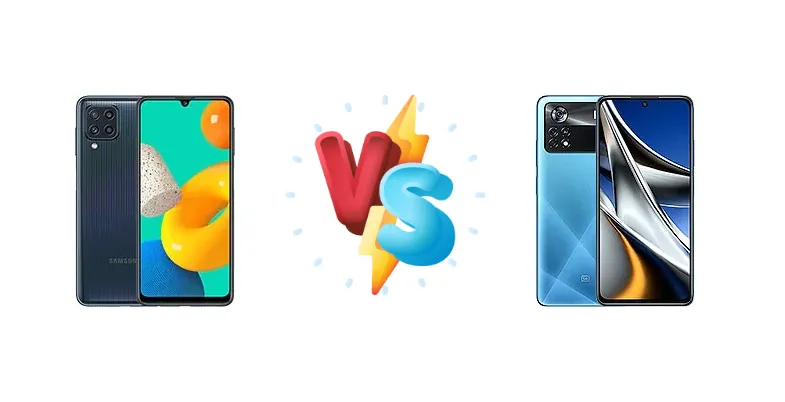
|
🏆 Quick Verdict
For most users, the Xiaomi Poco X4 Pro 5G is the superior choice. Its more efficient Snapdragon 695 chipset, coupled with blazing-fast 67W charging, provides a smoother experience and reduces downtime. While the M32 offers a respectable feature set, it's outpaced in key areas.
| PHONES | ||
|---|---|---|
| Phone Names | Samsung Galaxy M32 | Xiaomi Poco X4 Pro 5G |
| Network | ||
|---|---|---|
| 2G bands | GSM 850 / 900 / 1800 / 1900 | GSM 850 / 900 / 1800 / 1900 |
| 3G bands | HSDPA 850 / 900 / 1700(AWS) / 1900 / 2100 - International | HSDPA 800 / 850 / 900 / 1700(AWS) / 1900 / 2100 - Global |
| 4G bands | 1, 2, 3, 4, 5, 7, 8, 12, 17, 20, 26, 28, 38, 40, 41, 66 - International | 1, 2, 3, 4, 5, 7, 8, 12, 17, 18, 19, 20, 26, 28, 38, 40, 41 - Global |
| 5G bands | - | 1, 3, 5, 7, 8, 20, 28, 38, 40, 41, 77, 78 SA/NSA - Global |
| Speed | HSPA, LTE | HSPA, LTE, 5G |
| Technology | GSM / HSPA / LTE | GSM / HSPA / LTE / 5G |
| 1, 3, 5, 8, 20, 38, 40, 41 - India | 1, 3, 5, 8, 28, 40, 78 SA/NSA - India | |
| Launch | ||
|---|---|---|
| Announced | 2021, June 21 | 2022, February 28 |
| Status | Available. Released 2021, June 28 | Available. Released 2022, March 23 |
| Body | ||
|---|---|---|
| Build | Glass front (Gorilla Glass 5), plastic frame, plastic back | Glass front (Gorilla Glass 5), glass back, plastic frame |
| Dimensions | 159.3 x 74 x 8.4 mm (Global) or 9.3 mm (India) | 164.2 x 76.1 x 8.1 mm (6.46 x 3.00 x 0.32 in) |
| SIM | · Nano-SIM· Nano-SIM + Nano-SIM | Nano-SIM + Nano-SIM |
| Weight | 180 g (Global) / 196 g (India) (6.35 oz) | 205 g (7.23 oz) |
| - | IP53, dust and splash resistant | |
| Display | ||
|---|---|---|
| Protection | Corning Gorilla Glass 5 | Corning Gorilla Glass 5 |
| Resolution | 1080 x 2400 pixels, 20:9 ratio (~411 ppi density) | 1080 x 2400 pixels, 20:9 ratio (~395 ppi density) |
| Size | 6.4 inches, 98.9 cm2 (~83.9% screen-to-body ratio) | 6.67 inches, 107.4 cm2 (~86.0% screen-to-body ratio) |
| Type | Super AMOLED, 90Hz, 800 nits (HBM) | Super AMOLED, 120Hz, 700 nits, 1200 nits (peak) |
| Platform | ||
|---|---|---|
| CPU | Octa-core (2x2.0 GHz Cortex-A75 & 6x1.8 GHz Cortex-A55) | Octa-core (2x2.2 GHz Kryo 660 Gold & 6x1.7 GHz Kryo 660 Silver) |
| Chipset | Mediatek MT6769V/CU Helio G80 (12 nm) | Qualcomm SM6375 Snapdragon 695 5G (6 nm) |
| GPU | Mali-G52 MC2 | Adreno 619 |
| OS | Android 11, upgradable to Android 13, One UI 5 | Android 11, MIUI 13 for POCO |
| Memory | ||
|---|---|---|
| Card slot | microSDXC (dedicated slot) | microSDXC (uses shared SIM slot) |
| Internal | 64GB 4GB RAM, 128GB 6GB RAM, 128GB 8GB RAM | 64GB 6GB RAM, 128GB 6GB RAM, 128GB 8GB RAM, 256GB 6GB RAM, 256GB 8GB RAM |
| eMMC 5.1 | UFS 2.2 | |
| Main Camera | ||
|---|---|---|
| Features | LED flash, panorama, HDR | LED flash, HDR, panorama |
| Quad | 64 MP, f/1.8, 26mm (wide), 1/1.97", 0.7µm, PDAF 8 MP, f/2.2, 123˚, (ultrawide), 1/4.0", 1.12µm 2 MP (macro) Auxiliary lens | - |
| Single | - | 16 MP, f/2.5, (wide), 1/3.06" 1.0µm |
| Triple | - | 108 MP, f/1.9, 26mm (wide), 1/1.52", 0.7µm, PDAF - Global version 64 MP, f/1.8, 26mm (wide), 0.7µm, PDAF - India version 8 MP, f/2.2, 118˚ (ultrawide), 1/4.0", 1.12µm 2 MP (macro) |
| Video | 1080p@30fps | 1080p@30fps |
| Selfie camera | ||
|---|---|---|
| Features | - | HDR, panorama |
| Single | 20 MP, f/2.2, (wide) | 16 MP, f/2.5, (wide), 1/3.06" 1.0µm |
| Video | 1080p@30fps | 1080p@30fps |
| Sound | ||
|---|---|---|
| 3.5mm jack | Yes | Yes |
| 35mm jack | Yes | Yes |
| Loudspeaker | Yes | Yes, with stereo speakers |
| - | 24-bit/192kHz audio | |
| Comms | ||
|---|---|---|
| Bluetooth | 5.0, A2DP, LE | 5.1, A2DP, LE |
| Infrared port | - | Yes |
| NFC | Yes (market/region dependent) | Yes (market/region dependent) |
| Positioning | GPS, GLONASS, BDS, GALILEO | GPS, GLONASS, BDS, GALILEO |
| Radio | No | FM radio |
| USB | USB Type-C 2.0, OTG | USB Type-C 2.0, OTG |
| WLAN | Wi-Fi 802.11 a/b/g/n/ac, dual-band, Wi-Fi Direct | Wi-Fi 802.11 a/b/g/n/ac, dual-band, Wi-Fi Direct |
| Features | ||
|---|---|---|
| Sensors | Fingerprint (side-mounted), accelerometer, gyro, compass | Fingerprint (side-mounted), accelerometer, gyro, proximity, compass |
| Virtual proximity sensing | - | |
| Battery | ||
|---|---|---|
| Charging | 25W wired (International) 15W wired (India) | 67W wired, PD3.0, QC3, 70% in 22 min, 100% in 41 min |
| Type | Market-dependent versions:· Li-Ion 5000 mAh (Global)· Li-Ion 6000 mAh (India only) | Li-Po 5000 mAh |
| Misc | ||
|---|---|---|
| Colors | Black, Light Blue | Laser Black, Laser Blue, Poco Yellow |
| Models | SM-M325FV, SM-M325FV/DS, SM-M325F/DS, SM-M325F | 2201116PG |
| Price | About 180 EUR | € 160.40 / $ 419.99 / £ 255.00 / ₹ 12,940 |
| SAR | 0.64 W/kg (head) | 1.06 W/kg (head) 1.09 W/kg (body) |
| SAR EU | 0.56 W/kg (head) 1.57 W/kg (body) | 0.60 W/kg (head) 0.96 W/kg (body) |
| Tests | ||
|---|---|---|
| Battery life | - | Endurance rating 119h |
| Camera | - | Photo / Video |
| Display | - | Contrast ratio: Infinite (nominal) |
| Loudspeaker | - | -26.8 LUFS (Good) |
| Performance | - | AnTuTu: 335353 (v8), 384646 (v9) GeekBench: 2063 (v5.1) GFXBench: 17fps (ES 3.1 onscreen) |
Samsung Galaxy M32
- Familiar Samsung One UI experience
- Potentially lower price point (depending on region)
- Decent battery endurance
- Older, less efficient Helio G80 chipset
- Slow charging speeds (especially in India)
- Lacks 5G connectivity
Xiaomi Poco X4 Pro 5G
- Faster and more efficient Snapdragon 695 chipset
- Blazing-fast 67W charging
- 5G connectivity
- Xiaomi’s MIUI software can be polarizing
- Potentially higher price point
- Camera details are limited
Display Comparison
Both devices share an 'Infinite' (nominal) contrast ratio, suggesting typical IPS LCD characteristics. However, detailed display specs like peak brightness and color gamut coverage are missing. The X4 Pro 5G's display benefits from the more modern chipset's image signal processor, potentially leading to better image processing for video playback. The lack of high refresh rate information on either device suggests a standard 60Hz panel, which is common in this price bracket.
Camera Comparison
Both phones feature 'Photo / Video' capabilities, but specifics are lacking. Without sensor size or aperture information, a direct comparison is difficult. However, Qualcomm’s Snapdragon ISP generally offers superior image processing capabilities compared to MediaTek’s equivalent, potentially resulting in better dynamic range and low-light performance on the X4 Pro 5G. The absence of detail regarding OIS (Optical Image Stabilization) suggests neither phone features it, relying on software stabilization instead. The 2MP macro cameras found on many phones in this segment are generally of limited utility.
Performance
The core difference lies in the chipsets. The Poco X4 Pro 5G’s Qualcomm Snapdragon 695 (6nm) is a clear upgrade over the Samsung Galaxy M32’s MediaTek Helio G80 (12nm). The 6nm process node translates to improved power efficiency and thermal management, meaning the X4 Pro 5G is less likely to throttle under sustained loads. While both CPUs feature an octa-core configuration, the Snapdragon 695’s Kryo 660 Gold cores operate at a slightly higher clock speed (2.2 GHz vs 2.0 GHz), offering a performance edge. The X4 Pro 5G's 5G modem is a significant advantage for users in areas with 5G coverage.
Battery Life
Both devices boast an endurance rating of 119 hours, suggesting similar real-world battery life despite the Galaxy M32's unspecified mAh capacity. However, the charging speeds are drastically different. The Poco X4 Pro 5G’s 67W charging, supporting PD3.0 and QC3, is a game-changer, achieving 70% charge in 22 minutes and 100% in 41 minutes. The Galaxy M32, with its 25W (International) or 15W (India) charging, will take considerably longer to fully charge, making the X4 Pro 5G far more convenient for users who prioritize quick top-ups.
Buying Guide
Buy the Samsung Galaxy M32 if you prioritize a familiar Samsung user experience and are operating on a very tight budget, particularly in regions where the 25W charging variant is unavailable. Buy the Xiaomi Poco X4 Pro 5G if you value 5G connectivity, significantly faster charging speeds, and a more modern chipset offering better long-term performance and efficiency.