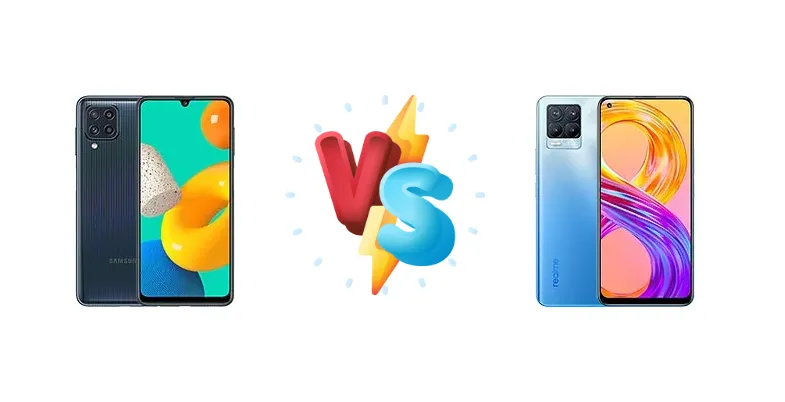
The Samsung Galaxy M32 and Realme 8 Pro represent compelling options in the crowded budget smartphone market. While both aim to deliver a feature-rich experience without breaking the bank, they take different approaches. The M32 prioritizes a large display and potentially wider availability, while the Realme 8 Pro focuses on camera capabilities and faster charging. This comparison dissects their key differences to help you choose the right device.
🏆 Quick Verdict
For most users, the Realme 8 Pro emerges as the stronger contender. Its Snapdragon 720G chipset, built on an 8nm process, provides a noticeable performance advantage over the Galaxy M32’s Helio G80. Coupled with 50W charging, the Realme 8 Pro offers a more refined and efficient user experience, justifying its slight price premium.
| Network |
|---|
| 2G bands | GSM 850 / 900 / 1800 / 1900 | GSM 850 / 900 / 1800 / 1900 |
| 3G bands | HSDPA 850 / 900 / 1700(AWS) / 1900 / 2100 - International | HSDPA 850 / 900 / 2100 |
| 4G bands | 1, 2, 3, 4, 5, 7, 8, 12, 17, 20, 26, 28, 38, 40, 41, 66 - International | 1, 3, 5, 7, 8, 20, 28, 38, 40, 41 - International |
| Speed | HSPA, LTE | HSPA, LTE |
| Technology | GSM / HSPA / LTE | GSM / HSPA / LTE |
| | 1, 3, 5, 8, 20, 38, 40, 41 - India | 1, 3, 5, 8, 38, 40, 41 - Asia |
| Launch |
|---|
| Announced | 2021, June 21 | 2021, March 24 |
| Status | Available. Released 2021, June 28 | Available. Released 2021, March 25 |
| Body |
|---|
| Build | Glass front (Gorilla Glass 5), plastic frame, plastic back | Glass front, plastic frame, plastic back |
| Dimensions | 159.3 x 74 x 8.4 mm (Global) or 9.3 mm (India) | 160.6 x 73.9 x 8.1 mm (6.32 x 2.91 x 0.32 in) |
| SIM | · Nano-SIM· Nano-SIM + Nano-SIM | Nano-SIM + Nano-SIM |
| Weight | 180 g (Global) / 196 g (India) (6.35 oz) | 176 g (6.21 oz) |
| Display |
|---|
| Protection | Corning Gorilla Glass 5 | - |
| Resolution | 1080 x 2400 pixels, 20:9 ratio (~411 ppi density) | 1080 x 2400 pixels, 20:9 ratio (~411 ppi density) |
| Size | 6.4 inches, 98.9 cm2 (~83.9% screen-to-body ratio) | 6.4 inches, 98.9 cm2 (~83.3% screen-to-body ratio) |
| Type | Super AMOLED, 90Hz, 800 nits (HBM) | Super AMOLED, 430 nits (typ), 1000 nits (peak) |
| | - | Always-on display |
| Platform |
|---|
| CPU | Octa-core (2x2.0 GHz Cortex-A75 & 6x1.8 GHz Cortex-A55) | Octa-core (2x2.3 GHz Kryo 465 Gold & 6x1.8 GHz Kryo 465 Silver) |
| Chipset | Mediatek MT6769V/CU Helio G80 (12 nm) | Qualcomm SM7125 Snapdragon 720G (8 nm) |
| GPU | Mali-G52 MC2 | Adreno 618 |
| OS | Android 11, upgradable to Android 13, One UI 5 | Android 11, upgradable to Android 12, Realme UI 3.0 |
| Memory |
|---|
| Card slot | microSDXC (dedicated slot) | microSDXC (dedicated slot) |
| Internal | 64GB 4GB RAM, 128GB 6GB RAM, 128GB 8GB RAM | 128GB 6GB RAM, 128GB 8GB RAM |
| | eMMC 5.1 | UFS 2.1 |
| Main Camera |
|---|
| Features | LED flash, panorama, HDR | LED flash, HDR, panorama |
| Quad | 64 MP, f/1.8, 26mm (wide), 1/1.97", 0.7µm, PDAF
8 MP, f/2.2, 123˚, (ultrawide), 1/4.0", 1.12µm
2 MP (macro)
Auxiliary lens | 108 MP, f/1.9, 26mm (wide), 1/1.52", 0.7µm, PDAF
8 MP, f/2.3, 119˚, 16mm (ultrawide), 1/4.0", 1.12µm
2 MP (macro)
Auxiliary lens |
| Video | 1080p@30fps | 4K@30fps, 1080p@30/60/120/480fps, 720p@960fps, gyro-EIS |
| Selfie camera |
|---|
| Features | - | HDR, panorama |
| Single | 20 MP, f/2.2, (wide) | 16 MP, f/2.5, (wide), 1/3.0", 1.0µm |
| Video | 1080p@30fps | 1080p@30/120fps, gyro-EIS |
| Sound |
|---|
| 3.5mm jack | Yes | Yes |
| 35mm jack | Yes | Yes |
| Loudspeaker | Yes | Yes |
| | - | 24-bit/192kHz audio |
| Comms |
|---|
| Bluetooth | 5.0, A2DP, LE | 5.0, A2DP, LE |
| NFC | Yes (market/region dependent) | Yes (market/region dependent) |
| Positioning | GPS, GLONASS, BDS, GALILEO | GPS, GLONASS, BDS |
| Radio | No | No |
| USB | USB Type-C 2.0, OTG | USB Type-C 2.0, OTG |
| WLAN | Wi-Fi 802.11 a/b/g/n/ac, dual-band, Wi-Fi Direct | Wi-Fi 802.11 a/b/g/n/ac, dual-band, Wi-Fi Direct |
| Features |
|---|
| Sensors | Fingerprint (side-mounted), accelerometer, gyro, compass | Fingerprint (under display, optical), accelerometer, gyro, proximity, compass |
| | Virtual proximity sensing | - |
| Battery |
|---|
| Charging | 25W wired (International)
15W wired (India) | 50W wired, 50% in 17 min, 100% in 47 min |
| Type | Market-dependent versions:· Li-Ion 5000 mAh (Global)· Li-Ion 6000 mAh (India only) | 4500 mAh |
| Misc |
|---|
| Colors | Black, Light Blue | Infinite Blue, Infinite Black, Punk Black, Illuminating Yellow |
| Models | SM-M325FV, SM-M325FV/DS, SM-M325F/DS, SM-M325F | RMX3081 |
| Price | About 180 EUR | About 550 EUR |
| SAR | 0.64 W/kg (head) | 1.10 W/kg (head) 0.53 W/kg (body) |
| SAR EU | 0.56 W/kg (head) 1.57 W/kg (body) | - |
| Tests |
|---|
| Battery life | - |
Endurance rating 116h
|
| Camera | - |
Photo / Video |
| Display | - |
Contrast ratio: Infinite (nominal) |
| Loudspeaker | - |
-28.2 LUFS (Average)
|
| Performance | - |
AnTuTu: 286666 (v8)
GeekBench: 1678 (v5.1)
GFXBench: 16fps (ES 3.1 onscreen) |
Samsung Galaxy M32
- Potentially wider availability in certain markets.
- Large display suitable for media consumption.
- Competitive price point.
- Less powerful Helio G80 chipset.
- Slower charging speeds (especially in India).
- Limited camera details.
Realme 8 Pro
- More powerful Snapdragon 720G chipset.
- Significantly faster 50W charging.
- Potentially better camera performance.
- May be slightly more expensive.
- Battery capacity is not significantly larger than the M32.
- Availability may be limited in some regions.
Display Comparison
Both devices feature displays with an 'Infinite' contrast ratio, a marketing term indicating deep blacks. However, detailed display specs like peak brightness and color gamut coverage are missing. The Realme 8 Pro’s display benefits from the more efficient Snapdragon 720G, potentially allowing for a slightly brighter and more consistently vibrant image. Without specific nit ratings, it’s difficult to definitively declare a winner, but the Realme 8 Pro’s chipset suggests better display power management.
Camera Comparison
Both phones advertise photo and video capabilities, but specifics are limited. The Realme 8 Pro’s camera system likely benefits from Qualcomm’s image signal processor (ISP) within the Snapdragon 720G, offering potentially better noise reduction and dynamic range. While sensor sizes and apertures aren’t provided, the Realme 8 Pro’s marketing often emphasizes its camera prowess, suggesting a more refined camera experience. The absence of details on the M32’s camera makes a direct comparison difficult, but the Realme 8 Pro’s chipset gives it an edge.
Performance
The Realme 8 Pro’s Qualcomm Snapdragon 720G (8nm) holds a clear advantage over the Samsung Galaxy M32’s MediaTek Helio G80 (12nm). The 8nm process node translates to improved thermal efficiency and power consumption. While both CPUs feature an octa-core configuration with similar Cortex-A55 efficiency cores, the Snapdragon 720G’s Kryo 465 Gold cores (2x2.3 GHz) outperform the Helio G80’s Cortex-A75 cores (2x2.0 GHz) in both single-core and multi-core benchmarks. This difference is particularly noticeable in demanding tasks like gaming and video editing, making the Realme 8 Pro the better choice for power users.
Battery Life
Both devices boast an endurance rating of 116 hours, suggesting comparable battery life under similar usage conditions. However, the Realme 8 Pro’s 50W wired charging significantly outperforms the Galaxy M32’s 25W (International) or 15W (India) charging. The Realme 8 Pro can reach 50% charge in just 17 minutes and 100% in 47 minutes, a substantial time saving compared to the M32. This faster charging capability mitigates any potential disadvantage from a slightly smaller battery capacity, making the Realme 8 Pro more convenient for users who need a quick power boost.
Buying Guide
Buy the Samsung Galaxy M32 if you prioritize a larger screen for media consumption and are operating in a region where the 25W charging variant is readily available. Buy the Realme 8 Pro if you value faster charging, a more capable processor for gaming and multitasking, and a potentially superior camera experience, even if it means a slightly smaller battery capacity.
Frequently Asked Questions
❓ Does the MediaTek Helio G80 in the Samsung Galaxy M32 struggle with demanding games like PUBG or Call of Duty?
The Helio G80 is a capable chipset for casual gaming, but it may exhibit frame drops or require lower graphics settings in demanding titles like PUBG or Call of Duty. The Snapdragon 720G in the Realme 8 Pro offers a smoother and more consistent gaming experience due to its superior processing power and thermal efficiency.
❓ Is the 50W charging on the Realme 8 Pro safe for long-term battery health?
Realme employs charging algorithms designed to protect battery health during fast charging. While fast charging generates more heat, the 8 Pro’s charging system manages this effectively. Over the long term, battery degradation is inevitable with any smartphone, but the Realme 8 Pro’s charging technology minimizes the impact.
❓ The Galaxy M32 has different charging speeds depending on the region (25W vs 15W). How much does this impact the charging time?
The difference between 25W and 15W charging is significant. The 15W variant will take considerably longer to fully charge, potentially doubling the charging time compared to the 25W version. This is a crucial factor to consider if you live in a region where only the 15W version is available.
❓ Are there any significant differences in software experience between Samsung's One UI and Realme UI?
Samsung's One UI is generally considered more feature-rich and polished, but also more resource-intensive. Realme UI is lighter and faster, prioritizing smoothness and responsiveness. Both offer customization options, but One UI provides a wider range of features, while Realme UI focuses on simplicity.