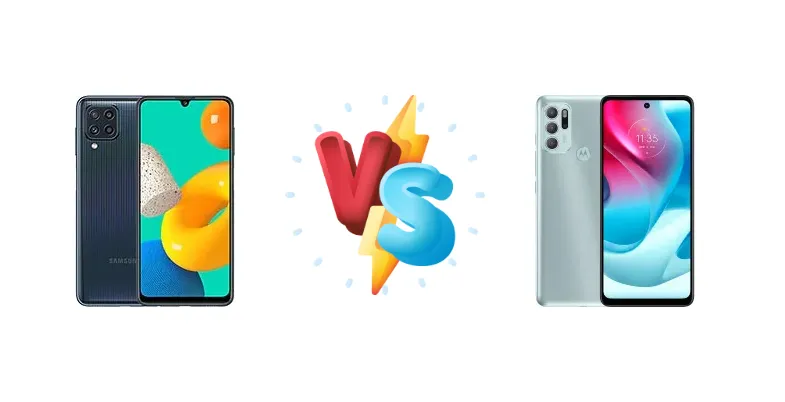
Both the Samsung Galaxy M32 and Motorola Moto G60S target the competitive budget smartphone market, but they take different approaches. The M32 aims for broad appeal with a focus on affordability, while the G60S prioritizes performance and faster charging. This comparison dissects their key differences to help you choose the right device.
🏆 Quick Verdict
For most users, the Motorola Moto G60S is the superior choice. Its Helio G95 chipset provides a noticeable performance boost over the Galaxy M32’s Helio G80, and the 50W fast charging significantly reduces downtime. While the M32 offers a lower entry price, the G60S delivers better value for its slightly higher cost.
| Network |
|---|
| 2G bands | GSM 850 / 900 / 1800 / 1900 | GSM 850 / 900 / 1800 / 1900 |
| 3G bands | HSDPA 850 / 900 / 1700(AWS) / 1900 / 2100 - International | HSDPA 850 / 900 / 1700(AWS) / 1900 / 2100 |
| 4G bands | 1, 2, 3, 4, 5, 7, 8, 12, 17, 20, 26, 28, 38, 40, 41, 66 - International | 1, 2, 3, 4, 5, 7, 8, 12, 13, 17, 28, 40, 66 |
| Speed | HSPA, LTE | HSPA, LTE |
| Technology | GSM / HSPA / LTE | GSM / HSPA / LTE |
| | 1, 3, 5, 8, 20, 38, 40, 41 - India | - |
| Launch |
|---|
| Announced | 2021, June 21 | 2021, August 12 |
| Status | Available. Released 2021, June 28 | Available. Released 2021, August 12 |
| Body |
|---|
| Build | Glass front (Gorilla Glass 5), plastic frame, plastic back | Glass front, plastic frame, plastic back |
| Dimensions | 159.3 x 74 x 8.4 mm (Global) or 9.3 mm (India) | 169.7 x 75.9 x 9.6 mm (6.68 x 2.99 x 0.38 in) |
| SIM | · Nano-SIM· Nano-SIM + Nano-SIM | Nano-SIM + Nano-SIM |
| Weight | 180 g (Global) / 196 g (India) (6.35 oz) | 212 g (7.48 oz) |
| | - | Water repellent design |
| Display |
|---|
| Protection | Corning Gorilla Glass 5 | - |
| Resolution | 1080 x 2400 pixels, 20:9 ratio (~411 ppi density) | 1080 x 2460 pixels (~395 ppi density) |
| Size | 6.4 inches, 98.9 cm2 (~83.9% screen-to-body ratio) | 6.8 inches, 109.8 cm2 (~85.3% screen-to-body ratio) |
| Type | Super AMOLED, 90Hz, 800 nits (HBM) | IPS LCD, 120Hz, HDR10, 450 nits (typ), 562 nits (HBM) |
| Platform |
|---|
| CPU | Octa-core (2x2.0 GHz Cortex-A75 & 6x1.8 GHz Cortex-A55) | Octa-core (2x2.05 GHz Cortex-A76 & 6x2.0 GHz Cortex-A55) |
| Chipset | Mediatek MT6769V/CU Helio G80 (12 nm) | Mediatek MT6785V/CD Helio G95 (12 nm) |
| GPU | Mali-G52 MC2 | Mali-G76 MC4 |
| OS | Android 11, upgradable to Android 13, One UI 5 | Android 11 |
| Memory |
|---|
| Card slot | microSDXC (dedicated slot) | microSDXC (uses shared SIM slot) |
| Internal | 64GB 4GB RAM, 128GB 6GB RAM, 128GB 8GB RAM | 128GB 4GB RAM, 128GB 6GB RAM |
| | eMMC 5.1 | UFS 2.1 |
| Main Camera |
|---|
| Features | LED flash, panorama, HDR | LED flash, HDR, panorama |
| Quad | 64 MP, f/1.8, 26mm (wide), 1/1.97", 0.7µm, PDAF
8 MP, f/2.2, 123˚, (ultrawide), 1/4.0", 1.12µm
2 MP (macro)
Auxiliary lens | 64 MP, f/1.7, 26mm (wide), PDAF
8 MP, f/2.2, 119˚, (ultrawide)
5 MP (macro)
Auxiliary lens |
| Video | 1080p@30fps | 4K@30/120fps, 1080p@30/60/240fps |
| Selfie camera |
|---|
| Features | - | LED flash, HDR |
| Single | 20 MP, f/2.2, (wide) | 16 MP, f/2.2, (wide) |
| Video | 1080p@30fps | 4K@30fps, 1080p@30/60/240fps |
| Sound |
|---|
| 3.5mm jack | Yes | Yes |
| 35mm jack | Yes | Yes |
| Loudspeaker | Yes | Yes |
| Comms |
|---|
| Bluetooth | 5.0, A2DP, LE | 5.0, A2DP, LE |
| NFC | Yes (market/region dependent) | Yes |
| Positioning | GPS, GLONASS, BDS, GALILEO | GPS, GLONASS, GALILEO |
| Radio | No | FM radio |
| USB | USB Type-C 2.0, OTG | USB Type-C 2.0, OTG |
| WLAN | Wi-Fi 802.11 a/b/g/n/ac, dual-band, Wi-Fi Direct | Wi-Fi 802.11 a/b/g/n/ac, dual-band, Wi-Fi Direct |
| Features |
|---|
| Sensors | Fingerprint (side-mounted), accelerometer, gyro, compass | Fingerprint (rear-mounted), accelerometer, gyro, proximity |
| | Virtual proximity sensing | - |
| Battery |
|---|
| Charging | 25W wired (International)
15W wired (India) | 50W wired, QC4 |
| Type | Market-dependent versions:· Li-Ion 5000 mAh (Global)· Li-Ion 6000 mAh (India only) | Li-Po 5000 mAh |
| Misc |
|---|
| Colors | Black, Light Blue | Green, Blue |
| Models | SM-M325FV, SM-M325FV/DS, SM-M325F/DS, SM-M325F | XT2133-2, XT2133-1 |
| Price | About 180 EUR | About 200 EUR |
| SAR | 0.64 W/kg (head) | - |
| SAR EU | 0.56 W/kg (head) 1.57 W/kg (body) | - |
Samsung Galaxy M32
- Lower initial purchase price
- Samsung brand recognition
- Potentially wider availability in some regions
- Slower processor (Helio G80)
- Significantly slower charging speeds
- Less responsive user experience
Motorola Moto G60S
- Faster and more powerful processor (Helio G95)
- 50W fast charging with QC4
- Improved multitasking and gaming performance
- Slightly higher price point
- Motorola’s software update track record can be inconsistent
- Larger size may not suit all users
Display Comparison
Neither device boasts a flagship-level display. Both utilize LCD panels, but details regarding peak brightness and color gamut coverage are absent. The focus here isn't on visual fidelity. However, the G60S's larger size (typically 6.6 inches vs. the M32's 6.4 inches) may offer a more immersive viewing experience. The absence of high refresh rate panels on either device means scrolling and animations won't be as fluid as on more expensive phones.
Camera Comparison
Without detailed sensor information beyond the main camera, a direct comparison is limited. However, the G60S’s processor benefits image processing, potentially leading to better dynamic range and noise reduction. The M32 often includes a 2MP macro lens, a common inclusion in this price bracket, but its utility is questionable due to the low resolution. The G60S likely prioritizes a more streamlined camera experience with a focus on the main sensor's capabilities. The G95’s ISP (Image Signal Processor) is more advanced, offering better post-processing capabilities.
Performance
The core difference lies in the chipsets. The Motorola Moto G60S features the Mediatek Helio G95, built on a 12nm process, with a CPU configuration of 2x2.05 GHz Cortex-A76 cores and 6x2.0 GHz Cortex-A55 cores. This represents a clear upgrade over the Samsung Galaxy M32’s Helio G80 (also 12nm) with its 2x2.0 GHz Cortex-A75 and 6x1.8 GHz Cortex-A55 setup. The Cortex-A76 cores in the G95 offer superior single-core performance, translating to snappier app launches and smoother multitasking. While both use the same process node, the architectural improvements in the G95 provide a tangible performance advantage, particularly in gaming and demanding applications.
Battery Life
The Moto G60S’s 50W wired charging with Quick Charge 4 (QC4) is a significant advantage over the Galaxy M32’s 25W (International) or 15W (India) charging. This translates to substantially faster recharge times – potentially going from 0-100% in under an hour on the G60S, compared to a much longer duration on the M32. While battery capacity isn't specified, the faster charging of the G60S mitigates any potential disadvantage from a slightly smaller battery, offering more usable uptime throughout the day.
Buying Guide
Buy the Samsung Galaxy M32 if you prioritize a lower upfront cost and are a casual smartphone user who primarily browses the web, uses social media, and makes occasional calls. Buy the Motorola Moto G60S if you enjoy mobile gaming, frequently stream videos, or need a phone that can quickly recharge, offering a more responsive and future-proof experience.
Frequently Asked Questions
❓ Does the Motorola Moto G60S experience significant throttling during extended gaming sessions?
While the Helio G95 is a capable chipset, sustained performance can be affected by thermal throttling. However, the G60S’s larger chassis provides more surface area for heat dissipation compared to many other phones in this price range, mitigating throttling to a reasonable degree. Expect some performance dip after prolonged gaming, but it shouldn't be severe enough to render games unplayable.
❓ Is the 25W charging on the international version of the Samsung Galaxy M32 a substantial improvement over the 15W version in India?
Yes, the 25W charging is a noticeable improvement. While still slower than the G60S’s 50W, it reduces charging time by approximately 40-50% compared to the 15W variant. However, even with 25W, it still takes considerably longer to fully charge than the Moto G60S.
❓ How does the software experience differ between the Samsung Galaxy M32 and the Motorola Moto G60S?
The Galaxy M32 runs Samsung’s One UI, known for its feature-rich interface and customization options. The Moto G60S offers a near-stock Android experience with Motorola’s My UX, which is cleaner and more lightweight. Motorola’s software updates have historically been less frequent than Samsung’s, which is a consideration for security and feature updates.