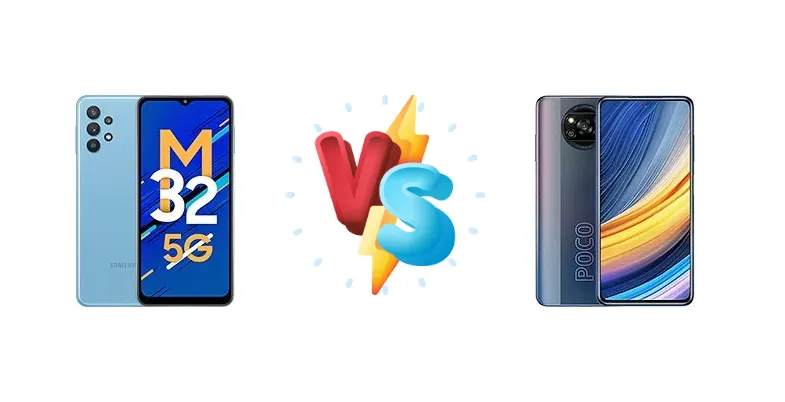
The Xiaomi Poco X3 Pro and Samsung Galaxy M32 5G represent compelling options in the crowded mid-range smartphone market. The Poco X3 Pro aggressively targets gamers with its powerful Snapdragon 860 chipset, while the Galaxy M32 5G prioritizes 5G connectivity and affordability. This comparison dissects their key differences to help you choose the right device.
🏆 Quick Verdict
For users prioritizing raw performance and gaming, the Xiaomi Poco X3 Pro is the clear winner, thanks to its Snapdragon 860. However, the Samsung Galaxy M32 5G provides a more balanced experience with 5G access and a lower price point, making it ideal for everyday users.
| Network |
|---|
| 2G bands | GSM 850 / 900 / 1800 / 1900 | GSM 850 / 900 / 1800 / 1900 |
| 3G bands | HSDPA 850 / 900 / 1700(AWS) / 1900 / 2100 | HSDPA 850 / 900 / 1700(AWS) / 1900 / 2100 |
| 4G bands | 1, 2, 3, 4, 5, 7, 8, 12, 17, 20, 26, 28, 38, 40, 41, 66 | 1, 2, 3, 4, 5, 7, 8, 20, 28, 38, 40, 41 - International |
| 5G bands | 1, 3, 5, 7, 8, 20, 28, 38, 40, 41, 66, 78 SA/NSA/Sub6 | - |
| Speed | HSPA, LTE, 5G | HSPA, LTE |
| Technology | GSM / HSPA / LTE / 5G | GSM / HSPA / LTE |
| | - | 1, 2, 3, 5, 8, 38, 40, 41 - India |
| Launch |
|---|
| Announced | 2021, August 25 | 2021, March 22 |
| Status | Available. Released 2021, September 02 | Available. Released 2021, March 24 |
| Body |
|---|
| Build | - | Glass front (Gorilla Glass 6), plastic back |
| Dimensions | 164.2 x 76.1 x 9.1 mm (6.46 x 3.00 x 0.36 in) | 165.3 x 76.8 x 9.4 mm (6.51 x 3.02 x 0.37 in) |
| SIM | Nano-SIM + Nano-SIM | Nano-SIM + Nano-SIM |
| Weight | 205 g (7.23 oz) | 215 g (7.58 oz) |
| | - | IP53, dust and splash resistant |
| Display |
|---|
| Protection | - | Corning Gorilla Glass 6 |
| Resolution | 720 x 1600 pixels, 20:9 ratio (~270 ppi density) | 1080 x 2400 pixels, 20:9 ratio (~395 ppi density) |
| Size | 6.5 inches, 102.0 cm2 (~81.6% screen-to-body ratio) | 6.67 inches, 107.4 cm2 (~84.6% screen-to-body ratio) |
| Type | TFT LCD | IPS LCD, 120Hz, 2404Hz PWM, HDR10, 450 nits (typ) |
| Platform |
|---|
| CPU | Octa-core (2x2.0 GHz Cortex-A76 & 6x2.0 GHz Cortex-A55) | Octa-core (1x2.96 GHz Kryo 485 Gold & 3x2.42 GHz Kryo 485 Gold & 4x1.78 GHz Kryo 485 Silver) |
| Chipset | Mediatek Dimensity 720 (7 nm) | Qualcomm Snapdragon 860 (7 nm) |
| GPU | Mali-G57 MC3 | Adreno 640 |
| OS | Android 11, upgradable to Android 13, One UI 5 | Android 11, upgradable to Android 12, MIUI 13 for POCO |
| Memory |
|---|
| Card slot | microSDXC (uses shared SIM slot) | microSDXC (uses shared SIM slot) |
| Internal | 128GB 6GB RAM, 128GB 8GB RAM | 128GB 6GB RAM, 128GB 8GB RAM, 256GB 6GB RAM, 256GB 8GB RAM |
| | eMMC 5.1 | UFS 3.1 |
| Main Camera |
|---|
| Features | LED flash, panorama, HDR | Dual-LED flash, HDR, panorama |
| Quad | 48 MP, f/1.8, 26mm (wide), PDAF
8 MP, f/2.2, 123˚ (ultrawide)
5 MP (macro)
Auxiliary lens | 48 MP, f/1.8, (wide), 1/2.0", 0.8µm, PDAF
8 MP, f/2.2, 119˚ (ultrawide), 1.0µm
2 MP (macro)
Auxiliary lens |
| Single | - | 20 MP, f/2.2, (wide), 1/3.4", 0.8µm |
| Video | 4K@30fps, 1080p@30fps | 4K@30fps, 1080p@30/60/120/240fps, 1080p@960fps, gyro-EIS |
| Selfie camera |
|---|
| Features | - | HDR, panorama |
| Single | 13 MP, f/2.2, (wide) | 20 MP, f/2.2, (wide), 1/3.4", 0.8µm |
| Video | 1080p@30fps | 1080p@30fps |
| Sound |
|---|
| 3.5mm jack | Yes | Yes |
| 35mm jack | Yes | Yes |
| Loudspeaker | Yes | Yes, with stereo speakers |
| | - | 24-bit/192kHz audio |
| Comms |
|---|
| Bluetooth | 5.0, A2DP, LE, aptX | 5.0, A2DP, LE |
| Infrared port | - | Yes |
| NFC | Yes | Yes (market/region dependent) |
| Positioning | GPS, GLONASS, BDS, GALILEO | GPS, GLONASS, GALILEO, BDS |
| Radio | Unspecified | FM radio, recording |
| USB | USB Type-C 2.0, OTG | USB Type-C 2.0, OTG |
| WLAN | Wi-Fi 802.11 a/b/g/n/ac, dual-band, Wi-Fi Direct | Wi-Fi 802.11 a/b/g/n/ac, dual-band, Wi-Fi Direct |
| Features |
|---|
| Sensors | Fingerprint (side-mounted), accelerometer, gyro, compass | Fingerprint (side-mounted), accelerometer, gyro, proximity, compass |
| | Virtual proximity sensing | - |
| Battery |
|---|
| Charging | 15W wired | 33W wired, 59% in 30 min, 100% in 59 min |
| Type | Li-Ion 5000 mAh | Li-Po 5160 mAh |
| Misc |
|---|
| Colors | Slate Black, Sky Blue | Phantom Black, Frost Blue, Metal Bronze |
| Models | SM-M326B, SM-M326B/DS | M2102J20SG, M2102J20SI |
| Price | About 220 EUR | $ 128.04 / £ 249.99 |
| SAR | 0.48 W/kg (head) | 0.99 W/kg (head) 0.67 W/kg (body) |
| SAR EU | - | 0.57 W/kg (head) 0.90 W/kg (body) |
| Tests |
|---|
| Battery life | - |
Endurance rating 112h
|
| Camera | - |
Photo / Video |
| Display | - |
Contrast ratio: 1401:1 (nominal) |
| Loudspeaker | - |
-26.1 LUFS (Good)
|
| Performance | - |
AnTuTu: 453223 (v8)
GeekBench: 2574 (v5.1)
GFXBench: 38fps (ES 3.1 onscreen) |
Samsung Galaxy M32 5G
- Affordable 5G connectivity
- Long battery endurance (112h)
- Lower price point
- Significantly weaker processor
- Slower charging speed (15W)
- Likely lower display quality
Xiaomi Poco X3 Pro
- Powerful Snapdragon 860 processor
- Fast 33W charging
- 120Hz display for smoother gaming
- Lacks 5G connectivity
- Potentially higher price
- May run warmer under heavy load
Display Comparison
Both devices share a nominal contrast ratio of 1401:1, suggesting similar visual pop. However, detailed display specs like peak brightness, panel type (IPS vs AMOLED), and refresh rate are missing for the M32 5G. Given the M32 5G's price point, it likely utilizes a standard 60Hz IPS LCD, while the Poco X3 Pro's display is geared towards gaming with a 120Hz refresh rate, offering a smoother visual experience, particularly in fast-paced games. The absence of LTPO technology on either device means they won't dynamically adjust refresh rates for power saving.
Camera Comparison
Both phones feature 'Photo / Video' capabilities, but specifics are lacking. Without sensor size or aperture information, a direct comparison is difficult. However, the market positioning suggests the Poco X3 Pro likely prioritizes camera performance more than the M32 5G. The inclusion of OIS (Optical Image Stabilization) on the Poco X3 Pro, if present (not specified in data), would provide a significant advantage in low-light photography and video recording. The 2MP macro cameras on both devices are likely to offer limited utility due to their small sensor size and low resolution.
Performance
The performance gap is significant. The Xiaomi Poco X3 Pro’s Qualcomm Snapdragon 860 (7nm) boasts a prime core clocked at 2.96 GHz, alongside three additional performance cores at 2.42 GHz, and four efficiency cores at 1.78 GHz. This configuration dramatically outperforms the Samsung Galaxy M32 5G’s MediaTek Dimensity 720 (7nm) with its 2x2.0 GHz Cortex-A76 and 6x2.0 GHz Cortex-A55 cores. The Snapdragon 860’s Kryo 485 Gold cores offer superior single-core and multi-core performance, translating to faster app loading times, smoother multitasking, and higher sustained frame rates in games. The Poco X3 Pro is the clear choice for demanding users.
Battery Life
Both devices achieve an endurance rating of 112 hours, indicating comparable battery life under similar usage conditions. However, the Poco X3 Pro’s 33W wired charging is a substantial advantage over the M32 5G’s 15W charging. The Poco X3 Pro can reach 59% charge in 30 minutes and 100% in 59 minutes, minimizing downtime. The M32 5G will require significantly longer to fully charge, impacting convenience for users who frequently need to top up their battery.
Buying Guide
Buy the Samsung Galaxy M32 5G if you need reliable 5G connectivity on a budget and prioritize a smooth, everyday experience over demanding gaming. Buy the Xiaomi Poco X3 Pro if you are a mobile gamer who demands high frame rates and responsive performance, and are willing to trade off 5G for a more powerful processor.
Frequently Asked Questions
❓ Does the Dimensity 720 in the Galaxy M32 5G struggle with graphically intensive games like PUBG?
Yes, the Dimensity 720 is a mid-range chipset and will likely require reduced graphics settings and frame rates to achieve a playable experience in demanding games like PUBG. Expect occasional frame drops and stuttering, especially during intense firefights. The Poco X3 Pro's Snapdragon 860 is far better suited for smooth, high-frame-rate gaming.
❓ How much faster is the 33W charging on the Poco X3 Pro compared to the 15W charging on the M32 5G in real-world use?
The Poco X3 Pro's 33W charging significantly reduces charging time. It can reach 100% in approximately 59 minutes, while the M32 5G will likely take well over two hours to fully charge. This difference is crucial for users who need a quick power boost throughout the day.
❓ Is the lack of 5G on the Poco X3 Pro a dealbreaker in 2024?
That depends on your location and carrier. If 5G coverage is widespread and you have a 5G data plan, the lack of 5G on the Poco X3 Pro might be a drawback. However, if 5G is unavailable in your area or you primarily use Wi-Fi, it's less of a concern. The Snapdragon 860's performance benefits may outweigh the lack of 5G for many users.