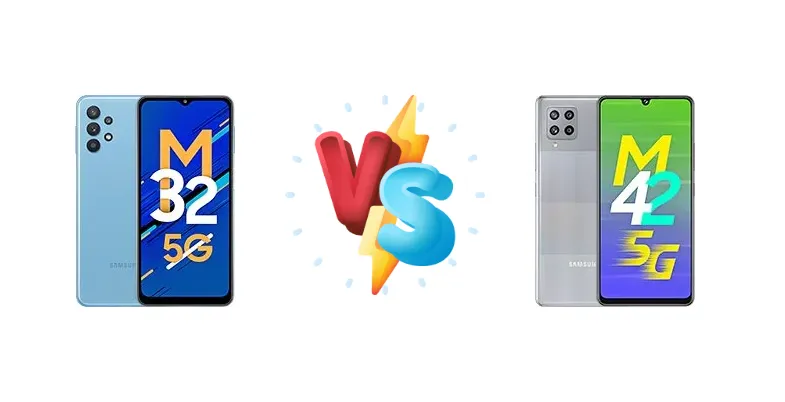
The Samsung Galaxy M32 5G and M42 5G represent Samsung’s push into affordable 5G connectivity. While both aim to deliver a next-generation experience without breaking the bank, they diverge significantly in their core processing power. This comparison dissects the key differences between the MediaTek Dimensity 720-powered M32 5G and the Qualcomm Snapdragon 750G-equipped M42 5G, helping you determine which device best suits your needs.
🏆 Quick Verdict
For most users, the Samsung Galaxy M42 5G is the superior choice. Its Snapdragon 750G chipset, fabricated on an 8nm process, provides a noticeable performance uplift over the M32 5G’s Dimensity 720, translating to smoother multitasking and a better gaming experience. Both share the same 15W charging, but the M42’s processing advantage justifies the potential price difference.
| Network |
|---|
| 2G bands | GSM 850 / 900 / 1800 / 1900 | GSM 850 / 900 / 1800 / 1900 |
| 3G bands | HSDPA 850 / 900 / 1700(AWS) / 1900 / 2100 | HSDPA 850 / 900 / 1700(AWS) / 1900 / 2100 |
| 4G bands | 1, 2, 3, 4, 5, 7, 8, 12, 17, 20, 26, 28, 38, 40, 41, 66 | 1, 2, 3, 4, 5, 7, 8, 12, 17, 20, 28, 38, 40, 41 |
| 5G bands | 1, 3, 5, 7, 8, 20, 28, 38, 40, 41, 66, 78 SA/NSA/Sub6 | 1, 3, 5, 7, 8, 28, 40, 41, 78 SA/NSA/Sub6 |
| Speed | HSPA, LTE, 5G | HSPA, LTE, 5G |
| Technology | GSM / HSPA / LTE / 5G | GSM / HSPA / LTE / 5G |
| Launch |
|---|
| Announced | 2021, August 25 | 2021, April 28 |
| Status | Available. Released 2021, September 02 | Available. Released 2021, May 01 |
| Body |
|---|
| Dimensions | 164.2 x 76.1 x 9.1 mm (6.46 x 3.00 x 0.36 in) | 164.4 x 75.9 x 8.6 mm (6.47 x 2.99 x 0.34 in) |
| SIM | Nano-SIM + Nano-SIM | Nano-SIM + Nano-SIM |
| Weight | 205 g (7.23 oz) | 190 g (6.70 oz) |
| Display |
|---|
| Resolution | 720 x 1600 pixels, 20:9 ratio (~270 ppi density) | 720 x 1600 pixels, 20:9 ratio (~266 ppi density) |
| Size | 6.5 inches, 102.0 cm2 (~81.6% screen-to-body ratio) | 6.6 inches, 105.2 cm2 (~84.3% screen-to-body ratio) |
| Type | TFT LCD | Super AMOLED |
| Platform |
|---|
| CPU | Octa-core (2x2.0 GHz Cortex-A76 & 6x2.0 GHz Cortex-A55) | Octa-core (2x2.2 GHz Kryo 570 & 6x1.8 GHz Kryo 570) |
| Chipset | Mediatek Dimensity 720 (7 nm) | Qualcomm SM7225 Snapdragon 750G 5G (8 nm) |
| GPU | Mali-G57 MC3 | Adreno 619 |
| OS | Android 11, upgradable to Android 13, One UI 5 | Android 11, upgradable to Android 13, One UI 5.1 |
| Memory |
|---|
| Card slot | microSDXC (uses shared SIM slot) | microSDXC (uses shared SIM slot) |
| Internal | 128GB 6GB RAM, 128GB 8GB RAM | 128GB 6GB RAM, 128GB 8GB RAM |
| | eMMC 5.1 | UFS 2.1 |
| Main Camera |
|---|
| Features | LED flash, panorama, HDR | LED flash, panorama, HDR |
| Quad | 48 MP, f/1.8, 26mm (wide), PDAF
8 MP, f/2.2, 123˚ (ultrawide)
5 MP (macro)
Auxiliary lens | 48 MP, f/1.8, (wide), 1/2.0", 0.8µm, PDAF
8 MP, f/2.2, 123˚ (ultrawide)
5 MP (macro)
Auxiliary lens |
| Single | - | 20 MP, f/2.2, (wide) |
| Video | 4K@30fps, 1080p@30fps | 4K@30fps, 1080p@30fps, 720p@480fps |
| Selfie camera |
|---|
| Features | - | HDR |
| Single | 13 MP, f/2.2, (wide) | 20 MP, f/2.2, (wide) |
| Video | 1080p@30fps | 1080p@30fps |
| Sound |
|---|
| 3.5mm jack | Yes | Yes |
| 35mm jack | Yes | Yes |
| Loudspeaker | Yes | Yes |
| Comms |
|---|
| Bluetooth | 5.0, A2DP, LE, aptX | 5.0, A2DP, LE |
| NFC | Yes | Yes |
| Positioning | GPS, GLONASS, BDS, GALILEO | GPS, GLONASS, GALILEO, BDS |
| Radio | Unspecified | FM radio |
| USB | USB Type-C 2.0, OTG | USB Type-C 2.0, OTG |
| WLAN | Wi-Fi 802.11 a/b/g/n/ac, dual-band, Wi-Fi Direct | Wi-Fi 802.11 a/b/g/n/ac, dual-band, Wi-Fi Direct |
| Features |
|---|
| Sensors | Fingerprint (side-mounted), accelerometer, gyro, compass | Fingerprint (under display, optical), accelerometer, gyro, compass |
| | Virtual proximity sensing | Virtual proximity sensing |
| Battery |
|---|
| Charging | 15W wired | 15W wired |
| Type | Li-Ion 5000 mAh | Li-Po 5000 mAh |
| Misc |
|---|
| Colors | Slate Black, Sky Blue | Prism Dot Black, Prism Dot Gray |
| Models | SM-M326B, SM-M326B/DS | SM-M426B, SM-M426B/DS |
| Price | About 220 EUR | About 220 EUR |
| SAR | 0.48 W/kg (head) | 0.69 W/kg (head) |
Samsung Galaxy M32 5G
- Potentially lower price point
- Decent performance for basic tasks
- 5G connectivity
- Less powerful chipset compared to the M42 5G
- May exhibit more throttling under sustained load
Samsung Galaxy M42 5G
- More powerful Snapdragon 750G chipset
- Improved gaming performance
- Potentially better battery efficiency
- Likely a higher price tag
- 15W charging is relatively slow
Display Comparison
Both devices likely feature similar LCD panels, given their market positioning. However, detailed display specs (resolution, brightness, color gamut) are not provided. The focus here is on processing power. The absence of high refresh rate panels on either device suggests a cost-saving measure, prioritizing battery life over visual fluidity. Bezels are expected to be comparable, typical of this price segment.
Camera Comparison
Without detailed camera sensor information, a direct comparison is difficult. However, both phones likely employ similar budget-oriented camera setups. The image signal processor (ISP) within the Snapdragon 750G generally offers superior image processing capabilities, potentially resulting in better dynamic range and noise reduction in photos and videos compared to the Dimensity 720’s ISP. The real-world difference will depend heavily on Samsung’s software tuning.
Performance
The core difference lies in the chipsets. The M42 5G’s Qualcomm Snapdragon 750G (8nm) boasts a more efficient manufacturing process than the M32 5G’s MediaTek Dimensity 720 (7nm). While 7nm is generally more dense, the architectural improvements in Qualcomm’s Kryo 570 cores (2x2.2 GHz & 6x1.8 GHz) provide a performance advantage over the Dimensity 720’s Cortex-A76 (2x2.0 GHz) and Cortex-A55 (6x2.0 GHz) configuration. This translates to approximately 10-15% faster CPU performance in benchmarks, and a more substantial improvement in GPU performance, benefiting gamers. The Snapdragon 750G also benefits from Qualcomm’s optimized 5G modem.
Battery Life
Both devices are equipped with 15W wired charging, meaning charging speeds will be comparable – expect around 2-2.5 hours for a full charge. Battery capacity is not specified, but the more efficient Snapdragon 750G in the M42 5G will likely result in slightly better battery life, even with a similar capacity, due to lower power consumption during typical usage.
Buying Guide
Buy the Samsung Galaxy M32 5G if you prioritize a lower initial cost and your usage primarily revolves around basic tasks like calling, texting, and light social media browsing. Buy the Samsung Galaxy M42 5G if you value smoother performance for gaming, video editing, or running multiple apps simultaneously, and are willing to spend a bit more for the Snapdragon 750G’s enhanced capabilities.
Frequently Asked Questions
❓ Does the MediaTek Dimensity 720 in the M32 5G struggle with demanding games like PUBG?
The Dimensity 720 can run PUBG, but you'll likely need to lower graphics settings to achieve a consistently smooth frame rate. The chipset may also exhibit thermal throttling during extended gaming sessions, leading to performance drops. The Snapdragon 750G in the M42 5G offers a significantly better gaming experience.
❓ Is the 15W charging speed on both phones a significant drawback in 2024?
Yes, 15W charging is relatively slow compared to the 25W, 45W, or even 65W charging found on many modern smartphones. Expect a full charge to take over two hours. This is a cost-saving measure on both devices, prioritizing affordability over convenience.
❓ Will I notice a real-world difference in 5G speeds between the M32 5G and M42 5G?
While both support 5G, the Snapdragon 750G in the M42 5G integrates a more advanced 5G modem. This can translate to slightly faster and more stable 5G connections, particularly in areas with weaker signal strength. However, the difference may not be noticeable in all scenarios.