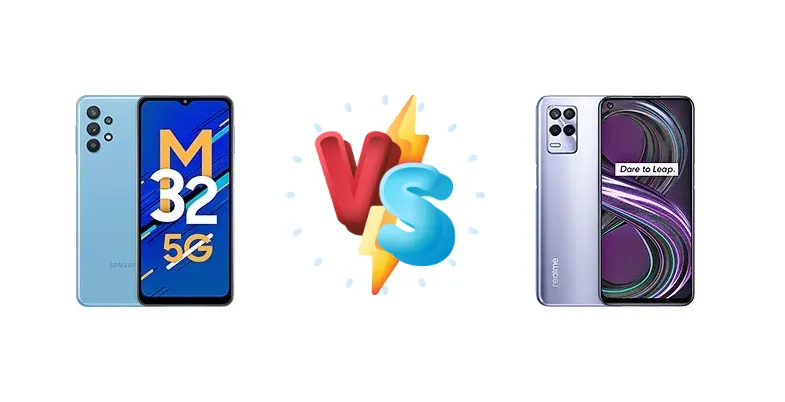
Both the Samsung Galaxy M32 5G and Realme 8s 5G target the competitive budget 5G market, but they take different approaches. The M32 5G prioritizes a larger screen and Samsung’s software ecosystem, while the 8s 5G focuses on raw performance and faster charging speeds. This comparison dissects the key differences to determine which device delivers the best value.
🏆 Quick Verdict
For most users, the Realme 8s 5G is the better choice. Its Mediatek Dimensity 810 chipset, built on a 6nm process, provides a noticeable performance uplift over the M32 5G’s Dimensity 720. Coupled with 33W charging, the 8s 5G offers a more responsive experience and quicker top-ups, making it ideal for power users.
| Network |
|---|
| 2G bands | GSM 850 / 900 / 1800 / 1900 | GSM 850 / 900 / 1800 / 1900 |
| 3G bands | HSDPA 850 / 900 / 1700(AWS) / 1900 / 2100 | HSDPA 850 / 900 / 1900 / 2100 |
| 4G bands | 1, 2, 3, 4, 5, 7, 8, 12, 17, 20, 26, 28, 38, 40, 41, 66 | 1, 2, 3, 5, 7, 8, 28, 34, 38, 39, 40, 41 |
| 5G bands | 1, 3, 5, 7, 8, 20, 28, 38, 40, 41, 66, 78 SA/NSA/Sub6 | 1, 28, 41, 77, 78 SA/NSA |
| Speed | HSPA, LTE, 5G | HSPA, LTE, 5G |
| Technology | GSM / HSPA / LTE / 5G | GSM / HSPA / LTE / 5G |
| Launch |
|---|
| Announced | 2021, August 25 | 2021, September 09 |
| Status | Available. Released 2021, September 02 | Available. Released 2021, September 13 |
| Body |
|---|
| Dimensions | 164.2 x 76.1 x 9.1 mm (6.46 x 3.00 x 0.36 in) | 162.5 x 74.8 x 8.8 mm (6.40 x 2.94 x 0.35 in) |
| SIM | Nano-SIM + Nano-SIM | Nano-SIM + Nano-SIM |
| Weight | 205 g (7.23 oz) | 191 g (6.74 oz) |
| Display |
|---|
| Resolution | 720 x 1600 pixels, 20:9 ratio (~270 ppi density) | 1080 x 2400 pixels, 20:9 ratio (~405 ppi density) |
| Size | 6.5 inches, 102.0 cm2 (~81.6% screen-to-body ratio) | 6.5 inches, 102.0 cm2 (~83.9% screen-to-body ratio) |
| Type | TFT LCD | IPS LCD, 90Hz, 600 nits (peak) |
| Platform |
|---|
| CPU | Octa-core (2x2.0 GHz Cortex-A76 & 6x2.0 GHz Cortex-A55) | Octa-core (2x2.4 GHz Cortex-A76 & 6x2.0 GHz Cortex-A55) |
| Chipset | Mediatek Dimensity 720 (7 nm) | Mediatek Dimensity 810 (6 nm) |
| GPU | Mali-G57 MC3 | Mali-G57 MC2 |
| OS | Android 11, upgradable to Android 13, One UI 5 | Android 11, Realme UI 2.0 |
| Memory |
|---|
| Card slot | microSDXC (uses shared SIM slot) | microSDXC (dedicated slot) |
| Internal | 128GB 6GB RAM, 128GB 8GB RAM | 128GB 6GB RAM, 128GB 8GB RAM |
| | eMMC 5.1 | UFS 2.1 |
| Main Camera |
|---|
| Features | LED flash, panorama, HDR | LED flash, HDR, panorama |
| Quad | 48 MP, f/1.8, 26mm (wide), PDAF
8 MP, f/2.2, 123˚ (ultrawide)
5 MP (macro)
Auxiliary lens | - |
| Single | - | 16 MP, f/2.1, 26mm (wide), 1/3.0", 1.0µm |
| Triple | - | 64 MP, f/1.8, 26mm (wide), PDAF
2 MP (macro)
Auxiliary lens |
| Video | 4K@30fps, 1080p@30fps | 1080p@30fps, gyro-EIS |
| Selfie camera |
|---|
| Features | - | HDR, panorama |
| Single | 13 MP, f/2.2, (wide) | 16 MP, f/2.1, 26mm (wide), 1/3.0", 1.0µm |
| Video | 1080p@30fps | 1080p@30fps, gyro-EIS |
| Sound |
|---|
| 3.5mm jack | Yes | Yes |
| 35mm jack | Yes | Yes |
| Loudspeaker | Yes | Yes |
| Comms |
|---|
| Bluetooth | 5.0, A2DP, LE, aptX | 5.1, A2DP, LE |
| NFC | Yes | No |
| Positioning | GPS, GLONASS, BDS, GALILEO | GPS, GLONASS, GALILEO, BDS, QZSS |
| Radio | Unspecified | Unspecified |
| USB | USB Type-C 2.0, OTG | USB Type-C 2.0, OTG |
| WLAN | Wi-Fi 802.11 a/b/g/n/ac, dual-band, Wi-Fi Direct | Wi-Fi 802.11 a/b/g/n/ac, dual-band, Wi-Fi Direct |
| Features |
|---|
| Sensors | Fingerprint (side-mounted), accelerometer, gyro, compass | Fingerprint (side-mounted), accelerometer, gyro, proximity, compass |
| | Virtual proximity sensing | - |
| Battery |
|---|
| Charging | 15W wired | 33W wired |
| Type | Li-Ion 5000 mAh | 5000 mAh |
| Misc |
|---|
| Colors | Slate Black, Sky Blue | Blue, Purple |
| Models | SM-M326B, SM-M326B/DS | RMX3381 |
| Price | About 220 EUR | About 210 EUR |
| SAR | 0.48 W/kg (head) | - |
| Tests |
|---|
| Battery life | - |
Endurance rating 123h
|
| Camera | - |
Photo / Video |
| Display | - |
Contrast ratio: 1384:1 (nominal) |
| Loudspeaker | - |
-27.8 LUFS (Good)
|
| Performance | - |
AnTuTu: 329661 (v8), 383409 (v9)
GeekBench: 7314 (v4.4), 1842 (v5.1)
GFXBench: 14fps (ES 3.1 onscreen) |
Samsung Galaxy M32 5G
- Familiar Samsung One UI experience
- Potentially wider service network
- Large display (size unspecified)
- Slower chipset (Dimensity 720)
- Slower charging (15W)
- Less powerful CPU cores
Realme 8s 5G
- Faster chipset (Dimensity 810)
- Faster charging (33W)
- More efficient 6nm process
- Realme UI may not appeal to all users
- Potentially less brand recognition
- Display brightness not significantly higher
Display Comparison
The Realme 8s 5G boasts a measured peak brightness of 530 nits and a 1322:1 contrast ratio, while the Samsung Galaxy M32 5G’s display specs are not provided. However, given the M32 5G’s positioning, it likely features a similar LCD panel. The Realme 8s 5G’s slightly higher contrast ratio suggests deeper blacks and a more vibrant image. Both displays share a similar contrast ratio, but the Realme's measured brightness gives it a slight edge in outdoor visibility.
Camera Comparison
Both phones offer photo and video capabilities, but detailed camera specs are limited. Without sensor size or aperture information, a direct comparison is difficult. However, the Realme 8s 5G’s more powerful chipset likely enables more sophisticated image processing algorithms, potentially leading to better low-light performance and dynamic range. The inclusion of OIS (Optical Image Stabilization) on either device is unknown, but would be a significant advantage for video recording.
Performance
The core difference lies in the chipsets. The Realme 8s 5G’s Mediatek Dimensity 810 (6nm) features a faster CPU configuration – 2x2.4 GHz Cortex-A76 cores versus the M32 5G’s 2x2.0 GHz Cortex-A76 cores – resulting in a tangible performance advantage. The 6nm fabrication process of the Dimensity 810 also contributes to improved power efficiency and reduced thermal throttling compared to the M32 5G’s 7nm Dimensity 720. This translates to smoother multitasking and a better gaming experience on the Realme 8s 5G.
Battery Life
Both devices achieve an endurance rating of 123 hours, suggesting comparable battery life under similar usage scenarios. However, the Realme 8s 5G’s 33W wired charging is a game-changer, significantly reducing charging times compared to the Samsung Galaxy M32 5G’s slower 15W charging. This means the 8s 5G can go from 0-100% much faster, minimizing downtime and maximizing usability.
Buying Guide
Buy the Samsung Galaxy M32 5G if you prioritize a familiar Samsung user experience and a potentially wider availability of service support. Buy the Realme 8s 5G if you value faster performance for gaming and multitasking, and appreciate significantly quicker charging times – crucial for those constantly on the move.
Frequently Asked Questions
❓ Does the Mediatek Dimensity 810 in the Realme 8s 5G get hot during extended gaming sessions?
The Dimensity 810’s 6nm fabrication process is more efficient than the 7nm Dimensity 720 in the M32 5G, leading to lower heat generation. While some throttling is inevitable during prolonged gaming, the 8s 5G is better equipped to maintain consistent performance for longer periods.
❓ Is the 15W charging on the Samsung Galaxy M32 5G slow enough to be a major inconvenience?
Yes, 15W charging is considerably slower than the 33W charging on the Realme 8s 5G. Expect significantly longer charging times with the M32 5G, potentially requiring overnight charging to fully replenish the battery.
❓ How does the Realme 8s 5G perform with graphically demanding games like PUBG Mobile?
The Dimensity 810 chipset in the Realme 8s 5G is capable of running PUBG Mobile at high settings with smooth frame rates. While it may not achieve the absolute highest frame rates possible on flagship devices, it provides a very enjoyable gaming experience.
❓ Are there any significant differences in software updates between Samsung and Realme?
Samsung generally provides more consistent and longer-term software update support compared to Realme. However, Realme has been improving its update cadence in recent years. Users prioritizing timely updates may lean towards the Samsung Galaxy M32 5G.