
Samsung Galaxy M32 5G vs Motorola Moto G51 5G: A Deep Dive into Budget 5G Contenders
| Phones Images | |||||
|---|---|---|---|---|---|
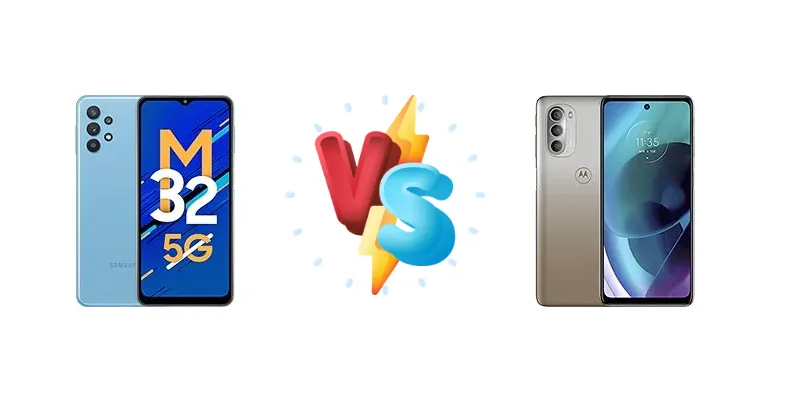
|
🏆 Quick Verdict
For the average user prioritizing sustained performance and a slightly more refined software experience, the Samsung Galaxy M32 5G emerges as the better choice. Its Mediatek Dimensity 720, built on a 7nm process, offers a performance edge over the Motorola Moto G51 5G’s Snapdragon 480+, despite the latter’s slightly higher clock speeds.
| PHONES | ||
|---|---|---|
| Phone Names | Samsung Galaxy M32 5G | Motorola Moto G51 5G |
| Network | ||
|---|---|---|
| 2G bands | GSM 850 / 900 / 1800 / 1900 | GSM 850 / 900 / 1800 / 1900 |
| 3G bands | HSDPA 850 / 900 / 1700(AWS) / 1900 / 2100 | HSDPA 800 / 850 / 900 / 1900 / 2100 - Europe, Asia, Saudi Arabia |
| 4G bands | 1, 2, 3, 4, 5, 7, 8, 12, 17, 20, 26, 28, 38, 40, 41, 66 | 1, 2, 3, 5, 7, 8, 18, 20, 26, 28, 32, 38, 40, 41, 42, 43 - Europe/Asia |
| 5G bands | 1, 3, 5, 7, 8, 20, 28, 38, 40, 41, 66, 78 SA/NSA/Sub6 | 1, 3, 5, 7, 8, 20, 28, 38, 40, 41, 77, 78 SA/NSA/Sub6 - Europe/Asia |
| Speed | HSPA, LTE, 5G | HSPA 42.2/5.76 Mbps, LTE Cat18 1200/150 Mbps, 5G |
| Technology | GSM / HSPA / LTE / 5G | GSM / HSPA / LTE / 5G |
| - | 1, 5, 8, 28, 41, 78 SA/NSA/Sub6 - China | |
| Launch | ||
|---|---|---|
| Announced | 2021, August 25 | 2021, November 03 |
| Status | Available. Released 2021, September 02 | Available. Released 2021, December 16 |
| Body | ||
|---|---|---|
| Build | - | Glass front, plastic frame, plastic back |
| Dimensions | 164.2 x 76.1 x 9.1 mm (6.46 x 3.00 x 0.36 in) | 170.5 x 76.5 x 9.1 mm (6.71 x 3.01 x 0.36 in) |
| SIM | Nano-SIM + Nano-SIM | Nano-SIM + Nano-SIM |
| Weight | 205 g (7.23 oz) | 208 g (7.34 oz) |
| - | Water-repellent design | |
| Display | ||
|---|---|---|
| Resolution | 720 x 1600 pixels, 20:9 ratio (~270 ppi density) | 1080 x 2400 pixels, 20:9 ratio (~387 ppi density) |
| Size | 6.5 inches, 102.0 cm2 (~81.6% screen-to-body ratio) | 6.8 inches, 111.6 cm2 (~85.6% screen-to-body ratio) |
| Type | TFT LCD | IPS LCD, 120Hz |
| Platform | ||
|---|---|---|
| CPU | Octa-core (2x2.0 GHz Cortex-A76 & 6x2.0 GHz Cortex-A55) | Octa-core (2x2.2 GHz Kryo 460 & 6x1.8 GHz Kryo 460) |
| Chipset | Mediatek Dimensity 720 (7 nm) | Qualcomm SM4350-AC Snapdragon 480+ 5G (8 nm) |
| GPU | Mali-G57 MC3 | Adreno 619 |
| OS | Android 11, upgradable to Android 13, One UI 5 | Android 11, upgradable to Android 12 |
| Memory | ||
|---|---|---|
| Card slot | microSDXC (uses shared SIM slot) | microSDXC (uses shared SIM slot) |
| Internal | 128GB 6GB RAM, 128GB 8GB RAM | 64GB 4GB RAM, 64GB 6GB RAM 128GB 4GB RAM, 128GB 6GB RAM, 128GB 8GB RAM |
| eMMC 5.1 | - | |
| Main Camera | ||
|---|---|---|
| Features | LED flash, panorama, HDR | LED flash, HDR, panorama |
| Quad | 48 MP, f/1.8, 26mm (wide), PDAF 8 MP, f/2.2, 123˚ (ultrawide) 5 MP (macro) Auxiliary lens | - |
| Triple | - | 50 MP, f/1.8 (wide), 1/2.76", 0.64µm, PDAF 8 MP, f/2.2, 118˚ (ultrawide), 1/4.0", 1.12µm 2 MP (macro) |
| Video | 4K@30fps, 1080p@30fps | 1080p@30/60/240fps |
| Selfie camera | ||
|---|---|---|
| Single | 13 MP, f/2.2, (wide) | 13 MP, f/2.2, (wide), 1.12µm - Global or 16 MP, f/2.2, (wide), 1.12µm - China only |
| Video | 1080p@30fps | 1080p@30fps |
| Sound | ||
|---|---|---|
| 3.5mm jack | Yes | Yes |
| 35mm jack | Yes | Yes |
| Loudspeaker | Yes | Yes |
| Comms | ||
|---|---|---|
| Bluetooth | 5.0, A2DP, LE, aptX | 5.1, A2DP, LE, aptX HD/Adaptive |
| NFC | Yes | Yes (market/region dependent) |
| Positioning | GPS, GLONASS, BDS, GALILEO | GPS, GLONASS, GALILEO |
| Radio | Unspecified | FM radio |
| USB | USB Type-C 2.0, OTG | USB Type-C 2.0 |
| WLAN | Wi-Fi 802.11 a/b/g/n/ac, dual-band, Wi-Fi Direct | Wi-Fi 802.11 a/b/g/n/ac, dual-band, Wi-Fi Direct |
| Features | ||
|---|---|---|
| Sensors | Fingerprint (side-mounted), accelerometer, gyro, compass | Fingerprint (side-mounted), accelerometer, gyro, proximity, compass |
| Virtual proximity sensing | - | |
| Battery | ||
|---|---|---|
| Charging | 15W wired | 20W wired (India) 10W wired (Global) |
| Type | Li-Ion 5000 mAh | Li-Po 5000 mAh |
| Misc | ||
|---|---|---|
| Colors | Slate Black, Sky Blue | Indigo Blue, Bright Silver, Aqua Blue |
| Models | SM-M326B, SM-M326B/DS | XT2171-2, XT2171-1 |
| Price | About 220 EUR | About 210 EUR |
| SAR | 0.48 W/kg (head) | - |
| Tests | ||
|---|---|---|
| Battery life | - | Endurance rating 124h |
| Camera | - | Photo / Video |
| Display | - | Contrast ratio: 1634:1 |
| Loudspeaker | - | -28.3 LUFS (Average) |
| Performance | - | AnTuTu: 302859 (v9) GeekBench: 1696 (v5.1) GFXBench: 26fps (ES 3.1 onscreen) |
Samsung Galaxy M32 5G
- Potentially better sustained performance due to 7nm Dimensity 720
- Established Samsung software ecosystem
- Likely better image processing in challenging lighting
- Slower 15W charging
- Likely lower peak display brightness
Motorola Moto G51 5G
- Brighter 595 nit display for outdoor visibility
- Faster 20W charging (India) / 10W (Global)
- Cleaner, near-stock Android experience
- Snapdragon 480+ may throttle under sustained load
- Potentially less refined software features
Display Comparison
Both the Samsung Galaxy M32 5G and Motorola Moto G51 5G share a contrast ratio of 1634:1, indicating similar levels of black depth and color vibrancy. However, the Moto G51 5G distinguishes itself with a measured peak brightness of 595 nits, significantly exceeding what’s typically found in this price bracket. This translates to superior visibility under direct sunlight. While the M32 5G’s panel specifications aren’t explicitly stated, it’s likely to offer lower peak brightness. The G51’s brightness advantage is particularly beneficial for outdoor photography and video consumption.
Camera Comparison
Both devices offer a 'Photo / Video' camera experience, but lack detailed specifications in the provided data. Given the market segment, we can assume both rely on primary sensors around the 48MP-50MP range. The Motorola Moto G51 5G’s brighter display could aid in framing shots, but without knowing sensor sizes, apertures, or image processing algorithms, a definitive camera comparison is impossible. It’s reasonable to expect similar image quality in good lighting conditions, with the M32 potentially offering slightly better dynamic range due to Samsung’s image processing expertise. The inclusion of a 2MP macro camera on either device is largely a marketing gimmick and unlikely to deliver significant photographic value.
Performance
The core difference lies in the chipsets: the Samsung Galaxy M32 5G utilizes the Mediatek Dimensity 720 (7nm), while the Motorola Moto G51 5G features the Qualcomm Snapdragon 480+ 5G (8nm). Despite the Snapdragon 480+ having slightly higher peak CPU clock speeds (2.2 GHz vs 2.0 GHz on the M32’s Cortex-A76 cores), the Dimensity 720’s more efficient 7nm fabrication process and Cortex-A76 cores generally translate to better sustained performance and thermal management. The 8nm Snapdragon 480+ may show a slight edge in single-core tasks, but the Dimensity 720 is likely to outperform in multi-threaded workloads and gaming. Both phones feature adequate RAM for their price point, but the chipset is the limiting factor.
Battery Life
Both the Samsung Galaxy M32 5G and Motorola Moto G51 5G boast an endurance rating of 124 hours, suggesting comparable battery life under similar usage patterns. However, charging speeds differ significantly. The Moto G51 5G supports 20W wired charging (in India) and 10W globally, while the M32 5G is limited to 15W. This means the G51 can potentially recharge faster, offsetting any slight battery capacity differences. The faster charging is a tangible benefit for users who frequently find themselves needing a quick top-up.
Buying Guide
Buy the Samsung Galaxy M32 5G if you need a phone capable of handling moderate gaming and multitasking without significant throttling, and value a brand with a more established software ecosystem. Buy the Motorola Moto G51 5G if you prioritize long battery life and a brighter display for outdoor visibility, and prefer a cleaner, near-stock Android experience. The G51 is also a better choice for those who frequently use their phone in direct sunlight.