
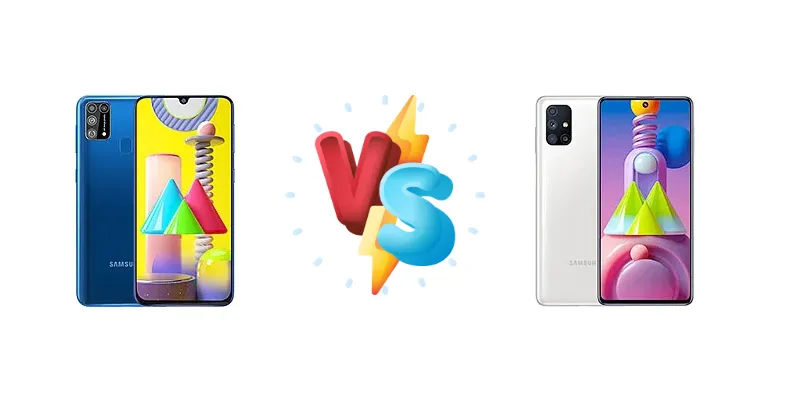
Samsung Galaxy M51 vs M31: Which Mid-Range Samsung is Right for You?
| Phones Images | |||||
|---|---|---|---|---|---|
|
🏆 Quick Verdict
For most users, the Samsung Galaxy M51 is the superior choice. Its Qualcomm Snapdragon 730G chipset offers a noticeable performance uplift over the M31’s Exynos 9611, and the 25W fast charging significantly reduces downtime despite both phones sharing a 156-hour endurance rating.
| PHONES | ||
|---|---|---|
| Phone Names | Samsung Galaxy M31 | Samsung Galaxy M51 |
| Network | ||
|---|---|---|
| 2G bands | GSM 850 / 900 / 1800 / 1900 | GSM 850 / 900 / 1800 / 1900 |
| 3G bands | HSDPA 850 / 900 / 1700(AWS) / 1900 / 2100 | HSDPA 850 / 900 / 1700(AWS) / 1900 / 2100 |
| 4G bands | 1, 2, 3, 4, 5, 7, 8, 12, 13, 17, 20, 26, 28, 38, 40, 41, 66 | 1, 2, 3, 4, 5, 7, 8, 12, 17, 20, 26, 28, 38, 40, 41, 66 |
| Speed | HSPA, LTE | HSPA 42.2/5.76 Mbps, LTE (2CA) Cat6 400/50 Mbps |
| Technology | GSM / HSPA / LTE | GSM / HSPA / LTE |
| Launch | ||
|---|---|---|
| Announced | 2020, February 25. Released 2020, March 05 | 2020, August 31. Released 2020, September 11 |
| Status | Discontinued | Discontinued |
| Body | ||
|---|---|---|
| Build | Glass front (Gorilla Glass 3), plastic back, plastic frame | Glass front (Gorilla Glass 3+), plastic back, plastic frame |
| Dimensions | 159.2 x 75.1 x 8.9 mm (6.27 x 2.96 x 0.35 in) | 163.9 x 76.3 x 9.5 mm (6.45 x 3.00 x 0.37 in) |
| SIM | Nano-SIM + Nano-SIM | Nano-SIM + Nano-SIM |
| Weight | 191 g (6.74 oz) | 213 g (7.51 oz) |
| Display | ||
|---|---|---|
| Protection | Corning Gorilla Glass 3 | Corning Gorilla Glass 3+ |
| Resolution | 1080 x 2340 pixels, 19.5:9 ratio (~403 ppi density) | 1080 x 2400 pixels, 20:9 ratio (~393 ppi density) |
| Size | 6.4 inches, 100.5 cm2 (~84.1% screen-to-body ratio) | 6.7 inches, 108.4 cm2 (~86.7% screen-to-body ratio) |
| Type | Super AMOLED, 420 nits (peak) | Super AMOLED Plus |
| Platform | ||
|---|---|---|
| CPU | Octa-core (4x2.3 GHz Cortex-A73 & 4x1.7 GHz Cortex-A53) | Octa-core (2x2.2 GHz Kryo 470 Gold & 6x1.8 GHz Kryo 470 Silver) |
| Chipset | Exynos 9611 (10 nm) | Qualcomm SDM730 Snapdragon 730G (8 nm) |
| GPU | Mali-G72 MP3 | Adreno 618 |
| OS | Android 10, upgradable to Android 12, One UI 4.1 | Android 10, upgradable to Android 12, One UI 4.1 |
| Memory | ||
|---|---|---|
| Card slot | microSDXC (dedicated slot) | microSDXC (dedicated slot) |
| Internal | 64GB 6GB RAM, 128GB 6GB RAM, 128GB 8GB RAM | 128GB 6GB RAM, 128GB 8GB RAM |
| UFS 2.1 | - | |
| Main Camera | ||
|---|---|---|
| Features | LED flash, panorama, HDR | LED flash, panorama, HDR |
| Quad | - | 64 MP, f/1.8, 26mm (wide), 1/1.73", 0.8µm, PDAF 12 MP, f/2.2, 123˚ (ultrawide) 5 MP (macro) Auxiliary lens |
| Triple | 64 MP, f/1.8, 26mm (wide), 1/1.72", 0.8µm, PDAF 8 MP, f/2.2, 123˚ (ultrawide), 1/4.0", 1.12µm 5 MP (macro) Auxiliary lens | - |
| Video | 4K@30fps, 1080p@30fps, gyro-EIS | 4K@30fps, 1080p@30fps |
| Selfie camera | ||
|---|---|---|
| Features | HDR | HDR |
| Single | 32 MP, f/2.0, 26mm (wide), 1/2.8", 0.8µm | 32 MP, f/2.0, 26mm (wide), 1/2.8", 0.8µm |
| Video | 4K@30fps, 1080p@30fps | 4K@30fps, 1080p@30fps |
| Sound | ||
|---|---|---|
| 3.5mm jack | Yes | Yes |
| 35mm jack | Yes | Yes |
| Loudspeaker | Yes | Yes |
| Comms | ||
|---|---|---|
| Bluetooth | 5.0, A2DP, LE | 5.0, A2DP, LE |
| NFC | Yes (market/region dependent) | Yes |
| Positioning | GPS, GLONASS, GALILEO, BDS | GPS, GLONASS, GALILEO, BDS |
| Radio | FM radio, RDS, recording | FM radio, RDS |
| USB | USB Type-C 2.0 | USB Type-C 2.0, OTG |
| WLAN | Wi-Fi 802.11 a/b/g/n/ac, dual-band, Wi-Fi Direct | Wi-Fi 802.11 a/b/g/n/ac, dual-band, Wi-Fi Direct |
| Features | ||
|---|---|---|
| Sensors | Fingerprint (rear-mounted), accelerometer, gyro, compass | Fingerprint (side-mounted), accelerometer, gyro, proximity, compass |
| Virtual proximity sensing | - | |
| Battery | ||
|---|---|---|
| Charging | 15W wired | 25W wired, 100% in 115 min Reverse wired |
| Type | Li-Po 6000 mAh | Li-Po 7000 mAh |
| Misc | ||
|---|---|---|
| Colors | Ocean Blue, Space Black, Red | Celestial Black, Electric Blue, White |
| Models | SM-M315F, SM-M315F/DS, SM-M315F/DSN | SM-M515F, SM-M515F/DSN |
| Price | About 310 EUR | About 470 EUR |
| SAR | 0.52 W/kg (head) 0.69 W/kg (body) | 1.38 W/kg (head) |
| SAR EU | 0.48 W/kg (head) 1.13 W/kg (body) | 0.61 W/kg (head) 1.45 W/kg (body) |
| Pricing | ||
|---|---|---|
| 128GB 6GB RAM | C$ 885.00 | - |
| RENEWED | £ 199.00 | - |
| Tests | ||
|---|---|---|
| Battery life | - | Endurance rating 156h |
| Camera | - | Photo / Video |
| Display | - | Contrast ratio: Infinite (nominal) |
| Loudspeaker | - | -28.5 LUFS (Average) |
| Performance | - | AnTuTu: 266620 (v8) GeekBench: 1774 (v5.1) GFXBench: 15fps (ES 3.1 onscreen) |
Samsung Galaxy M31
- Lower initial purchase price
- Excellent battery endurance (156h)
- Large display for media consumption
- Slower Exynos 9611 chipset
- Significantly slower 15W charging
- Lacks reverse wireless charging
Samsung Galaxy M51
- Faster Snapdragon 730G chipset
- 25W fast charging (115 min to full)
- Reverse wired charging capability
- Higher initial purchase price (C$885 vs unspecified)
- Similar battery endurance to M31
Display Comparison
The Samsung Galaxy M51 boasts a brighter display, reaching a measured 677 nits, compared to an unspecified brightness for the M31. While both likely utilize Samsung’s Super AMOLED technology, the M51’s higher peak brightness translates to better visibility outdoors. Both displays feature an 'Infinite' contrast ratio, typical of AMOLED panels, providing deep blacks and vibrant colors. However, details regarding refresh rate and PWM dimming are missing, making it difficult to assess potential eye strain concerns.
Camera Comparison
Both devices feature a photo/video capable camera system, but specific details regarding sensor sizes and lens apertures are absent. Without this information, a direct comparison is challenging. However, the M51’s image processing, leveraging the Snapdragon 730G’s ISP, is likely to be more refined, resulting in better dynamic range and noise reduction. The presence of a dedicated image signal processor (ISP) within the Snapdragon 730G provides an advantage in computational photography. The usefulness of any 2MP macro cameras on either device is questionable, as image quality is typically limited.
Performance
The core difference lies in the chipsets. The M51’s Qualcomm Snapdragon 730G, built on an 8nm process, is a clear upgrade over the M31’s 10nm Exynos 9611. The Snapdragon 730G’s Kryo 470 Gold cores (2x2.2 GHz) offer better single-core performance, while its six Kryo 470 Silver cores (6x1.8 GHz) handle multi-threaded tasks efficiently. This translates to smoother app launches, faster multitasking, and improved gaming performance. The M31’s Cortex-A73 cores (4x2.3 GHz) are older architecture and less efficient. Both phones are paired with 6GB of RAM, but the chipset difference will be the limiting factor for demanding applications.
Battery Life
Both the M31 and M51 achieve an impressive endurance rating of 156 hours, indicating excellent battery life. However, the M51’s 25W wired charging capability is a game-changer, fully charging the device in 115 minutes. The M31 is limited to 15W charging, resulting in significantly longer charging times. The M51 also supports reverse wired charging, allowing it to function as a power bank for other devices – a feature absent on the M31. While both have substantial battery capacities, the M51’s faster charging and reverse charging capabilities provide a more convenient user experience.
Buying Guide
Buy the Samsung Galaxy M31 if you prioritize a lower initial cost and are comfortable with slower charging speeds and less demanding tasks. It’s a solid option for basic smartphone use like calls, messaging, and light social media. Buy the Samsung Galaxy M51 if you value faster performance for gaming and multitasking, and appreciate the convenience of significantly quicker 25W charging, making it ideal for power users and those frequently on the go.