
OnePlus Nord 5 vs Samsung Galaxy M31: A Deep Dive into Performance and Value
| Phones Images | |||||
|---|---|---|---|---|---|
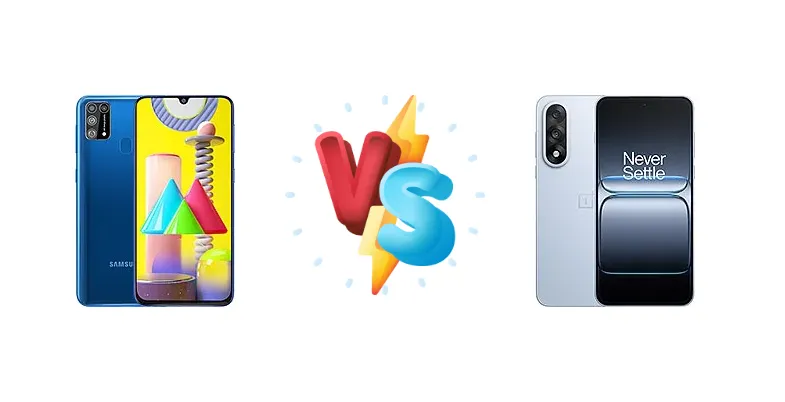
|
🏆 Quick Verdict
For most users, the OnePlus Nord 5 is the clear winner. Its Snapdragon 8s Gen 3 chipset delivers substantially superior performance and efficiency, coupled with incredibly fast 80W charging. While the M31 remains a budget-friendly option, the Nord 5’s advancements justify the price difference.
| PHONES | ||
|---|---|---|
| Phone Names | Samsung Galaxy M31 | OnePlus Nord 5 |
| Network | ||
|---|---|---|
| 2G bands | GSM 850 / 900 / 1800 / 1900 | GSM 850 / 900 / 1800 / 1900 |
| 3G bands | HSDPA 850 / 900 / 1700(AWS) / 1900 / 2100 | HSDPA 850 / 900 / 1900 / 2100 |
| 4G bands | 1, 2, 3, 4, 5, 7, 8, 12, 13, 17, 20, 26, 28, 38, 40, 41, 66 | 1, 2, 3, 4, 5, 7, 8, 12, 17, 18, 19, 20, 26, 28, 32, 38, 39, 40, 41, 42, 66 - International |
| 5G bands | - | 1, 2, 3, 5, 7, 8, 12, 20, 28, 38, 40, 41, 66, 75, 77, 78 SA/NSA - International |
| Speed | HSPA, LTE | HSPA, LTE, 5G |
| Technology | GSM / HSPA / LTE | GSM / HSPA / LTE / 5G |
| Launch | ||
|---|---|---|
| Announced | 2020, February 25. Released 2020, March 05 | 2025, July 08 |
| Status | Discontinued | Available. Released 2025, July 08 |
| Body | ||
|---|---|---|
| Build | Glass front (Gorilla Glass 3), plastic back, plastic frame | Glass front (Gorilla Glass 7i), glass back, plastic frame |
| Dimensions | 159.2 x 75.1 x 8.9 mm (6.27 x 2.96 x 0.35 in) | 163.4 x 77 x 8.1 mm (6.43 x 3.03 x 0.32 in) |
| SIM | Nano-SIM + Nano-SIM | Nano-SIM + Nano-SIM |
| Weight | 191 g (6.74 oz) | 211 g (7.44 oz) |
| Display | ||
|---|---|---|
| Protection | Corning Gorilla Glass 3 | Corning Gorilla Glass 7i, Mohs level 6 |
| Resolution | 1080 x 2340 pixels, 19.5:9 ratio (~403 ppi density) | 1272 x 2800 pixels (~450 ppi density) |
| Size | 6.4 inches, 100.5 cm2 (~84.1% screen-to-body ratio) | 6.83 inches, 113.3 cm2 (~90.1% screen-to-body ratio) |
| Type | Super AMOLED, 420 nits (peak) | Swift AMOLED, 1B colors, 144Hz, 3840Hz PWM, HDR10+, 800 nits (typ), 1400 nits (HBM), 1800 nits (peak) |
| Platform | ||
|---|---|---|
| CPU | Octa-core (4x2.3 GHz Cortex-A73 & 4x1.7 GHz Cortex-A53) | Octa-core (1x3.0 GHz Cortex-X4 & 4x2.8 GHz Cortex-A720 & 3x2.0 GHz Cortex-A520) |
| Chipset | Exynos 9611 (10 nm) | Qualcomm SM8635 Snapdragon 8s Gen 3 (4 nm) |
| GPU | Mali-G72 MP3 | Adreno 735 |
| OS | Android 10, upgradable to Android 12, One UI 4.1 | Android 15, up to 4 major Android upgrades, OxygenOS 15 |
| Memory | ||
|---|---|---|
| Card slot | microSDXC (dedicated slot) | No |
| Internal | 64GB 6GB RAM, 128GB 6GB RAM, 128GB 8GB RAM | 256GB 8GB RAM, 256GB 12GB RAM, 512GB 12GB RAM |
| UFS 2.1 | - | |
| Main Camera | ||
|---|---|---|
| Dual | - | 50 MP, f/1.8, 24mm (wide), 1/1.56", 1.0µm, PDAF, OIS 8 MP, f/2.2, 15mm, 116˚ (ultrawide), 1/4.0", 1.12µm, AF |
| Features | LED flash, panorama, HDR | LED flash, Ultra HDR, panorama |
| Triple | 64 MP, f/1.8, 26mm (wide), 1/1.72", 0.8µm, PDAF 8 MP, f/2.2, 123˚ (ultrawide), 1/4.0", 1.12µm 5 MP (macro) Auxiliary lens | - |
| Video | 4K@30fps, 1080p@30fps, gyro-EIS | 4K@30/60fps, 1080p@30/60/120fps, gyro-EIS |
| Selfie camera | ||
|---|---|---|
| Features | HDR | Panorama |
| Single | 32 MP, f/2.0, 26mm (wide), 1/2.8", 0.8µm | 50 MP, f/2.0, 21mm (wide), 1/2.76", 0.64µm, AF |
| Video | 4K@30fps, 1080p@30fps | 4K@30/60fps, 1080p@30/60fps; gyro-EIS |
| Sound | ||
|---|---|---|
| 3.5mm jack | Yes | - |
| 35mm jack | Yes | No |
| Loudspeaker | Yes | Yes, with stereo speakers |
| Comms | ||
|---|---|---|
| Bluetooth | 5.0, A2DP, LE | 5.4, A2DP, LE, aptX HD, LHDC 5 |
| Infrared port | - | Yes |
| NFC | Yes (market/region dependent) | Yes |
| Positioning | GPS, GLONASS, GALILEO, BDS | GPS, GLONASS, GALILEO, BDS, QZSS, NavIC |
| Radio | FM radio, RDS, recording | No |
| USB | USB Type-C 2.0 | USB Type-C 2.0 |
| WLAN | Wi-Fi 802.11 a/b/g/n/ac, dual-band, Wi-Fi Direct | Wi-Fi 802.11 a/b/g/n/ac/6, dual-band, Wi-Fi Direct |
| Features | ||
|---|---|---|
| Sensors | Fingerprint (rear-mounted), accelerometer, gyro, compass | Fingerprint (under display, optical), accelerometer, gyro, proximity, compass |
| Virtual proximity sensing | - | |
| Battery | ||
|---|---|---|
| Charging | 15W wired | 80W wired, 33W PPS, 18W PD, 100% in just 54 min 5W reverse wired Bypass charging |
| Type | Li-Po 6000 mAh | Market-dependent versions:· 5200 mAh (Europe)· 6800 mAh (Global) |
| Misc | ||
|---|---|---|
| Colors | Ocean Blue, Space Black, Red | Phantom Grey, Dry Ice, Marble Sands |
| Models | SM-M315F, SM-M315F/DS, SM-M315F/DSN | CPH2709 |
| Price | About 310 EUR | £ 339.00 / € 294.97 / ₹ 31,998 |
| SAR | 0.52 W/kg (head) 0.69 W/kg (body) | 1.18 W/kg (head) 0.90 W/kg (body) |
| SAR EU | 0.48 W/kg (head) 1.13 W/kg (body) | - |
| Pricing | ||
|---|---|---|
| 128GB 6GB RAM | C$ 885.00 | - |
| RENEWED | £ 199.00 | - |
| EU LABEL | ||
|---|---|---|
| Battery | - | 49:12h endurance, 1200 cycles |
| Energy | - | Class B |
| Free fall | - | Class C (90 falls) |
| Repairability | - | Class B |
Samsung Galaxy M31
- Lower price point
- Potentially larger display size (unconfirmed)
- Acceptable performance for basic tasks
- Outdated Exynos 9611 chipset
- Slow 15W charging
- Likely inferior display quality
OnePlus Nord 5
- Powerful Snapdragon 8s Gen 3 chipset
- Ultra-fast 80W charging
- Bright and vibrant display (1330 nits)
- Excellent battery endurance
- Higher price tag
- May lack expandable storage (unconfirmed)
- Potentially smaller display size
Display Comparison
The OnePlus Nord 5 boasts a significantly brighter display, peaking at 1330 nits, compared to the Galaxy M31’s unspecified brightness. This translates to vastly improved visibility outdoors. While the M31’s panel size isn’t specified, the Nord 5’s superior brightness and likely higher contrast ratio (given its newer technology) offer a more immersive viewing experience. The Nord 5’s display technology is likely AMOLED, offering vibrant colors, while the M31 likely uses an IPS LCD panel.
Camera Comparison
Without detailed camera specifications for the M31 beyond its market segment, a direct comparison is limited. However, the OnePlus Nord 5 is expected to feature a more advanced camera system, leveraging the image signal processor (ISP) within the Snapdragon 8s Gen 3. The ISP enables faster image processing, improved low-light performance, and potentially more sophisticated computational photography features. The M31 likely relies on older image processing algorithms, resulting in less detail and dynamic range in challenging conditions. The absence of OIS information for the M31 suggests it may lack optical image stabilization, further disadvantaging it in low-light scenarios.
Performance
The core difference lies in the chipsets. The Samsung Galaxy M31’s Exynos 9611 (10nm) is a capable but aging processor, utilizing a mix of Cortex-A73 and A53 cores. The OnePlus Nord 5’s Snapdragon 8s Gen 3 (4nm) represents a massive leap forward. The 4nm process node provides significantly better power efficiency, reducing thermal throttling during sustained workloads. The Nord 5’s CPU configuration – a Cortex-X4 prime core alongside A720 and A520 cores – delivers substantially higher single-core and multi-core performance. This will be noticeable in everything from app launch times to demanding games.
Battery Life
The OnePlus Nord 5’s battery endurance of 49:12h and active use score of 13:47h demonstrate superior efficiency, despite potentially having a similar capacity to the M31 (which is not specified). The key differentiator is the charging speed. The Nord 5’s 80W wired charging, alongside 33W PPS and 18W PD support, can fully charge the device in just 54 minutes. The M31’s 15W charging is significantly slower, requiring considerably longer to reach a full charge. The Nord 5 also offers 5W reverse wired charging, a feature absent on the M31.
Buying Guide
Buy the Samsung Galaxy M31 if you prioritize extreme budget-friendliness and a large display for media consumption, accepting compromises in performance and charging speed. Buy the OnePlus Nord 5 if you demand a smooth, responsive experience for gaming and demanding apps, and value the convenience of incredibly fast charging and a brighter, more modern display.