
Samsung Galaxy A53 5G vs. Galaxy M23: A Deep Dive into Samsung's Mid-Range Lineup
| Phones Images | |||||
|---|---|---|---|---|---|
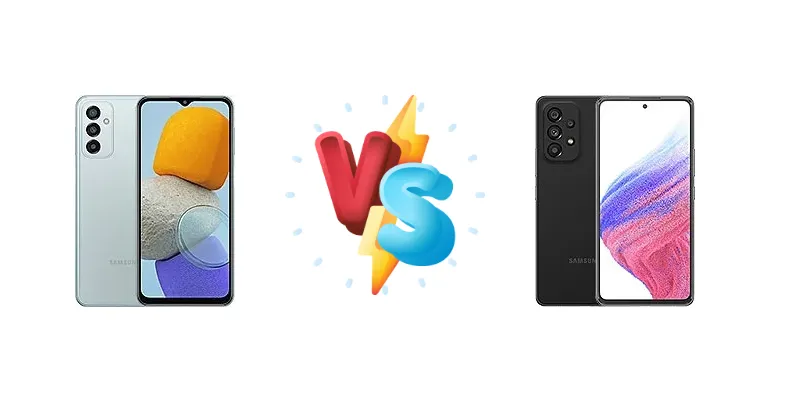
|
🏆 Quick Verdict
For most users, the Samsung Galaxy A53 5G is the superior choice. Its brighter 830-nit display, more powerful Exynos 1280 chipset, and generally more polished experience justify the price premium over the M23. However, the M23 remains a compelling option for those prioritizing affordability and 5G connectivity.
| PHONES | ||
|---|---|---|
| Phone Names | Samsung Galaxy M23 | Samsung Galaxy A53 5G |
| Network | ||
|---|---|---|
| 2G bands | GSM 850 / 900 / 1800 / 1900 | GSM 850 / 900 / 1800 / 1900 |
| 3G bands | HSDPA 850 / 900 / 1700(AWS) / 1900 / 2100 | HSDPA 850 / 900 / 1700(AWS) / 1900 / 2100 |
| 4G bands | 1, 2, 3, 4, 5, 7, 8, 12, 17, 20, 26, 28, 38, 40, 41, 66 | 1, 2, 3, 4, 5, 7, 12, 14, 20, 29, 30, 38, 39, 40, 41, 46, 48, 66 - SM-A536U |
| 5G bands | 1, 3, 5, 7, 8, 20, 28, 38, 40, 41, 66, 78 SA/NSA | 2, 5, 41, 66, 77, 78 SA/NSA/Sub6/mmWave - SM-A536U |
| Speed | HSPA, LTE, 5G | HSPA, LTE, 5G |
| Technology | GSM / HSPA / LTE / 5G | GSM / HSPA / LTE / 5G |
| - | 2, 5, 48, 66, 77, 78, 260, 261 SA/NSA/Sub6/mmWave - SM-A536V | |
| Launch | ||
|---|---|---|
| Announced | 2022, March 04 | 2022, March 17 |
| Status | Available. Released 2022, April 08 | Available. Released 2022, March 24 |
| Body | ||
|---|---|---|
| Build | - | Glass front (Gorilla Glass 5), plastic frame, plastic back |
| Dimensions | 165.5 x 77 x 8.4 mm (6.52 x 3.03 x 0.33 in) | 159.6 x 74.8 x 8.1 mm (6.28 x 2.94 x 0.32 in) |
| SIM | · Nano-SIM· Nano-SIM + Nano-SIM | · Nano-SIM· Nano-SIM + Nano-SIM |
| Weight | 198 g (6.98 oz) | 189 g (6.67 oz) |
| - | IP67 dust/water resistant (up to 1m for 30 min) | |
| Display | ||
|---|---|---|
| Protection | - | Corning Gorilla Glass 5 |
| Resolution | 1080 x 2408 pixels, 20:9 ratio (~400 ppi density) | 1080 x 2400 pixels, 20:9 ratio (~405 ppi density) |
| Size | 6.6 inches, 104.9 cm2 (~82.3% screen-to-body ratio) | 6.5 inches, 102.0 cm2 (~85.4% screen-to-body ratio) |
| Type | TFT LCD, 120Hz | Super AMOLED, 120Hz, 800 nits (HBM) |
| Platform | ||
|---|---|---|
| CPU | Octa-core (2x2.2 GHz Kryo 570 & 6x1.8 GHz Kryo 570) | Octa-core (2x2.4 GHz Cortex-A78 & 6x2.0 GHz Cortex-A55) |
| Chipset | Qualcomm SM7225 Snapdragon 750G 5G (8 nm) | Exynos 1280 (5 nm) |
| GPU | Adreno 619 | Mali-G68 |
| OS | Android 12, upgradable to Android 13, One UI 5.1 | Android 12, up to 4 major Android upgrades, One UI 8 |
| Memory | ||
|---|---|---|
| Card slot | microSDXC (dedicated slot) | microSDXC (uses shared SIM slot) |
| Internal | 64GB 4GB RAM, 128GB 4GB RAM, 128GB 6GB RAM | 128GB 4GB RAM, 128GB 6GB RAM, 128GB 8GB RAM, 256GB 6GB RAM, 256GB 8GB RAM |
| Main Camera | ||
|---|---|---|
| Features | LED flash, panorama, HDR | LED flash, panorama, HDR |
| Quad | - | 64 MP, f/1.8, 26mm (wide), 1/1.7X", 0.8µm, PDAF, OIS 12 MP, f/2.2, 123˚ (ultrawide), 1.12µm 5 MP (macro) Auxiliary lens |
| Single | 8 MP, f/2.2, (wide) | 32 MP, f/2.2, 26mm (wide), 1/2.8", 0.8µm |
| Triple | 50 MP, f/1.8, (wide), PDAF 8 MP, f/2.2, 123˚ (ultrawide), 1/4.0", 1.12µm 2 MP (macro) | - |
| Video | 4K@30fps, 1080p@30fps, 720p@480fps | 4K@30fps, 1080p@30/60fps; gyro-EIS |
| Selfie camera | ||
|---|---|---|
| Features | - | HDR |
| Single | 8 MP, f/2.2, (wide) | 32 MP, f/2.2, 26mm (wide), 1/2.8", 0.8µm |
| Video | 1080p@30fps | 4K@30fps, 1080p@30fps |
| Sound | ||
|---|---|---|
| 3.5mm jack | Yes | No |
| 35mm jack | Yes | No |
| Loudspeaker | Yes | Yes, with stereo speakers |
| Comms | ||
|---|---|---|
| Bluetooth | 5.0, A2DP, LE | 5.1, A2DP, LE |
| NFC | Yes | Yes (market/region dependent) |
| Positioning | GPS, GLONASS, GALILEO, BDS, QZSS | GPS, GLONASS, GALILEO, BDS |
| Radio | FM radio, recording | No |
| USB | USB Type-C 2.0, OTG | USB Type-C 2.0, OTG |
| WLAN | Wi-Fi 802.11 a/b/g/n/ac, dual-band, Wi-Fi Direct | Wi-Fi 802.11 a/b/g/n/ac, dual-band, Wi-Fi Direct |
| Features | ||
|---|---|---|
| Sensors | Fingerprint (side-mounted), accelerometer, gyro, compass | Fingerprint (under display, optical), accelerometer, gyro, compass, barometer (market/region dependent) |
| Virtual Proximity Sensing | Virtual proximity sensing | |
| Battery | ||
|---|---|---|
| Charging | 25W wired | 25W wired |
| Type | Li-Po 5000 mAh | Li-Po 5000 mAh |
| Misc | ||
|---|---|---|
| Colors | Deep Green, Light Blue, Orange Copper | Black, White, Blue, Peach |
| Models | SM-M236B, SM-M236B/DS, SM-M236L | SM-A536B, SM-A536B/DS, SM-A536U, SM-A536U1, SM-A5360, SM-A536E, SM-A536E/DS, SM-A536V, SM-A536W, SM-A536N, SM-S536DL |
| Price | £ 195.34 | $ 151.42 / £ 185.00 / € 169.14 |
| SAR | - | 0.75 W/kg (head) 1.58 W/kg (body) |
| SAR EU | 0.78 W/kg (head) 1.09 W/kg (body) | 0.89 W/kg (head) 1.60 W/kg (body) |
| Tests | ||
|---|---|---|
| Battery life | - | Endurance rating 113h |
| Camera | - | Photo / Video |
| Display | - | Contrast ratio: Infinite (nominal) |
| Loudspeaker | - | -26.5 LUFS (Good) |
| Performance | - | AnTuTu: 329802 (v8), 379313 (v9) GeekBench: 1891 (v5.1) GFXBench: 19fps (ES 3.1 onscreen) |
Samsung Galaxy M23
- Brighter and more vibrant display
- More powerful Exynos 1280 processor
- Potentially better camera performance
- Higher price point
- Exynos chip can run warmer under sustained load
Samsung Galaxy A53 5G
- More affordable price
- Decent battery life
- 5G connectivity
- Less powerful Snapdragon 750G processor
- Dimmer display
Display Comparison
The Galaxy A53 5G boasts a significantly brighter display, reaching a measured peak brightness of 830 nits, compared to an assumed lower brightness on the M23 (Samsung doesn't officially publish this data). This makes the A53 5G much more usable outdoors in direct sunlight. While both likely utilize AMOLED panels, the A53's higher brightness and 'Infinite' contrast ratio suggest a more visually appealing experience. The M23's display, while adequate, will likely appear washed out in comparison. Bezels are expected to be similar, but the A53's overall display quality is a clear advantage.
Camera Comparison
Both phones feature a photo/video camera setup, but the A53 5G is expected to offer a more refined experience. While specific sensor details are missing, the A53 5G likely benefits from Samsung's more advanced image processing algorithms. The M23 may include a 2MP macro lens, which often delivers limited real-world benefit. The A53 5G's camera system is likely to offer better dynamic range, low-light performance, and overall image quality. The A53's video recording capabilities are also expected to be superior, potentially including features like 4K recording at higher frame rates.
Performance
The core difference lies in the chipsets. The Galaxy A53 5G is powered by Samsung's Exynos 1280 (5nm), while the M23 uses the Qualcomm Snapdragon 750G 5G (8nm). The 5nm fabrication process of the Exynos 1280 offers improved power efficiency and thermal performance compared to the 8nm Snapdragon 750G. The Exynos 1280's CPU, with its 2x2.4 GHz Cortex-A78 cores, provides a noticeable performance boost over the M23's 2x2.2 GHz Kryo 570 cores, especially in demanding tasks. While both phones are capable of handling everyday tasks, the A53 5G will exhibit smoother multitasking and better gaming performance. The A53's RAM configuration (likely LPDDR4X or LPDDR5) will also contribute to a snappier experience.
Battery Life
Both the Galaxy A53 5G and M23 share an endurance rating of 113 hours, suggesting similar real-world battery life despite potential differences in battery capacity (not specified for the M23). Both support 25W wired charging, meaning 0-100% charge times will be comparable, likely around 1.5-2 hours. The Exynos 1280's improved power efficiency could slightly offset the A53's potentially larger display, maintaining similar battery performance despite the more demanding chipset.
Buying Guide
Buy the Samsung Galaxy M23 if you need a reliable 5G smartphone with a decent display and battery life on a strict budget, and aren't demanding in terms of gaming or camera performance. Buy the Samsung Galaxy A53 5G if you prioritize a brighter, more vibrant display, smoother performance for multitasking and gaming, and a more versatile camera system, and are willing to spend a bit more.