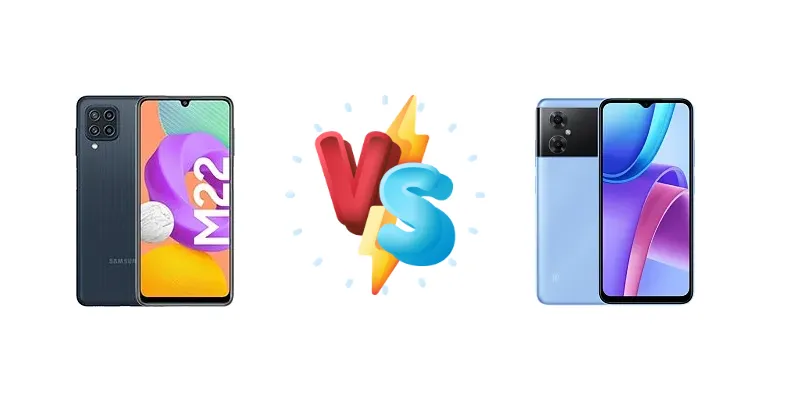
The Samsung Galaxy M22 and Xiaomi Redmi Note 11R represent compelling options in the crowded budget smartphone market. While both aim to deliver essential features at an accessible price, they diverge significantly in their core hardware, particularly in their chipsets. This comparison dissects those differences, focusing on real-world performance implications for everyday users and gamers.
🏆 Quick Verdict
For most users, the Xiaomi Redmi Note 11R emerges as the stronger choice. Its Mediatek Dimensity 700, built on a more efficient 7nm process, provides a noticeable performance uplift over the Galaxy M22’s Helio G80, translating to smoother multitasking and better gaming experiences. While the M22 offers faster 25W charging, the 11R’s superior processing power is a more impactful advantage.
| Network |
|---|
| 2G bands | GSM 850 / 900 / 1800 / 1900 | GSM 850 / 900 / 1800 / 1900 |
| 3G bands | HSDPA 850 / 900 / 1700(AWS) / 1900 / 2100 | HSDPA 850 / 900 / 1900 / 2100 |
| 4G bands | 1, 2, 3, 4, 5, 7, 8, 12, 17, 20, 26, 28, 38, 40, 41, 66 | 1, 3, 5, 7, 8, 34, 38, 39, 40, 41 |
| 5G bands | - | 1, 5, 8, 28, 41, 78 |
| Speed | HSPA, LTE | HSPA, LTE, 5G |
| Technology | GSM / HSPA / LTE | GSM / CDMA / HSPA / LTE / 5G |
| | - | CDMA 800 |
| Launch |
|---|
| Announced | 2021, September 14 | 2022, September 30 |
| Status | Available. Released 2021, October 13 | Available. Released 2022, September 30 |
| Body |
|---|
| Build | Glass front, plastic frame, plastic back | Glass front, plastic frame, plastic back |
| Dimensions | 159.9 x 74 x 8.4 mm (6.30 x 2.91 x 0.33 in) | 164 x 76.1 x 8.9 mm (6.46 x 3.00 x 0.35 in) |
| SIM | Nano-SIM + Nano-SIM | Nano-SIM + Nano-SIM |
| Weight | 186 g (6.56 oz) | 201 g (7.09 oz) |
| Display |
|---|
| Resolution | 720 x 1600 pixels, 20:9 ratio (~274 ppi density) | 1080 x 2408 pixels, 20:9 ratio (~401 ppi density) |
| Size | 6.4 inches, 98.9 cm2 (~83.6% screen-to-body ratio) | 6.58 inches, 104.3 cm2 (~83.6% screen-to-body ratio) |
| Type | Super AMOLED, 90Hz, 600 nits (HDR) | IPS LCD, 90Hz, 400 nits (typ) |
| Platform |
|---|
| CPU | Octa-core (2x2.0 GHz Cortex-A75 & 6x1.8 GHz Cortex-A55) | Octa-core (2x2.2 GHz Cortex-A76 & 6x2.0 GHz Cortex-A55) |
| Chipset | Mediatek MT6769V/CU Helio G80 (12 nm) | Mediatek Dimensity 700 (7 nm) |
| GPU | Mali-G52 MC2 | Mali-G57 MC2 |
| OS | Android 11, upgradable to Android 13, One UI Core 5.1 | Android 12, MIUI 13 |
| Memory |
|---|
| Card slot | microSDXC (dedicated slot) | microSDXC (dedicated slot) |
| Internal | 64GB 4GB RAM, 128GB 4GB RAM, 128GB 6GB RAM | 128GB 4GB RAM, 128GB 6GB RAM, 128GB 8GB RAM |
| | eMMC 5.1 | UFS 2.2 |
| Main Camera |
|---|
| Dual | - | 13 MP, f/2.2, (wide), PDAF
Auxiliary lens |
| Features | LED flash, panorama, HDR | LED flash, HDR, panorama |
| Quad | 48 MP, f/2.0, (wide), PDAF, OIS
8 MP, f/2.2, 123˚ (ultrawide), 1/4.0", 1.12µm
2 MP (macro)
Auxiliary lens | - |
| Single | 13 MP, f/2.2, (wide), 1/3.1", 1.12µm | - |
| Video | 1080p@30fps | 1080p@30fps |
| Selfie camera |
|---|
| Features | - | HDR |
| Single | 13 MP, f/2.2, (wide), 1/3.1", 1.12µm | 5 MP, f/2.2, (wide) |
| Video | 1080p@30fps | 1080p@30fps |
| Sound |
|---|
| 3.5mm jack | Yes | Yes |
| 35mm jack | Yes | Yes |
| Loudspeaker | Yes | Yes |
| | - | 24-bit/192kHz audio |
| Comms |
|---|
| Bluetooth | 5.0, A2DP, LE | 5.1, A2DP, LE |
| Infrared port | - | Yes |
| NFC | Yes | No |
| Positioning | GPS, GLONASS, GALILEO, BDS | GPS, GLONASS, GALILEO, BDS |
| Radio | Unspecified | No |
| USB | USB Type-C 2.0 | USB Type-C 2.0, OTG |
| WLAN | Wi-Fi 802.11 a/b/g/n/ac, dual-band, Wi-Fi Direct | Wi-Fi 802.11 a/b/g/n/ac, dual-band, Wi-Fi Direct |
| Features |
|---|
| Sensors | Fingerprint (side-mounted), unspecified sensors | Fingerprint (side-mounted), accelerometer, proximity, compass |
| Battery |
|---|
| Charging | 25W wired | 18W wired |
| Type | Li-Po 5000 mAh | Li-Po 5000 mAh |
| Misc |
|---|
| Colors | Black, White, Light Blue | Black, Blue, Gray |
| Models | SM-M225FV, SM-M225FV/DS | 22095RA98C |
| Price | About 230 EUR | About 160 EUR |
| SAR EU | 0.62 W/kg (head) 1.24 W/kg (body) | - |
Samsung Galaxy M22
- Faster 25W wired charging
- Potentially longer battery life due to efficient software
- Samsung’s established brand reputation
- Older, less efficient Helio G80 chipset
- Likely lower performance in demanding tasks
- Potentially slower software updates
Xiaomi Redmi Note 11R
- More powerful and efficient Dimensity 700 chipset
- Smoother multitasking and gaming experience
- Modern 7nm process technology
- Slower 18W wired charging
- Xiaomi’s MIUI software can be polarizing
- Potentially less refined build quality
Display Comparison
Neither device boasts a standout display. Both likely utilize LCD panels, a common cost-saving measure in this segment. However, detailed display specs (resolution, brightness, color gamut) are missing. The focus here is on internal components. The absence of high refresh rate panels on either device suggests a prioritization of battery life over visual fluidity.
Camera Comparison
Without detailed camera specifications (sensor size, aperture), a direct comparison is limited. However, it’s reasonable to assume both phones employ similar budget camera setups. The focus is likely on a primary sensor with supporting lenses for depth and macro photography. Image processing will play a crucial role, and Xiaomi’s software tends to favor more vibrant, saturated images, while Samsung often aims for more natural color reproduction. The absence of Optical Image Stabilization (OIS) on either device suggests image stabilization will rely on software algorithms.
Performance
The core difference lies in the chipsets. The Xiaomi Redmi Note 11R’s Mediatek Dimensity 700 (7nm) is a significant upgrade over the Samsung Galaxy M22’s Mediatek Helio G80 (12nm). The 7nm process inherently offers better power efficiency, meaning the 11R will generate less heat under load and potentially sustain peak performance for longer. The Dimensity 700’s CPU configuration – 2x2.2 GHz Cortex-A76 cores – also represents a step up in individual core performance compared to the M22’s 2x2.0 GHz Cortex-A75 cores. This translates to faster app launch times, smoother scrolling, and a more responsive user experience. While both have 6x Cortex-A55 efficiency cores, the Dimensity 700’s superior architecture will still provide an advantage in multi-tasking scenarios.
Battery Life
The Samsung Galaxy M22’s 25W wired charging is a clear advantage over the Redmi Note 11R’s 18W charging. This means the M22 will likely charge from 0-100% faster. However, battery capacity isn’t specified for either device. The Dimensity 700’s superior power efficiency could offset a potentially smaller battery in the Redmi Note 11R, resulting in comparable real-world battery life. The faster charging of the M22 is beneficial for users who frequently need to top up their phone quickly.
Buying Guide
Buy the Samsung Galaxy M22 if you prioritize faster charging speeds and are primarily focused on basic smartphone tasks like calling, texting, and light social media use. Buy the Xiaomi Redmi Note 11R if you value smoother performance for multitasking, enjoy mobile gaming, and appreciate a more modern chipset architecture that offers better long-term efficiency and potential software support.
Frequently Asked Questions
❓ Will the Redmi Note 11R struggle with graphically intensive games like PUBG Mobile?
The Dimensity 700 is capable of running PUBG Mobile, but you’ll likely need to use medium graphics settings for a consistently smooth experience. The Helio G80 in the Galaxy M22 will likely require even lower settings, and may exhibit more frame drops during intense firefights.
❓ How much faster is the charging on the Galaxy M22 compared to the Redmi Note 11R in real-world use?
Expect the Galaxy M22 to gain approximately 15-20% more charge in the same amount of time due to its 25W charging capability. A full charge from 0% could take around 90-120 minutes on the M22, while the Redmi Note 11R might take closer to 120-150 minutes.
❓ Does the Dimensity 700 in the Redmi Note 11R support 5G connectivity?
Yes, the Mediatek Dimensity 700 is a 5G-enabled chipset. This means the Redmi Note 11R can connect to 5G networks, offering significantly faster data speeds where available, unlike the Galaxy M22 which is likely limited to 4G.