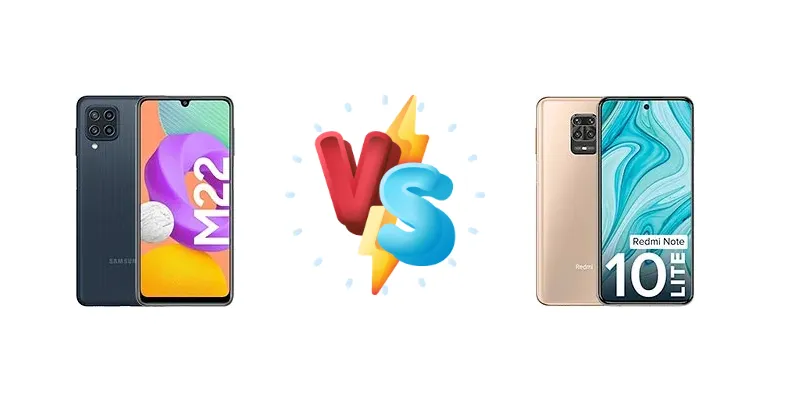
Both the Samsung Galaxy M22 and the Xiaomi Redmi Note 10 Lite occupy the competitive sub-$200 smartphone segment. While both aim to deliver essential features at an accessible price, they diverge significantly in their core processing power and charging capabilities, making the choice less straightforward than it appears. This comparison dissects these differences to reveal which device offers the best overall experience.
🏆 Quick Verdict
For the average user prioritizing sustained performance and efficient power management, the Xiaomi Redmi Note 10 Lite is the better choice. Its Snapdragon 720G, built on an 8nm process, provides a noticeable advantage over the Galaxy M22’s 12nm Helio G80, especially during demanding tasks and prolonged gaming sessions. While the M22 boasts faster 25W charging, the Redmi Note 10 Lite’s efficiency mitigates the charging speed difference.
| Network |
|---|
| 2G bands | GSM 850 / 900 / 1800 / 1900 | GSM 850 / 900 / 1800 / 1900 |
| 3G bands | HSDPA 850 / 900 / 1700(AWS) / 1900 / 2100 | HSDPA 850 / 900 / 1700(AWS) / 1900 / 2100 |
| 4G bands | 1, 2, 3, 4, 5, 7, 8, 12, 17, 20, 26, 28, 38, 40, 41, 66 | 1, 2, 3, 4, 5, 7, 8, 20, 28, 38, 40, 41 |
| Speed | HSPA, LTE | HSPA, LTE |
| Technology | GSM / HSPA / LTE | GSM / HSPA / LTE |
| Launch |
|---|
| Announced | 2021, September 14 | 2021, October 01 |
| Status | Available. Released 2021, October 13 | Available. Released 2021, October 02 |
| Body |
|---|
| Build | Glass front, plastic frame, plastic back | Glass front (Gorilla Glass 5), glass back (Gorilla Glass 5), plastic frame |
| Dimensions | 159.9 x 74 x 8.4 mm (6.30 x 2.91 x 0.33 in) | 165.8 x 76.7 x 8.8 mm (6.53 x 3.02 x 0.35 in) |
| SIM | Nano-SIM + Nano-SIM | Nano-SIM + Nano-SIM |
| Weight | 186 g (6.56 oz) | 209 g (7.37 oz) |
| | - | Water-repellent coating |
| Display |
|---|
| Protection | - | Corning Gorilla Glass 5 |
| Resolution | 720 x 1600 pixels, 20:9 ratio (~274 ppi density) | 1080 x 2400 pixels, 20:9 ratio (~395 ppi density) |
| Size | 6.4 inches, 98.9 cm2 (~83.6% screen-to-body ratio) | 6.67 inches, 107.4 cm2 (~84.5% screen-to-body ratio) |
| Type | Super AMOLED, 90Hz, 600 nits (HDR) | IPS LCD |
| Platform |
|---|
| CPU | Octa-core (2x2.0 GHz Cortex-A75 & 6x1.8 GHz Cortex-A55) | Octa-core (2x2.3 GHz Kryo 465 Gold & 6x1.8 GHz Kryo 465 Silver) |
| Chipset | Mediatek MT6769V/CU Helio G80 (12 nm) | Qualcomm SM7125 Snapdragon 720G (8 nm) |
| GPU | Mali-G52 MC2 | Adreno 618 |
| OS | Android 11, upgradable to Android 13, One UI Core 5.1 | Android 10, MIUI 11 |
| Memory |
|---|
| Card slot | microSDXC (dedicated slot) | microSDXC (dedicated slot) |
| Internal | 64GB 4GB RAM, 128GB 4GB RAM, 128GB 6GB RAM | 64GB 4GB RAM, 64GB 6GB RAM, 128GB 4GB RAM, 128GB 6GB RAM |
| | eMMC 5.1 | - |
| Main Camera |
|---|
| Features | LED flash, panorama, HDR | LED flash, HDR, panorama |
| Quad | 48 MP, f/2.0, (wide), PDAF, OIS
8 MP, f/2.2, 123˚ (ultrawide), 1/4.0", 1.12µm
2 MP (macro)
Auxiliary lens | 48 MP, f/1.9, 26mm (wide), 0.8µm, PDAF
8 MP, f/2.2, 119˚ (ultrawide), 1/4.0", 1.12µm
5 MP (macro), AF
Auxiliary lens |
| Single | 13 MP, f/2.2, (wide), 1/3.1", 1.12µm | 16 MP, f/2.5, (wide), 1/3.06", 1.0µm |
| Video | 1080p@30fps | 4K@30fps, 1080p@30/60/120fps, 720p@960fps, gyro-EIS |
| Selfie camera |
|---|
| Features | - | HDR, panorama |
| Single | 13 MP, f/2.2, (wide), 1/3.1", 1.12µm | 16 MP, f/2.5, (wide), 1/3.06", 1.0µm |
| Video | 1080p@30fps | 1080p@30fps |
| Sound |
|---|
| 3.5mm jack | Yes | Yes |
| 35mm jack | Yes | Yes |
| Loudspeaker | Yes | Yes |
| Comms |
|---|
| Bluetooth | 5.0, A2DP, LE | 5.0, A2DP, LE |
| Infrared port | - | Yes |
| NFC | Yes | Yes |
| Positioning | GPS, GLONASS, GALILEO, BDS | GPS, GLONASS, GALILEO, BDS, NavIC |
| Radio | Unspecified | FM radio, recording |
| USB | USB Type-C 2.0 | USB Type-C 2.0 |
| WLAN | Wi-Fi 802.11 a/b/g/n/ac, dual-band, Wi-Fi Direct | Wi-Fi 802.11 a/b/g/n/ac, dual-band, Wi-Fi Direct |
| Features |
|---|
| Sensors | Fingerprint (side-mounted), unspecified sensors | Fingerprint (side-mounted), accelerometer, gyro, proximity, compass |
| Battery |
|---|
| Charging | 25W wired | 18W wired |
| Type | Li-Po 5000 mAh | Li-Po 5020 mAh |
| Misc |
|---|
| Colors | Black, White, Light Blue | Aurora Blue, Glacier White, Interstellar Black, Champagne Gold |
| Models | SM-M225FV, SM-M225FV/DS | M2002F4LG |
| Price | About 230 EUR | About 200 EUR |
| SAR | - | 1.17 W/kg (head) 0.86 W/kg (body) |
| SAR EU | 0.62 W/kg (head) 1.24 W/kg (body) | 1.01 W/kg (head) 1.39 W/kg (body) |
Samsung Galaxy M22
- Faster 25W wired charging
- Potentially lower price (depending on region)
- Samsung’s One UI software (preference-based)
- Less efficient Helio G80 chipset
- Potential for thermal throttling under load
- Lower sustained performance
Xiaomi Redmi Note 10 Lite
- More efficient Snapdragon 720G chipset
- Better sustained performance for gaming and multitasking
- Improved power efficiency for longer battery life
- Slower 18W wired charging
- Xiaomi’s MIUI software (can be bloatware-heavy)
Display Comparison
Neither device is a display standout. Both likely feature LCD panels, common in this price bracket. However, detailed specs like resolution and refresh rate are missing. The key difference lies under the hood: processing power impacts the smoothness of animations and scrolling. While display quality is similar, the Snapdragon 720G in the Redmi Note 10 Lite can render UI elements more consistently, leading to a perceived improvement in visual fluidity.
Camera Comparison
Without detailed camera sensor information, a direct comparison is limited. However, the Redmi Note 10 Lite’s image signal processor (ISP) within the Snapdragon 720G generally offers superior image processing capabilities compared to the Helio G80’s ISP. This translates to better dynamic range, noise reduction, and overall image quality, especially in challenging lighting conditions. The prevalence of 2MP macro/depth sensors on both devices suggests these are largely marketing features and shouldn't heavily influence your decision.
Performance
The core battleground is the chipset. The Xiaomi Redmi Note 10 Lite’s Qualcomm Snapdragon 720G (8nm) is a clear step up from the Samsung Galaxy M22’s MediaTek Helio G80 (12nm). The 8nm process inherently offers better power efficiency, translating to less heat generation and sustained performance. While both CPUs feature a similar core configuration (2x high-performance & 6x efficiency cores), the Snapdragon’s Kryo 465 Gold cores, clocked at 2.3 GHz, outperform the Helio G80’s Cortex-A75 cores at 2.0 GHz. This difference is particularly noticeable in graphically intensive games and multitasking scenarios.
Battery Life
The Galaxy M22’s 25W wired charging is a significant advantage on paper, promising faster top-ups. However, the Redmi Note 10 Lite’s 18W charging is less critical due to the Snapdragon 720G’s superior power efficiency. The 8nm process consumes less energy, resulting in longer battery life for a given capacity. While the M22 might charge faster from 0-100%, the Redmi Note 10 Lite is likely to provide more usable screen-on time throughout the day.
Buying Guide
Buy the Samsung Galaxy M22 if you prioritize faster charging speeds and are primarily focused on casual smartphone use like social media and light browsing. The 25W charging will get you back up and running quicker. Buy the Xiaomi Redmi Note 10 Lite if you value smoother multitasking, better gaming performance, and longer battery life between charges. The Snapdragon 720G offers a more refined experience for power users.
Frequently Asked Questions
❓ Will the Helio G80 in the Galaxy M22 struggle with demanding games like PUBG Mobile?
The Helio G80 can run PUBG Mobile, but you’ll likely need to lower graphics settings to maintain a stable frame rate. The 12nm process and less powerful GPU compared to the Snapdragon 720G mean it’s prone to frame drops and thermal throttling during extended gaming sessions. The Redmi Note 10 Lite will provide a smoother, more consistent gaming experience.
❓ How much faster is the charging on the Galaxy M22 in real-world use?
While the Galaxy M22’s 25W charging is faster on paper, the Redmi Note 10 Lite’s superior efficiency means the difference in total charging time isn’t as dramatic as you might expect. The M22 might gain a 15-20 minute advantage in a full charge, but the Redmi Note 10 Lite will likely last longer on a single charge due to its more efficient chipset.
❓ Does the Snapdragon 720G in the Redmi Note 10 Lite support 5G connectivity?
No, the Snapdragon 720G does not have integrated 5G support. Both the Galaxy M22 and Redmi Note 10 Lite are 4G-only devices. If 5G is a priority, you’ll need to consider other smartphones in a higher price bracket.