
Samsung Galaxy M22 vs Motorola Moto G50 5G: Which Budget 5G Phone Wins?
| Phones Images | |||||
|---|---|---|---|---|---|
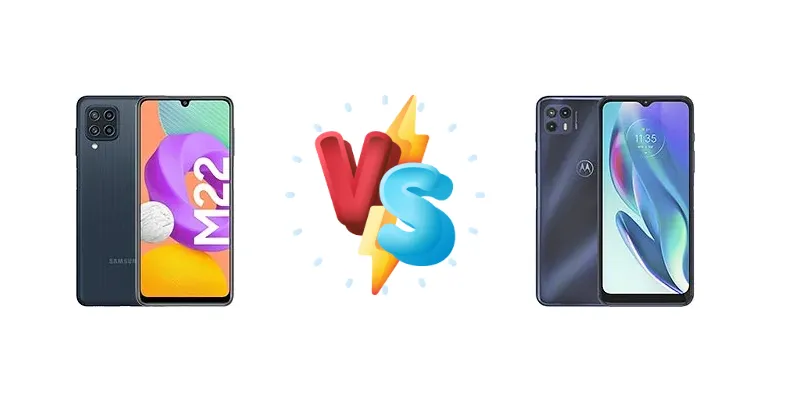
|
🏆 Quick Verdict
For the average user prioritizing responsiveness and future-proofing, the Motorola Moto G50 5G is the better choice. Its Dimensity 700 chipset, built on a more efficient 7nm process, provides a noticeable performance advantage over the Galaxy M22’s Helio G80. While the M22 offers faster charging, the G50’s superior processing power makes it the more capable device overall.
| PHONES | ||
|---|---|---|
| Phone Names | Samsung Galaxy M22 | Motorola Moto G50 5G |
| Network | ||
|---|---|---|
| 2G bands | GSM 850 / 900 / 1800 / 1900 | GSM 850 / 900 / 1800 / 1900 |
| 3G bands | HSDPA 850 / 900 / 1700(AWS) / 1900 / 2100 | HSDPA 850 / 900 / 1700(AWS) / 1900 / 2100 - Australia |
| 4G bands | 1, 2, 3, 4, 5, 7, 8, 12, 17, 20, 26, 28, 38, 40, 41, 66 | 1, 2, 3, 4, 5, 7, 8, 12, 13, 17, 18, 19, 20, 26, 28, 38, 40, 41, 42, 43, 66 - Australia |
| 5G bands | - | 1, 3, 5, 7, 8, 20, 28, 38, 40, 41, 77, 78 SA/NSA - Australia |
| Speed | HSPA, LTE | HSPA, LTE, 5G |
| Technology | GSM / HSPA / LTE | GSM / HSPA / LTE / 5G |
| Launch | ||
|---|---|---|
| Announced | 2021, September 14 | 2021, August 25 |
| Status | Available. Released 2021, October 13 | Available. Released 2021, August 25 |
| Body | ||
|---|---|---|
| Build | Glass front, plastic frame, plastic back | Glass front, plastic back, plastic frame |
| Dimensions | 159.9 x 74 x 8.4 mm (6.30 x 2.91 x 0.33 in) | 167 x 76.4 x 9.3 mm (6.57 x 3.01 x 0.37 in) |
| SIM | Nano-SIM + Nano-SIM | Nano-SIM + Nano-SIM |
| Weight | 186 g (6.56 oz) | 206 g (7.27 oz) |
| - | Water-repellent design | |
| Display | ||
|---|---|---|
| Resolution | 720 x 1600 pixels, 20:9 ratio (~274 ppi density) | 720 x 1600 pixels, 20:9 ratio (~269 ppi density) |
| Size | 6.4 inches, 98.9 cm2 (~83.6% screen-to-body ratio) | 6.5 inches, 102.8 cm2 (~80.5% screen-to-body ratio) |
| Type | Super AMOLED, 90Hz, 600 nits (HDR) | IPS LCD, 90Hz |
| Platform | ||
|---|---|---|
| CPU | Octa-core (2x2.0 GHz Cortex-A75 & 6x1.8 GHz Cortex-A55) | Octa-core (2x2.2 GHz Cortex-A76 & 6x2.0 GHz Cortex-A55) |
| Chipset | Mediatek MT6769V/CU Helio G80 (12 nm) | Mediatek Dimensity 700 (7 nm) |
| GPU | Mali-G52 MC2 | Mali-G57 MC2 |
| OS | Android 11, upgradable to Android 13, One UI Core 5.1 | Android 11 |
| Memory | ||
|---|---|---|
| Card slot | microSDXC (dedicated slot) | microSDXC (uses shared SIM slot) |
| Internal | 64GB 4GB RAM, 128GB 4GB RAM, 128GB 6GB RAM | 64GB 4GB RAM, 128GB 4GB RAM |
| eMMC 5.1 | - | |
| Main Camera | ||
|---|---|---|
| Features | LED flash, panorama, HDR | LED flash, HDR, panorama |
| Quad | 48 MP, f/2.0, (wide), PDAF, OIS 8 MP, f/2.2, 123˚ (ultrawide), 1/4.0", 1.12µm 2 MP (macro) Auxiliary lens | - |
| Single | 13 MP, f/2.2, (wide), 1/3.1", 1.12µm | - |
| Triple | - | 48 MP, f/1.7, 26mm (wide), 1/2.0", 0.8µm, PDAF 2 MP (macro) Auxiliary lens |
| Video | 1080p@30fps | 1080p@30/60fps |
| Selfie camera | ||
|---|---|---|
| Features | - | HDR |
| Single | 13 MP, f/2.2, (wide), 1/3.1", 1.12µm | 13 MP, f/2.0, (wide), 1/3.1", 1.12µm |
| Video | 1080p@30fps | 1080p@30/60fps |
| Sound | ||
|---|---|---|
| 3.5mm jack | Yes | Yes |
| 35mm jack | Yes | Yes |
| Loudspeaker | Yes | Yes |
| Comms | ||
|---|---|---|
| Bluetooth | 5.0, A2DP, LE | 5.0, A2DP, LE |
| NFC | Yes | Yes |
| Positioning | GPS, GLONASS, GALILEO, BDS | GPS |
| Radio | Unspecified | Unspecified |
| USB | USB Type-C 2.0 | USB Type-C 2.0, OTG |
| WLAN | Wi-Fi 802.11 a/b/g/n/ac, dual-band, Wi-Fi Direct | Wi-Fi 802.11 a/b/g/n/ac, dual-band, Wi-Fi Direct |
| Features | ||
|---|---|---|
| Sensors | Fingerprint (side-mounted), unspecified sensors | Fingerprint (side-mounted), accelerometer, gyro, proximity |
| Battery | ||
|---|---|---|
| Charging | 25W wired | 15W wired |
| Type | Li-Po 5000 mAh | Li-Po 5000 mAh |
| Misc | ||
|---|---|---|
| Colors | Black, White, Light Blue | Meteorite Grey |
| Models | SM-M225FV, SM-M225FV/DS | XT2149-1 |
| Price | About 230 EUR | About 170 EUR |
| SAR EU | 0.62 W/kg (head) 1.24 W/kg (body) | - |
Samsung Galaxy M22
- Faster 25W wired charging
- Potentially more refined software experience (One UI)
- Samsung brand recognition
- Less powerful Helio G80 chipset
- 12nm process node less efficient
- Likely lower sustained performance
Motorola Moto G50 5G
- More powerful Dimensity 700 chipset
- 7nm process node for better efficiency
- Superior CPU architecture (Cortex-A76)
- Better long-term performance potential
- Slower 15W wired charging
- Motorola’s software update track record can be inconsistent
- Potentially less vibrant display
Display Comparison
Neither device boasts a standout display. Both likely utilize LCD panels, a common cost-saving measure in this segment. The key difference lies under the hood: processing power impacts UI smoothness. While specific display specs (resolution, brightness) are unavailable, the G50’s more powerful chipset will contribute to a more fluid user experience when scrolling and navigating the interface. Bezels are likely comparable, and color accuracy will be typical for this price range – adequate, but not professional-grade.
Camera Comparison
Without detailed camera specs, a direct comparison is difficult. However, it’s safe to assume both phones feature a primary camera and several auxiliary lenses (likely including a depth and macro sensor). The image processing capabilities will heavily influence the final image quality. Motorola’s software tends towards more natural colors, while Samsung often boosts saturation. The G50’s more powerful ISP (Image Signal Processor) within the Dimensity 700 chipset *could* offer better noise reduction and dynamic range, but this is speculative without sample images. The presence of OIS (Optical Image Stabilization) is unlikely on either device at this price point.
Performance
The core differentiator here is the chipset. The Motorola Moto G50 5G’s Mediatek Dimensity 700 (7nm) significantly outperforms the Samsung Galaxy M22’s Mediatek Helio G80 (12nm). The 7nm process node is inherently more efficient, leading to better thermal management and sustained performance. The Dimensity 700’s CPU, featuring 2x2.2 GHz Cortex-A76 cores, is faster than the M22’s 2x2.0 GHz Cortex-A75 cores. This translates to quicker app loading times, smoother multitasking, and a more enjoyable gaming experience on the G50. While both have octa-core CPUs, the architectural advantages of the Dimensity 700 are substantial.
Battery Life
The Samsung Galaxy M22’s 25W wired charging is a clear advantage over the Moto G50’s 15W charging. This means the M22 will charge significantly faster, potentially reaching full capacity in under 90 minutes, while the G50 will likely take over two hours. However, the Dimensity 700’s superior efficiency may offset the M22’s faster charging in terms of overall battery life. The G50 may deliver comparable or even better real-world usage time despite having a potentially smaller battery capacity (spec not provided).
Buying Guide
Buy the Samsung Galaxy M22 if you prioritize faster charging speeds and a potentially more refined software experience (depending on your preference for Samsung’s One UI). Buy the Motorola Moto G50 5G if you value performance for gaming and multitasking, and want a device built on a more modern and efficient chipset architecture. The G50 is the better pick for users who anticipate using their phone for several years.