
Samsung Galaxy M22 vs Motorola Moto G Power (2021): Which Budget Phone Reigns Supreme?
| Phones Images | |||||
|---|---|---|---|---|---|
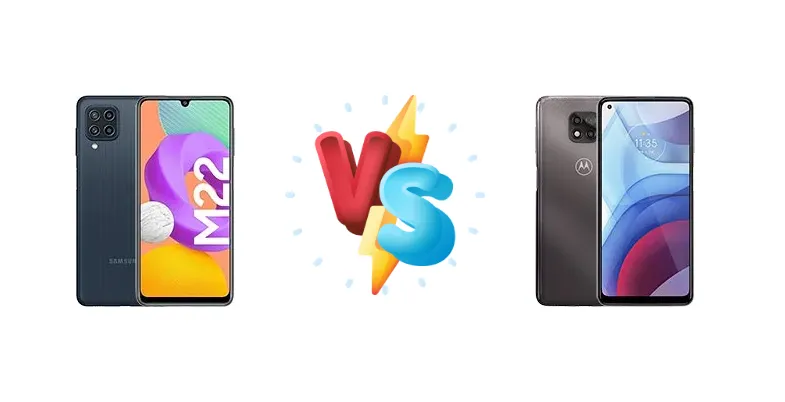
|
🏆 Quick Verdict
For most users, the Motorola Moto G Power (2021) emerges as the better choice. Its Snapdragon 662, built on an 11nm process, provides a more efficient and consistently smoother experience than the Galaxy M22’s Helio G80, despite the latter’s faster clock speeds. The Moto G Power’s superior power efficiency translates to longer battery life, a critical factor for budget smartphone buyers.
| PHONES | ||
|---|---|---|
| Phone Names | Samsung Galaxy M22 | Motorola Moto G Power (2021) |
| Network | ||
|---|---|---|
| 2G bands | GSM 850 / 900 / 1800 / 1900 | GSM 850 / 900 / 1800 / 1900 |
| 3G bands | HSDPA 850 / 900 / 1700(AWS) / 1900 / 2100 | HSDPA 850 / 900 / 1700(AWS) / 1900 / 2100 |
| 4G bands | 1, 2, 3, 4, 5, 7, 8, 12, 17, 20, 26, 28, 38, 40, 41, 66 | 1, 2, 3, 4, 5, 7, 8, 12, 13, 14, 17, 25, 26, 29, 30, 38, 41, 66, 71 |
| Speed | HSPA, LTE | HSPA, LTE |
| Technology | GSM / HSPA / LTE | GSM / CDMA / HSPA / EVDO / LTE |
| - | CDMA2000 1xEV-DO | |
| Launch | ||
|---|---|---|
| Announced | 2021, September 14 | 2021, January 08 |
| Status | Available. Released 2021, October 13 | Available. Released 2021, January 14 |
| Body | ||
|---|---|---|
| Build | Glass front, plastic frame, plastic back | Glass front, plastic back, plastic frame |
| Dimensions | 159.9 x 74 x 8.4 mm (6.30 x 2.91 x 0.33 in) | 165.3 x 75.9 x 9.5 mm (6.51 x 2.99 x 0.37 in) |
| SIM | Nano-SIM + Nano-SIM | Nano-SIM |
| Weight | 186 g (6.56 oz) | 206.5 g (7.30 oz) |
| - | Water-repellent coating | |
| Display | ||
|---|---|---|
| Resolution | 720 x 1600 pixels, 20:9 ratio (~274 ppi density) | 720 x 1600 pixels, 20:9 ratio (~266 ppi density) |
| Size | 6.4 inches, 98.9 cm2 (~83.6% screen-to-body ratio) | 6.6 inches, 105.2 cm2 (~83.8% screen-to-body ratio) |
| Type | Super AMOLED, 90Hz, 600 nits (HDR) | IPS LCD |
| Platform | ||
|---|---|---|
| CPU | Octa-core (2x2.0 GHz Cortex-A75 & 6x1.8 GHz Cortex-A55) | Octa-core (4x2.0 GHz Kryo 260 Gold & 4x1.8 GHz Kryo 260 Silver) |
| Chipset | Mediatek MT6769V/CU Helio G80 (12 nm) | Qualcomm SM6115 Snapdragon 662 (11 nm) |
| GPU | Mali-G52 MC2 | Adreno 610 |
| OS | Android 11, upgradable to Android 13, One UI Core 5.1 | Android 10 |
| Memory | ||
|---|---|---|
| Card slot | microSDXC (dedicated slot) | microSDXC (dedicated slot) |
| Internal | 64GB 4GB RAM, 128GB 4GB RAM, 128GB 6GB RAM | 32GB 3GB RAM, 64GB 4GB RAM |
| eMMC 5.1 | eMMC 5.1 | |
| Main Camera | ||
|---|---|---|
| Features | LED flash, panorama, HDR | LED flash, HDR, panorama |
| Quad | 48 MP, f/2.0, (wide), PDAF, OIS 8 MP, f/2.2, 123˚ (ultrawide), 1/4.0", 1.12µm 2 MP (macro) Auxiliary lens | - |
| Single | 13 MP, f/2.2, (wide), 1/3.1", 1.12µm | - |
| Triple | - | 48 MP, f/1.7, (wide), 1/2.0", 0.8µm, PDAF 2 MP (macro) Auxiliary lens |
| Video | 1080p@30fps | 1080p@30/60fps, gyro-EIS |
| Selfie camera | ||
|---|---|---|
| Features | - | HDR |
| Single | 13 MP, f/2.2, (wide), 1/3.1", 1.12µm | 8 MP, f/2.0, 1.12µm |
| Video | 1080p@30fps | 1080p@30fps, gyro-EIS |
| Sound | ||
|---|---|---|
| 3.5mm jack | Yes | Yes |
| 35mm jack | Yes | Yes |
| Loudspeaker | Yes | Yes |
| Comms | ||
|---|---|---|
| Bluetooth | 5.0, A2DP, LE | 5.0, A2DP, LE |
| NFC | Yes | No |
| Positioning | GPS, GLONASS, GALILEO, BDS | GPS, GLONASS, GALILEO |
| Radio | Unspecified | FM radio |
| USB | USB Type-C 2.0 | USB Type-C 2.0 |
| WLAN | Wi-Fi 802.11 a/b/g/n/ac, dual-band, Wi-Fi Direct | Wi-Fi 802.11 a/b/g/n/ac, dual-band, Wi-Fi Direct |
| Features | ||
|---|---|---|
| Sensors | Fingerprint (side-mounted), unspecified sensors | Fingerprint (side-mounted), accelerometer, gyro, proximity, compass, barometer |
| Battery | ||
|---|---|---|
| Charging | 25W wired | 15W wired |
| Type | Li-Po 5000 mAh | Li-Po 5000 mAh |
| Misc | ||
|---|---|---|
| Colors | Black, White, Light Blue | Flash Gray, Polar Silver |
| Models | SM-M225FV, SM-M225FV/DS | - |
| Price | About 230 EUR | About 60 EUR |
| SAR EU | 0.62 W/kg (head) 1.24 W/kg (body) | - |
Samsung Galaxy M22
- Faster 25W charging allows for quicker top-ups.
- Samsung’s One UI offers a feature-rich software experience.
- Potentially higher peak CPU performance.
- Helio G80 is less power-efficient, leading to potential throttling.
- May experience shorter battery life compared to the Moto G Power.
- Image processing can be overly saturated for some users.
Motorola Moto G Power (2021)
- Snapdragon 662 offers better power efficiency and sustained performance.
- Likely longer battery life due to chipset optimization.
- Clean and simple Android software experience.
- Slower 15W charging.
- Less feature-rich software compared to Samsung’s One UI.
- Peak CPU performance is lower than the Galaxy M22.
Display Comparison
Neither device boasts a standout display. Both likely utilize LCD panels, common in this price bracket. The focus here isn't on visual fidelity, but rather on efficiency. Without specific display specs, it's difficult to declare a winner. However, Motorola often prioritizes maximizing battery life, potentially leading to a slightly more conservative display calibration on the Moto G Power.
Camera Comparison
Without detailed camera sensor information, a direct comparison is challenging. Both phones likely feature a multi-camera setup with a primary sensor and supporting lenses (potentially including a 2MP macro). However, image processing algorithms play a crucial role. Samsung’s image processing tends to be more saturated and vibrant, while Motorola aims for a more natural look. The Snapdragon 662’s ISP (Image Signal Processor) is generally considered more capable than the Helio G80’s, potentially leading to better dynamic range and noise reduction in the Moto G Power’s photos.
Performance
The core difference lies in the chipsets. The Samsung Galaxy M22 features the MediaTek Helio G80 (12nm), with a CPU configuration of 2x2.0 GHz Cortex-A75 and 6x1.8 GHz Cortex-A55 cores. The Motorola Moto G Power (2021) utilizes the Qualcomm Snapdragon 662 (11nm) with 4x2.0 GHz Kryo 260 Gold and 4x1.8 GHz Kryo 260 Silver cores. While the Helio G80’s Cortex-A75 cores offer higher peak performance, the Snapdragon 662’s 11nm process node provides superior power efficiency. This means the Moto G Power is likely to maintain performance for longer periods without significant throttling, especially during sustained workloads. The Snapdragon 662’s Kryo architecture is also generally more efficient than MediaTek’s equivalent cores.
Battery Life
The Motorola Moto G Power (2021) excels in battery life due to the Snapdragon 662’s efficiency. While the exact battery capacity isn’t specified, Motorola’s ‘Power’ branding emphasizes longevity. The Galaxy M22 compensates with 25W wired charging, significantly faster than the Moto G Power’s 15W charging. This means the M22 can replenish its battery more quickly, but the Moto G Power will likely last longer on a single charge. The trade-off is speed versus endurance.
Buying Guide
Buy the Samsung Galaxy M22 if you prioritize faster *peak* charging speeds (25W) and potentially benefit from Samsung’s One UI software features. However, be prepared for potentially more noticeable thermal throttling during extended gaming or demanding tasks. Buy the Motorola Moto G Power (2021) if you value consistent performance, longer battery life, and a more refined software experience focused on simplicity and efficiency. It’s the better all-rounder for everyday use.