
Samsung Galaxy M31s vs M21s: A Deep Dive into Samsung's Budget Champions
| Phones Images | |||||
|---|---|---|---|---|---|
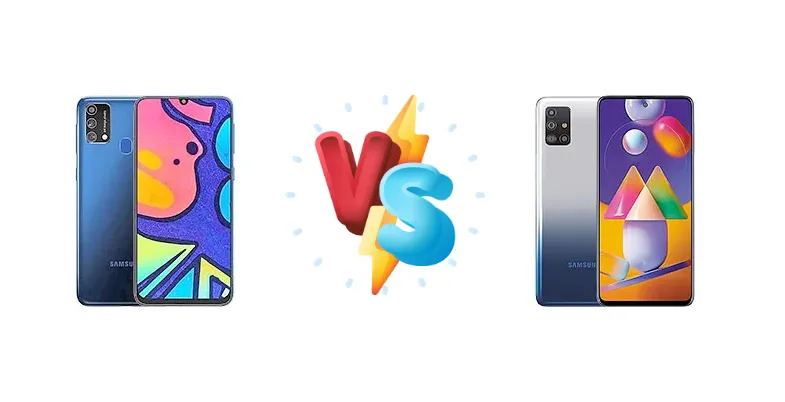
|
🏆 Quick Verdict
For most users, the Samsung Galaxy M31s is the superior choice. While both phones utilize the same Exynos 9611, the M31s’ 25W fast charging and inclusion of 4.5W reverse wireless charging provide a significant usability advantage, justifying the potential price premium.
| PHONES | ||
|---|---|---|
| Phone Names | Samsung Galaxy M21s | Samsung Galaxy M31s |
| Network | ||
|---|---|---|
| 2G bands | GSM 850 / 900 / 1800 / 1900 | GSM 850 / 900 / 1800 / 1900 |
| 3G bands | HSDPA 850 / 900 / 1700(AWS) / 1900 / 2100 | HSDPA 850 / 900 / 1700(AWS) / 1900 / 2100 |
| 4G bands | 1, 2, 3, 4, 5, 7, 8, 12, 13, 17, 20, 26, 28, 38, 40, 41, 66 | 1, 2, 3, 4, 5, 7, 8, 12, 17, 20, 26, 28, 38, 40, 41, 66 |
| Speed | HSPA, LTE | HSPA, LTE |
| Technology | GSM / HSPA / LTE | GSM / HSPA / LTE |
| Launch | ||
|---|---|---|
| Announced | 2020, November 06. Released 2020, November 06 | 2020, July 30. Released 2020, August 06 |
| Status | Discontinued | Discontinued |
| Body | ||
|---|---|---|
| Build | Glass front (Gorilla Glass 3), plastic back, plastic frame | - |
| Dimensions | 159.2 x 75.1 x 8.9 mm (6.27 x 2.96 x 0.35 in) | 159.3 x 74.4 x 9.3 mm (6.27 x 2.93 x 0.37 in) |
| Keyboard | - | QWERTY |
| SIM | · Nano-SIM· Nano-SIM + Nano-SIM | · Nano-SIM· Nano-SIM + Nano-SIM |
| Weight | 191 g (6.74 oz) | 203 g (7.16 oz) |
| Display | ||
|---|---|---|
| Protection | Corning Gorilla Glass 3 | Corning Gorilla Glass 3 |
| Resolution | 1080 x 2340 pixels, 19.5:9 ratio (~403 ppi density) | 1080 x 2400 pixels, 20:9 ratio (~405 ppi density) |
| Size | 6.4 inches, 100.5 cm2 (~84.1% screen-to-body ratio) | 6.5 inches, 102.0 cm2 (~86.1% screen-to-body ratio) |
| Type | Super AMOLED, 420 nits (peak) | Super AMOLED |
| Platform | ||
|---|---|---|
| CPU | Octa-core (4x2.3 GHz Cortex-A73 & 4x1.7 GHz Cortex-A53) | Octa-core (4x2.3 GHz Cortex-A73 & 4x1.7 GHz Cortex-A53) |
| Chipset | Exynos 9611 (10 nm) | Exynos 9611 (10 nm) |
| GPU | Mali-G72 MP3 | Mali-G72 MP3 |
| OS | Android 10, One UI 2.5 | Android 10, upgradable to Android 12, One UI 4.1 |
| Memory | ||
|---|---|---|
| Card slot | microSDXC (dedicated slot) | microSDXC (dedicated slot) |
| Internal | 64GB 4GB RAM, 128GB 6GB RAM | 128GB 6GB RAM, 128GB 8GB RAM |
| eMMC 5.1 | - | |
| Main Camera | ||
|---|---|---|
| Features | LED flash, panorama, HDR | LED flash, panorama, HDR |
| Single | - | 3.15 MP, AF |
| Triple | 64 MP, f/1.8, 26mm (wide), 1/1.72", 0.8µm, PDAF 8 MP, f/2.2, 12mm (ultrawide), 1/4.0", 1.12µm Auxiliary lens | 64 MP, f/1.8, 26mm (wide), 1/1.73", 0.8µm, PDAF 12 MP, f/2.2, 123˚ (ultrawide) 5 MP (macro) Auxiliary lens |
| Video | 4K@30fps, 1080p@30fps, gyro-EIS | 4K@30fps, 1080p@30fps, gyro-EIS |
| Selfie camera | ||
|---|---|---|
| Features | HDR | HDR |
| Single | 32 MP, f/2.0, 26mm (wide), 1/2.8", 0.8µm | 32 MP, f/2.2, 26mm (wide), 1/2.8", 0.8µm |
| Video | 1080p@30fps | 4K@30fps, 1080p@30fps |
| - | No | |
| Sound | ||
|---|---|---|
| 3.5mm jack | Yes | Yes |
| 35mm jack | Yes | Yes |
| Loudspeaker | Yes | Yes |
| Comms | ||
|---|---|---|
| Bluetooth | 5.0, A2DP, LE | 5.0, A2DP, LE |
| NFC | No | Yes (market/region dependent) |
| Positioning | GPS, GLONASS, GALILEO, BDS | GPS, GLONASS, GALILEO, BDS |
| Radio | FM radio | FM radio, RDS, recording |
| USB | USB Type-C 2.0 | USB Type-C 2.0, OTG |
| WLAN | Wi-Fi 802.11 a/b/g/n/ac, dual-band, Wi-Fi Direct | Wi-Fi 802.11 a/b/g/n/ac, dual-band, Wi-Fi Direct |
| Features | ||
|---|---|---|
| Sensors | Fingerprint (rear-mounted), accelerometer, gyro, proximity, compass | Fingerprint (side-mounted), accelerometer, gyro, compass |
| - | MP4/H.264 player MP3/WAV/eAAC+ player Organizer Voice memo Predictive text input | |
| Battery | ||
|---|---|---|
| Charging | 15W wired | 25W wired 4.5W reverse wired |
| Stand-by | - | Up to 288 h |
| Talk time | - | Up to 7 h |
| Type | Li-Po 6000 mAh | Li-Po 6000 mAh |
| Misc | ||
|---|---|---|
| Colors | Blue, Black | Mirage Black, Mirage Blue |
| Models | SM-F415F, SM-F415F/DS | SM-M317F, SM-M317F/DS |
| Price | About 230 EUR | About 300 EUR |
| SAR | 0.38 W/kg (head) | 1.38 W/kg (head) |
| SAR EU | 0.48 W/kg (head) 1.13 W/kg (body) | - |
Samsung Galaxy M21s
- Potentially lower price point
- Reliable Exynos 9611 performance for basic tasks
- Solid build quality expected from Samsung
- Slow 15W charging
- Lacks reverse wireless charging
- Limited camera capabilities (based on market segment)
Samsung Galaxy M31s
- Significantly faster 25W charging
- Convenient 4.5W reverse wireless charging
- Same reliable Exynos 9611 performance
- Potentially higher price
- May experience more thermal throttling under sustained load
- Similar camera limitations to the M21s
Display Comparison
Both the M21s and M31s feature similar LCD panels, though specific details like peak brightness and color gamut coverage aren't provided. Given their market positioning, expect standard LCD performance – adequate for everyday use but lacking the vibrancy of AMOLED displays found in higher-tier Samsung phones. Bezels are likely comparable, focusing on maximizing screen real estate within the budget constraints. Color accuracy will likely be tuned towards Samsung’s typically saturated profile.
Camera Comparison
Camera details beyond the presence of sensors are limited. Both phones likely feature a multi-camera setup, but the quality will depend heavily on the main sensor and image processing algorithms. The absence of details suggests a focus on affordability over cutting-edge camera technology. Any 2MP macro or depth sensors are likely to offer limited practical benefit. Image processing will likely prioritize vibrant colors and boosted contrast, typical of Samsung’s camera software.
Performance
The core of both devices is the Exynos 9611 (10nm). This chipset features an octa-core CPU configuration with 4x2.3 GHz Cortex-A73 cores and 4x1.7 GHz Cortex-A53 cores. Performance will be virtually identical for most tasks, including web browsing, social media, and light gaming. The 10nm process node offers reasonable efficiency, but sustained workloads may lead to thermal throttling. RAM configurations are not specified, but the performance will be heavily influenced by the amount of RAM. Neither device is positioned as a gaming powerhouse, but casual gamers will find the Exynos 9611 adequate.
Battery Life
While battery capacity isn’t specified, the key differentiator is charging speed. The M21s supports 15W wired charging, while the M31s boasts 25W wired charging and 4.5W reverse wired charging. This difference is substantial. The M31s will significantly reduce charging times, getting you back up and running much faster. The inclusion of reverse wireless charging on the M31s is a unique feature in this price segment, allowing you to use the phone as a portable power bank for accessories like earbuds or smartwatches.
Buying Guide
Buy the Samsung Galaxy M21s if you prioritize absolute affordability and don’t require rapid charging or the ability to top up other devices. It’s a solid, dependable phone for basic tasks. Buy the Samsung Galaxy M31s if you value convenience and faster power-ups. The 25W charging and reverse wireless capabilities are invaluable for users who are frequently on the move or need to share power with friends.