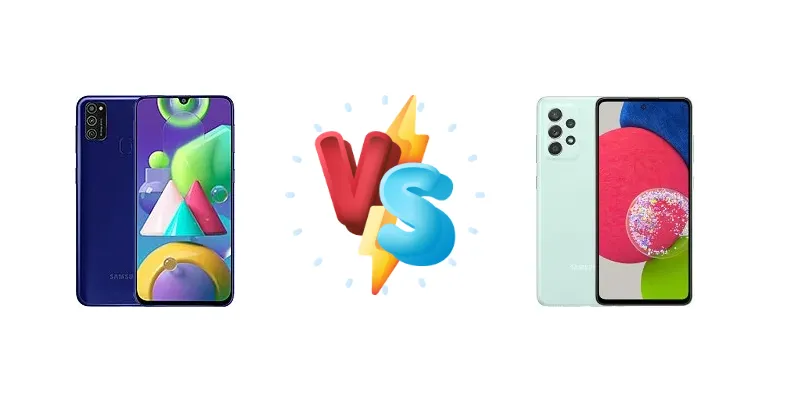
The Samsung Galaxy M21, originally positioned as a budget-friendly option, now faces competition from the newer Galaxy A52s 5G, which brings 5G connectivity and a more powerful chipset to the table. This comparison dissects the key differences between these two Samsung devices, helping you determine which best suits your needs and budget.
🏆 Quick Verdict
For most users, the Samsung Galaxy A52s 5G is the superior choice. Its Snapdragon 778G chipset delivers significantly better performance, and the 25W charging is a substantial upgrade. While the M21 remains a viable option for basic use, the A52s 5G offers a more future-proof and enjoyable experience.
| Network |
|---|
| 2G bands | GSM 850 / 900 / 1800 / 1900 | GSM 850 / 900 / 1800 / 1900 |
| 3G bands | HSDPA 850 / 900 / 1900 / 2100 | HSDPA 850 / 900 / 1700(AWS) / 1900 / 2100 |
| 4G bands | 1, 3, 5, 7, 8, 20, 38, 40, 41 | 1, 2, 3, 4, 5, 7, 8, 12, 17, 20, 26, 28, 32, 38, 40, 41, 66 |
| 5G bands | - | 1, 3, 5, 7, 8, 20, 28, 38, 40, 41, 66, 78 SA/NSA/Sub6 |
| Speed | HSPA, LTE | HSPA 42.2/5.76 Mbps, LTE Cat18 1200/150 Mbps, 5G |
| Technology | GSM / HSPA / LTE | GSM / HSPA / LTE / 5G |
| Launch |
|---|
| Announced | 2020, March 18. Released 2020, March 23 | 2021, August 17 |
| Status | Discontinued | Available. Released 2021, September 01 |
| Body |
|---|
| Build | Glass front (Gorilla Glass 3), plastic back, plastic frame | Glass front (Gorilla Glass 5), plastic back |
| Dimensions | 159 x 75.1 x 8.9 mm (6.26 x 2.96 x 0.35 in) | 159.9 x 75.1 x 8.4 mm (6.30 x 2.96 x 0.33 in) |
| SIM | · Nano-SIM· Nano-SIM + Nano-SIM | · Nano-SIM· Nano-SIM + Nano-SIM |
| Weight | 188 g (6.63 oz) | 189 g (6.67 oz) |
| | - | IP67 dust/water resistant (up to 1m for 30 min) |
| Display |
|---|
| Protection | Corning Gorilla Glass 3 | Corning Gorilla Glass 5 |
| Resolution | 1080 x 2340 pixels, 19.5:9 ratio (~403 ppi density) | 1080 x 2400 pixels, 20:9 ratio (~405 ppi density) |
| Size | 6.4 inches, 100.5 cm2 (~84.2% screen-to-body ratio) | 6.5 inches, 102.0 cm2 (~84.9% screen-to-body ratio) |
| Type | Super AMOLED, 420 nits (peak) | Super AMOLED, 120Hz, 800 nits (HBM) |
| Platform |
|---|
| CPU | Octa-core (4x2.3 GHz Cortex-A73 & 4x1.7 GHz Cortex-A53) | Octa-core (1x2.4 GHz Cortex-A78 & 3x2.2 GHz Cortex-A78 & 4x1.9 GHz Cortex-A55) |
| Chipset | Exynos 9611 (10 nm) | Qualcomm SM7325 Snapdragon 778G 5G (6 nm) |
| GPU | Mali-G72 MP3 | Adreno 642L |
| OS | Android 10, upgradable to Android 11, One UI 3.1 Core | Android 11, upgradable to Android 14, One UI 6 |
| Memory |
|---|
| Card slot | microSDXC (dedicated slot) | microSDXC (uses shared SIM slot) |
| Internal | 64GB 4GB RAM, 128GB 6GB RAM | 128GB 4GB RAM, 128GB 6GB RAM, 128GB 8GB RAM, 256GB 6GB RAM, 256GB 8GB RAM |
| | UFS 2.1 | - |
| Main Camera |
|---|
| Features | LED flash, panorama, HDR | LED flash, panorama, HDR |
| Quad | - | 64 MP, f/1.8, 26mm (wide), 1/1.7", 0.8µm, PDAF, OIS
12 MP, f/2.2, 123˚ (ultrawide), 1.12µm
5 MP (macro)
Auxiliary lens |
| Single | - | 32 MP, f/2.2, 26mm (wide), 1/2.8", 0.8µm |
| Triple | 48 MP, f/2.0, 26mm (wide), 1/2.0", 0.8µm, PDAF
8 MP, f/2.2, 12mm (ultrawide), 1/4.0", 1.12µm
Auxiliary lens | - |
| Video | 4K@30fps, 1080p@30fps, 720p@240fps, gyro-EIS | 4K@30fps, 1080p@30/60fps; gyro-EIS |
| Selfie camera |
|---|
| Features | HDR | HDR |
| Single | 20 MP, f/2.2, 26mm (wide) | 32 MP, f/2.2, 26mm (wide), 1/2.8", 0.8µm |
| Video | 1080p@30fps | 4K@30fps, 1080p@30/60fps |
| Sound |
|---|
| 3.5mm jack | Yes | Yes |
| 35mm jack | Yes | Yes |
| Loudspeaker | Yes | Yes, with stereo speakers |
| Comms |
|---|
| Bluetooth | 5.0, A2DP, LE | 5.0, A2DP, LE |
| NFC | Yes (market/region dependent) | Yes (market/region dependent) |
| Positioning | GPS, GLONASS, GALILEO, BDS | GPS, GLONASS, GALILEO, BDS, QZSS |
| Radio | FM radio, RDS, recording | No |
| USB | USB Type-C 2.0 | USB Type-C 2.0, OTG |
| WLAN | Wi-Fi 802.11 a/b/g/n/ac, dual-band, Wi-Fi Direct | Wi-Fi 802.11 a/b/g/n/ac/6, dual-band, Wi-Fi Direct |
| Features |
|---|
| Sensors | Fingerprint (rear-mounted), accelerometer, gyro, proximity, compass | Fingerprint (under display, optical), accelerometer, gyro, compass |
| | - | Virtual Proximity Sensing |
| Battery |
|---|
| Charging | 15W wired | 25W wired |
| Type | Li-Po 6000 mAh | Li-Ion 4500 mAh |
| Misc |
|---|
| Colors | Midnight Blue, Raven Black | Awesome Black, Awesome White, Awesome Purple, Awesome Mint |
| Models | SM-M215F, SM-M215F/DS, SM-M215F/DSN | SM-A528B, SM-A528B/DS, SM-A528N |
| Price | About 190 EUR | £ 112.98 / € 249.47 |
| SAR | 0.47 W/kg (head) | 0.72 W/kg (head) |
| SAR EU | - | 0.88 W/kg (head) 0.84 W/kg (body) |
| Pricing |
|---|
| 64GB 4GB RAM | £ 279.99 | - |
| RENEWED | £ 129.00 | - |
| Tests |
|---|
| Battery life | - |
Endurance rating 113h
|
| Camera | - |
Photo / Video |
| Display | - |
Contrast ratio: Infinite (nominal) |
| Loudspeaker | - |
-27.5 LUFS (Good)
|
| Performance | - |
AnTuTu: 429675 (v8), 506432(v9)
GeekBench: 11060 (v4.4), 2801 (v5.1)
GFXBench: 28fps (ES 3.1 onscreen) |
Samsung Galaxy M21
- Significantly lower price point
- Decent battery life for basic usage
- Acceptable performance for everyday tasks
- Outdated Exynos 9611 chipset
- Slow 15W charging
- Likely inferior display quality
Samsung Galaxy A52s 5G
- Powerful Snapdragon 778G chipset
- Fast 25W charging
- Brighter and likely higher-quality display
- 5G connectivity
- Higher price tag
- Battery life is comparable, not superior, to the M21
Display Comparison
The Galaxy A52s 5G boasts a significantly brighter display, reaching a measured peak of 800 nits compared to an unspecified brightness on the M21. This translates to better visibility outdoors. While both displays have an 'Infinite' contrast ratio (nominal), the A52s 5G’s superior brightness makes a tangible difference in real-world usage. The M21’s display technology is not specified, suggesting it’s a standard LCD, while the A52s 5G likely uses a Super AMOLED panel, offering richer colors and deeper blacks.
Camera Comparison
Both phones are listed as having Photo/Video capabilities, but details are sparse. The A52s 5G likely benefits from Qualcomm’s image signal processor (ISP) within the Snapdragon 778G, offering improved image processing and potentially better low-light performance. While sensor sizes and apertures aren’t specified, the A52s 5G’s more advanced chipset suggests a more sophisticated camera system overall. The M21’s camera is likely adequate for casual photography, but the A52s 5G will deliver more detailed and vibrant images.
Performance
The core difference lies in the chipsets. The A52s 5G’s Qualcomm Snapdragon 778G (6nm) is a substantial leap over the M21’s Exynos 9611 (10nm). The 778G features a more modern CPU architecture – a 1x2.4 GHz Cortex-A78 prime core alongside 3x2.2 GHz Cortex-A78 cores and 4x1.9 GHz Cortex-A55 efficiency cores – versus the M21’s 4x2.3 GHz Cortex-A73 and 4x1.7 GHz Cortex-A53 configuration. The 6nm process node of the Snapdragon 778G also provides better power efficiency and thermal management, reducing the likelihood of performance throttling during extended gaming sessions. The A52s 5G will handle demanding apps and multitasking with ease, while the M21 may struggle with more intensive tasks.
Battery Life
Both devices share an endurance rating of 113 hours, suggesting comparable real-world battery life despite the M21’s unspecified mAh capacity. However, the A52s 5G’s 25W wired charging is a significant advantage over the M21’s 15W charging. This means the A52s 5G can be topped up much faster, reducing downtime. While the M21 might last a similar amount of time on a single charge, the convenience of quicker charging makes the A52s 5G more practical for many users.
Buying Guide
Buy the Samsung Galaxy M21 if you prioritize absolute affordability and primarily need a phone for basic tasks like calls, messaging, and light social media. It's a good choice for first-time smartphone users or those on a very tight budget. Buy the Samsung Galaxy A52s 5G if you value performance, 5G connectivity, faster charging, and a brighter, more vibrant display. It's ideal for gamers, content creators, and anyone who wants a phone that can keep up with their demanding lifestyle.
Frequently Asked Questions
❓ Does the Exynos 9611 in the Galaxy M21 overheat during prolonged gaming sessions?
The Exynos 9611, being a 10nm chip, is more prone to thermal throttling than the 6nm Snapdragon 778G. While it can handle casual gaming, extended sessions with demanding titles may lead to noticeable performance drops as the chip heats up.
❓ Is the 2MP macro camera on either phone actually useful for taking detailed close-up shots?
Generally, 2MP macro cameras on budget and mid-range phones offer limited detail and image quality. They are often included for marketing purposes but rarely deliver truly impressive macro photography. The A52s 5G’s superior image processing might yield slightly better results, but don’t expect professional-level macro shots from either device.
❓ Can the Samsung Galaxy A52s 5G consistently maintain 60fps in popular games like PUBG Mobile?
Yes, the Snapdragon 778G in the A52s 5G is capable of running PUBG Mobile at high settings with consistent 60fps. It may even be able to handle higher frame rates depending on the game's settings and the device's thermal conditions.
❓ How long does it realistically take to fully charge the Samsung Galaxy A52s 5G from 0% to 100% with the 25W charger?
With the included 25W charger, the Samsung Galaxy A52s 5G can typically charge from 0% to 100% in approximately 60-70 minutes. This is a significant improvement over the M21’s 15W charging, which would take considerably longer.