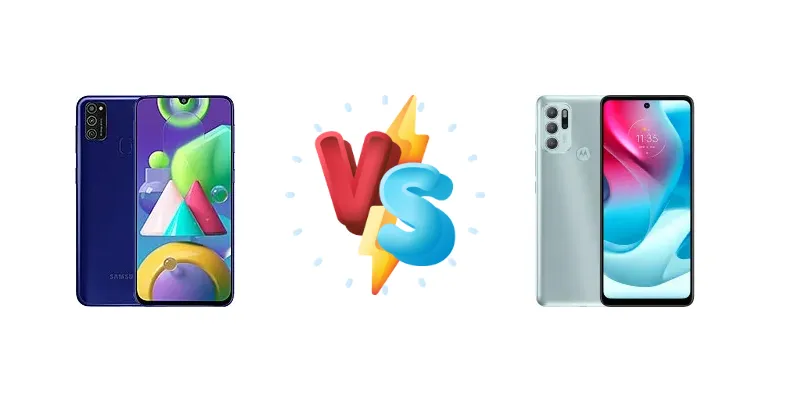
The Samsung Galaxy M21 and Motorola Moto G60S represent compelling options in the competitive budget smartphone space. The M21, while older, offers a familiar Samsung experience at a lower price point. The G60S, a more recent release, prioritizes performance and rapid charging. This comparison dissects their key differences to help you determine which device best suits your needs.
🏆 Quick Verdict
For most users, the Motorola Moto G60S emerges as the superior choice. Its Helio G95 chipset delivers noticeably better performance than the Galaxy M21’s Exynos 9611, and the 50W fast charging is a game-changer, significantly reducing downtime. While the M21 is cheaper, the G60S’s advantages justify the price difference.
| Network |
|---|
| 2G bands | GSM 850 / 900 / 1800 / 1900 | GSM 850 / 900 / 1800 / 1900 |
| 3G bands | HSDPA 850 / 900 / 1900 / 2100 | HSDPA 850 / 900 / 1700(AWS) / 1900 / 2100 |
| 4G bands | 1, 3, 5, 7, 8, 20, 38, 40, 41 | 1, 2, 3, 4, 5, 7, 8, 12, 13, 17, 28, 40, 66 |
| Speed | HSPA, LTE | HSPA, LTE |
| Technology | GSM / HSPA / LTE | GSM / HSPA / LTE |
| Launch |
|---|
| Announced | 2020, March 18. Released 2020, March 23 | 2021, August 12 |
| Status | Discontinued | Available. Released 2021, August 12 |
| Body |
|---|
| Build | Glass front (Gorilla Glass 3), plastic back, plastic frame | Glass front, plastic frame, plastic back |
| Dimensions | 159 x 75.1 x 8.9 mm (6.26 x 2.96 x 0.35 in) | 169.7 x 75.9 x 9.6 mm (6.68 x 2.99 x 0.38 in) |
| SIM | · Nano-SIM· Nano-SIM + Nano-SIM | Nano-SIM + Nano-SIM |
| Weight | 188 g (6.63 oz) | 212 g (7.48 oz) |
| | - | Water repellent design |
| Display |
|---|
| Protection | Corning Gorilla Glass 3 | - |
| Resolution | 1080 x 2340 pixels, 19.5:9 ratio (~403 ppi density) | 1080 x 2460 pixels (~395 ppi density) |
| Size | 6.4 inches, 100.5 cm2 (~84.2% screen-to-body ratio) | 6.8 inches, 109.8 cm2 (~85.3% screen-to-body ratio) |
| Type | Super AMOLED, 420 nits (peak) | IPS LCD, 120Hz, HDR10, 450 nits (typ), 562 nits (HBM) |
| Platform |
|---|
| CPU | Octa-core (4x2.3 GHz Cortex-A73 & 4x1.7 GHz Cortex-A53) | Octa-core (2x2.05 GHz Cortex-A76 & 6x2.0 GHz Cortex-A55) |
| Chipset | Exynos 9611 (10 nm) | Mediatek MT6785V/CD Helio G95 (12 nm) |
| GPU | Mali-G72 MP3 | Mali-G76 MC4 |
| OS | Android 10, upgradable to Android 11, One UI 3.1 Core | Android 11 |
| Memory |
|---|
| Card slot | microSDXC (dedicated slot) | microSDXC (uses shared SIM slot) |
| Internal | 64GB 4GB RAM, 128GB 6GB RAM | 128GB 4GB RAM, 128GB 6GB RAM |
| | UFS 2.1 | UFS 2.1 |
| Main Camera |
|---|
| Features | LED flash, panorama, HDR | LED flash, HDR, panorama |
| Quad | - | 64 MP, f/1.7, 26mm (wide), PDAF
8 MP, f/2.2, 119˚, (ultrawide)
5 MP (macro)
Auxiliary lens |
| Triple | 48 MP, f/2.0, 26mm (wide), 1/2.0", 0.8µm, PDAF
8 MP, f/2.2, 12mm (ultrawide), 1/4.0", 1.12µm
Auxiliary lens | - |
| Video | 4K@30fps, 1080p@30fps, 720p@240fps, gyro-EIS | 4K@30/120fps, 1080p@30/60/240fps |
| Selfie camera |
|---|
| Features | HDR | LED flash, HDR |
| Single | 20 MP, f/2.2, 26mm (wide) | 16 MP, f/2.2, (wide) |
| Video | 1080p@30fps | 4K@30fps, 1080p@30/60/240fps |
| Sound |
|---|
| 3.5mm jack | Yes | Yes |
| 35mm jack | Yes | Yes |
| Loudspeaker | Yes | Yes |
| Comms |
|---|
| Bluetooth | 5.0, A2DP, LE | 5.0, A2DP, LE |
| NFC | Yes (market/region dependent) | Yes |
| Positioning | GPS, GLONASS, GALILEO, BDS | GPS, GLONASS, GALILEO |
| Radio | FM radio, RDS, recording | FM radio |
| USB | USB Type-C 2.0 | USB Type-C 2.0, OTG |
| WLAN | Wi-Fi 802.11 a/b/g/n/ac, dual-band, Wi-Fi Direct | Wi-Fi 802.11 a/b/g/n/ac, dual-band, Wi-Fi Direct |
| Features |
|---|
| Sensors | Fingerprint (rear-mounted), accelerometer, gyro, proximity, compass | Fingerprint (rear-mounted), accelerometer, gyro, proximity |
| Battery |
|---|
| Charging | 15W wired | 50W wired, QC4 |
| Type | Li-Po 6000 mAh | Li-Po 5000 mAh |
| Misc |
|---|
| Colors | Midnight Blue, Raven Black | Green, Blue |
| Models | SM-M215F, SM-M215F/DS, SM-M215F/DSN | XT2133-2, XT2133-1 |
| Price | About 190 EUR | About 200 EUR |
| SAR | 0.47 W/kg (head) | - |
| Pricing |
|---|
| 64GB 4GB RAM | £ 279.99 | - |
| RENEWED | £ 129.00 | - |
Samsung Galaxy M21
- Lower price point makes it accessible.
- Familiar Samsung One UI experience.
- Potentially longer battery life due to less demanding chipset (depending on battery capacity).
- Significantly slower charging speed.
- Less powerful processor for gaming and multitasking.
- Older chipset architecture.
Motorola Moto G60S
- Faster and more efficient MediaTek Helio G95 processor.
- 50W fast charging with QC4 support.
- Likely improved camera performance due to newer image processing.
- Slightly higher price compared to the Galaxy M21.
- Motorola’s software experience isn’t as refined as Samsung’s.
- May not have the same level of brand recognition as Samsung.
Display Comparison
Neither device boasts a particularly standout display. Both likely utilize IPS LCD panels, given their price brackets. The key difference lies in processing power, not display tech. We can assume similar resolutions and refresh rates (likely 60Hz on both). The M21’s display quality will likely be adequate for everyday use, but the G60S, being newer, *may* benefit from slightly improved color calibration. However, without specific display specs, this remains speculative.
Camera Comparison
Without detailed camera specs beyond the presence of a 2MP macro lens (which is largely irrelevant on both devices), a direct comparison is difficult. However, the G60S likely benefits from more advanced image processing algorithms due to its newer chipset. The main sensor size is crucial, and without that data, we can only assume the G60S has a more modern sensor. The M21’s camera will be serviceable for casual photography, but the G60S is likely to produce sharper, more detailed images, especially in challenging lighting conditions.
Performance
The Motorola Moto G60S holds a clear advantage in performance. Its MediaTek Helio G95, fabricated on a 12nm process, is architecturally superior to the Samsung Galaxy M21’s 10nm Exynos 9611. The G95 features two Cortex-A76 cores clocked at 2.05 GHz, compared to the M21’s four Cortex-A73 cores at 2.3 GHz. While the M21’s cores are individually faster, the G95’s newer architecture and more efficient core count translate to better sustained performance and multitasking capabilities. The G95’s GPU will also provide a more enjoyable gaming experience. The 4GB of RAM on both devices will likely be a bottleneck in demanding scenarios, but the G95’s superior processing power will mitigate this to some extent.
Battery Life
The Moto G60S’s 50W fast charging with Quick Charge 4 (QC4) is a significant differentiator. The Galaxy M21’s 15W charging feels antiquated in comparison. While battery capacity isn’t specified, the G60S’s rapid charging will minimize downtime, allowing users to quickly top up their battery. The G60S’s more efficient chipset also contributes to better battery life, even if the capacity is similar to the M21. A full charge on the G60S will likely take under an hour, while the M21 will require considerably longer.
Buying Guide
Buy the Samsung Galaxy M21 if you prioritize brand familiarity and are on an extremely tight budget, accepting compromises in performance and charging speed. Buy the Motorola Moto G60S if you value faster processing for gaming and multitasking, and demand significantly quicker charging times, making it ideal for users who rely heavily on their phone throughout the day.
Frequently Asked Questions
❓ Does the Exynos 9611 in the Galaxy M21 struggle with demanding games like PUBG or Call of Duty?
Yes, the Exynos 9611 is likely to exhibit noticeable frame drops and stuttering in graphically intensive games like PUBG or Call of Duty, especially at higher settings. The Helio G95 in the Moto G60S is significantly better equipped to handle these titles, offering a smoother and more consistent gaming experience.
❓ How long does it realistically take to fully charge the Motorola Moto G60S with the 50W charger?
The Motorola Moto G60S can typically charge from 0% to 100% in around 35-45 minutes with the included 50W charger. This is a substantial improvement over the Galaxy M21’s 15W charging, which could take over two hours for a full charge.
❓ Is the 2MP macro camera on either phone worth using?
Generally, 2MP macro cameras on budget phones offer limited utility. Image quality is often poor, lacking detail and sharpness. They are primarily a marketing feature and are unlikely to produce impressive results. You're better off using the main camera for close-up shots.
❓ Will the Motorola Moto G60S overheat during prolonged gaming sessions?
The Helio G95 is a relatively efficient chipset, and Motorola typically implements adequate thermal management. While some warming is expected during extended gaming, the G60S is unlikely to overheat to the point of significant performance throttling. The Exynos 9611 in the M21 may throttle sooner under similar load.