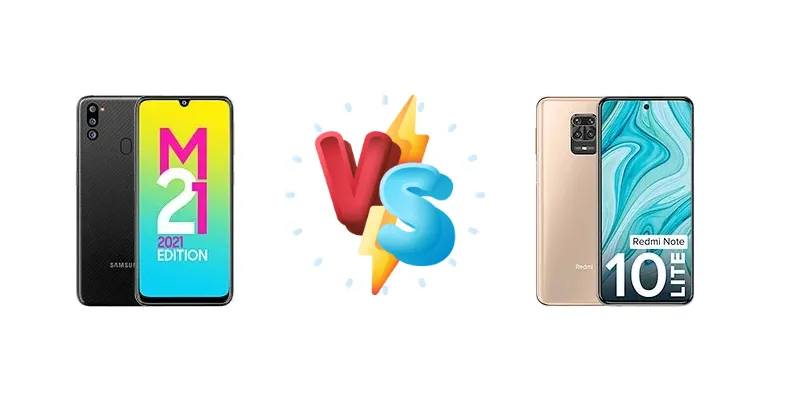
Both the Xiaomi Redmi Note 10 Lite and the Samsung Galaxy M21 2021 occupy a competitive space in the budget smartphone market. The Redmi Note 10 Lite leverages Qualcomm’s Snapdragon 720G, while the Galaxy M21 2021 relies on Samsung’s in-house Exynos 9611. This comparison dissects their key differences to help you determine which device best suits your needs.
🏆 Quick Verdict
For most users, the Xiaomi Redmi Note 10 Lite emerges as the stronger contender. Its Snapdragon 720G, built on an 8nm process, delivers superior efficiency and sustained performance compared to the 10nm Exynos 9611 in the Galaxy M21 2021. While the Samsung offers a familiar interface, the Xiaomi’s chipset advantage is difficult to ignore.
| Network |
|---|
| 2G bands | GSM 850 / 900 / 1800 / 1900 | GSM 850 / 900 / 1800 / 1900 |
| 3G bands | HSDPA 850 / 900 / 1900 / 2100 | HSDPA 850 / 900 / 1700(AWS) / 1900 / 2100 |
| 4G bands | 1, 3, 5, 7, 8, 20, 38, 40, 41 | 1, 2, 3, 4, 5, 7, 8, 20, 28, 38, 40, 41 |
| Speed | HSPA, LTE | HSPA, LTE |
| Technology | GSM / HSPA / LTE | GSM / HSPA / LTE |
| Launch |
|---|
| Announced | 2021, July 21 | 2021, October 01 |
| Status | Available. Released 2021, July 26 | Available. Released 2021, October 02 |
| Body |
|---|
| Build | Glass front, plastic back, plastic frame | Glass front (Gorilla Glass 5), glass back (Gorilla Glass 5), plastic frame |
| Dimensions | 159 x 75.1 x 9 mm (6.26 x 2.96 x 0.35 in) | 165.8 x 76.7 x 8.8 mm (6.53 x 3.02 x 0.35 in) |
| SIM | Nano-SIM + Nano-SIM | Nano-SIM + Nano-SIM |
| Weight | 192 g (6.77 oz) | 209 g (7.37 oz) |
| | - | Water-repellent coating |
| Display |
|---|
| Protection | - | Corning Gorilla Glass 5 |
| Resolution | 1080 x 2340 pixels, 19.5:9 ratio (~403 ppi density) | 1080 x 2400 pixels, 20:9 ratio (~395 ppi density) |
| Size | 6.4 inches, 100.5 cm2 (~84.2% screen-to-body ratio) | 6.67 inches, 107.4 cm2 (~84.5% screen-to-body ratio) |
| Type | Super AMOLED, 420 nits (peak) | IPS LCD |
| Platform |
|---|
| CPU | Octa-core (4x2.3 GHz Cortex-A73 & 4x1.7 GHz Cortex-A53) | Octa-core (2x2.3 GHz Kryo 465 Gold & 6x1.8 GHz Kryo 465 Silver) |
| Chipset | Exynos 9611 (10 nm) | Qualcomm SM7125 Snapdragon 720G (8 nm) |
| GPU | Mali-G72 MP3 | Adreno 618 |
| OS | Android 11, One UI 3.1 Core | Android 10, MIUI 11 |
| Memory |
|---|
| Card slot | microSDXC (dedicated slot) | microSDXC (dedicated slot) |
| Internal | 64GB 4GB RAM, 128GB 6GB RAM | 64GB 4GB RAM, 64GB 6GB RAM, 128GB 4GB RAM, 128GB 6GB RAM |
| Main Camera |
|---|
| Features | LED flash, panorama, HDR | LED flash, HDR, panorama |
| Quad | - | 48 MP, f/1.9, 26mm (wide), 0.8µm, PDAF
8 MP, f/2.2, 119˚ (ultrawide), 1/4.0", 1.12µm
5 MP (macro), AF
Auxiliary lens |
| Single | - | 16 MP, f/2.5, (wide), 1/3.06", 1.0µm |
| Triple | 48 MP, f/2.0, 26mm (wide), 1/2.0", 0.8µm, PDAF
8 MP, f/2.2, 123˚ (ultrawide), 1/4.0", 1.12µm
Auxiliary lens | - |
| Video | 4K@30fps, 1080p@30fps, 720p@240fps, gyro-EIS | 4K@30fps, 1080p@30/60/120fps, 720p@960fps, gyro-EIS |
| Selfie camera |
|---|
| Features | HDR | HDR, panorama |
| Single | 20 MP, f/2.2, 26mm (wide) | 16 MP, f/2.5, (wide), 1/3.06", 1.0µm |
| Video | 1080p@30fps | 1080p@30fps |
| Sound |
|---|
| 3.5mm jack | Yes | Yes |
| 35mm jack | Yes | Yes |
| Loudspeaker | Yes | Yes |
| Comms |
|---|
| Bluetooth | 5.0, A2DP, LE | 5.0, A2DP, LE |
| Infrared port | - | Yes |
| NFC | Yes (market/region dependent) | Yes |
| Positioning | GPS, GLONASS, GALILEO, BDS | GPS, GLONASS, GALILEO, BDS, NavIC |
| Radio | FM radio, RDS, recording | FM radio, recording |
| USB | USB Type-C 2.0 | USB Type-C 2.0 |
| WLAN | Wi-Fi 802.11 a/b/g/n/ac, dual-band, Wi-Fi Direct | Wi-Fi 802.11 a/b/g/n/ac, dual-band, Wi-Fi Direct |
| Features |
|---|
| Sensors | Fingerprint (rear-mounted), accelerometer, gyro, proximity, compass | Fingerprint (side-mounted), accelerometer, gyro, proximity, compass |
| Battery |
|---|
| Charging | 15W wired | 18W wired |
| Type | Li-Po 6000 mAh | Li-Po 5020 mAh |
| Misc |
|---|
| Colors | Charcoal Black, Arctic Blue | Aurora Blue, Glacier White, Interstellar Black, Champagne Gold |
| Models | SM-M215G, SM-M215G/DS | M2002F4LG |
| Price | About 130 EUR | About 200 EUR |
| SAR | 0.47 W/kg (head) | 1.17 W/kg (head) 0.86 W/kg (body) |
| SAR EU | - | 1.01 W/kg (head) 1.39 W/kg (body) |
Samsung Galaxy M21 2021
- Familiar Samsung One UI experience
- Potentially better software support (Samsung's update policy)
- Established brand reputation
- Less efficient Exynos 9611 chipset
- Slower 15W charging
- Potential for thermal throttling under heavy load
Xiaomi Redmi Note 10 Lite
- More efficient Snapdragon 720G chipset
- Faster 18W charging
- Better sustained performance for gaming
- Xiaomi’s MIUI can be polarizing
- Potentially more bloatware
- Software update consistency can vary
Display Comparison
Neither device boasts a standout display. Both likely feature LCD panels, common in this price bracket. However, the lack of detailed display specs necessitates focusing on the chipset impact on UI smoothness. The Snapdragon 720G’s GPU will contribute to a more fluid experience when scrolling and navigating the interface, even if the panel resolution and refresh rate are similar.
Camera Comparison
Without detailed camera specs, a direct comparison is limited. However, the Redmi Note 10 Lite’s image signal processor (ISP) within the Snapdragon 720G generally offers superior image processing capabilities, particularly in low-light conditions. The Exynos 9611 is capable, but the Snapdragon 720G’s ISP is known for better noise reduction and dynamic range. The prevalence of 2MP macro lenses on both devices suggests they are largely marketing features and shouldn’t heavily influence your decision.
Performance
The core difference lies in the chipsets. The Qualcomm Snapdragon 720G (SM7125) is fabricated on an 8nm process, offering a significant advantage in power efficiency over the Samsung Exynos 9611’s 10nm process. This translates to less heat generation under load, reducing the likelihood of performance throttling during extended gaming sessions. While both CPUs feature octa-core configurations with similar peak clock speeds (2.3 GHz), the Snapdragon’s Kryo 465 Gold cores are architecturally more efficient than the Cortex-A73 cores in the Exynos. This efficiency gap is crucial for sustained performance.
Battery Life
The Redmi Note 10 Lite’s 18W wired charging is a clear advantage over the Galaxy M21 2021’s 15W charging. While battery capacity isn’t specified, the Snapdragon 720G’s superior efficiency means the Redmi Note 10 Lite will likely deliver comparable or better real-world battery life despite potentially having a similar or even slightly smaller battery capacity. The faster charging also reduces downtime.
Buying Guide
Buy the Samsung Galaxy M21 2021 if you prioritize the Samsung ecosystem and a potentially more refined software experience, even at the cost of some performance. Buy the Xiaomi Redmi Note 10 Lite if you prioritize sustained performance for gaming and demanding apps, and value a more efficient chipset that translates to better battery life during heavy use.
Frequently Asked Questions
❓ Does the Exynos 9611 in the Galaxy M21 2021 overheat during prolonged gaming sessions?
The Exynos 9611, being fabricated on a 10nm process, is more prone to thermal throttling than the Snapdragon 720G. Expect performance to decrease after approximately 30-45 minutes of demanding games like PUBG or Call of Duty, as the chip attempts to manage heat buildup.
❓ Is the 18W charging on the Redmi Note 10 Lite significantly faster than the 15W charging on the Galaxy M21 2021?
Yes, while the difference may not seem substantial, the 18W charging on the Redmi Note 10 Lite will noticeably reduce charging times. Expect a roughly 30-minute reduction in a full 0-100% charge compared to the Galaxy M21 2021.
❓ How does the Snapdragon 720G handle multitasking compared to the Exynos 9611?
The Snapdragon 720G’s more efficient architecture and optimized memory management generally result in smoother multitasking. Switching between apps and running multiple applications simultaneously will likely be a more responsive experience on the Redmi Note 10 Lite.
❓ Are the 2MP macro cameras on either phone worth using?
Generally, no. The image quality from these 2MP macro cameras is typically low, lacking detail and sharpness. They are often included as a marketing feature rather than providing a genuinely useful photographic experience. Stick to the main camera for better results.