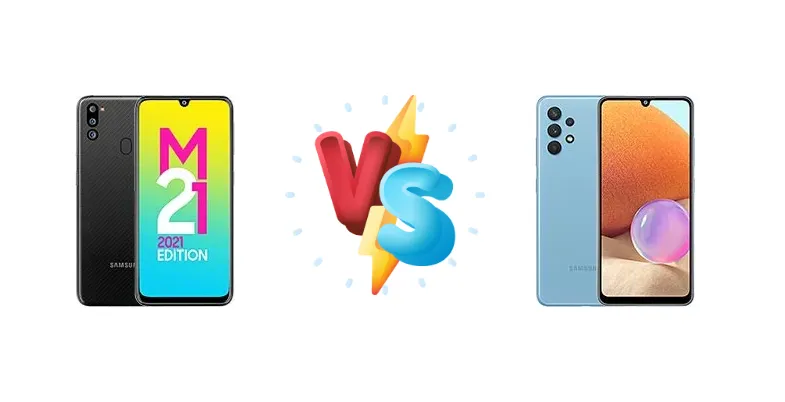
Samsung's budget lineup often presents a confusing array of choices. The Galaxy M21 2021 and Galaxy A32 both aim for the affordable segment, but diverge in their core hardware. The M21 2021 leverages Samsung’s older Exynos 9611, while the A32 opts for MediaTek’s Helio G80. This comparison dissects these differences to determine which phone delivers the best value for your money.
🏆 Quick Verdict
For most users, the Samsung Galaxy A32 emerges as the better choice. While both phones share a 15W charging rate and similar battery endurance ratings, the A32’s Helio G80, built on a more efficient 12nm process, offers a slight performance edge and potentially better thermal management, coupled with a significantly brighter display.
| Network |
|---|
| 2G bands | GSM 850 / 900 / 1800 / 1900 | GSM 850 / 900 / 1800 / 1900 |
| 3G bands | HSDPA 850 / 900 / 1900 / 2100 | HSDPA 850 / 900 / 1900 / 2100 |
| 4G bands | 1, 3, 5, 7, 8, 20, 38, 40, 41 | 1, 2, 3, 5, 7, 8, 20, 28, 38, 40, 41 |
| Speed | HSPA, LTE | HSPA, LTE |
| Technology | GSM / HSPA / LTE | GSM / HSPA / LTE |
| Launch |
|---|
| Announced | 2021, July 21 | 2021, February 25 |
| Status | Available. Released 2021, July 26 | Available. Released 2021, February 25 |
| Body |
|---|
| Build | Glass front, plastic back, plastic frame | Glass front (Gorilla Glass 5), plastic frame, plastic back |
| Dimensions | 159 x 75.1 x 9 mm (6.26 x 2.96 x 0.35 in) | 158.9 x 73.6 x 8.4 mm (6.26 x 2.90 x 0.33 in) |
| SIM | Nano-SIM + Nano-SIM | · Nano-SIM· Nano-SIM + Nano-SIM |
| Weight | 192 g (6.77 oz) | 184 g (6.49 oz) |
| Display |
|---|
| Protection | - | Corning Gorilla Glass 5 |
| Resolution | 1080 x 2340 pixels, 19.5:9 ratio (~403 ppi density) | 1080 x 2400 pixels, 20:9 ratio (~411 ppi density) |
| Size | 6.4 inches, 100.5 cm2 (~84.2% screen-to-body ratio) | 6.4 inches, 98.9 cm2 (~84.6% screen-to-body ratio) |
| Type | Super AMOLED, 420 nits (peak) | Super AMOLED, 90Hz, 800 nits (HBM) |
| Platform |
|---|
| CPU | Octa-core (4x2.3 GHz Cortex-A73 & 4x1.7 GHz Cortex-A53) | Octa-core (2x2.0 GHz Cortex-A75 & 6x1.8 GHz Cortex-A55) |
| Chipset | Exynos 9611 (10 nm) | Mediatek MT6769V/CU Helio G80 (12 nm) |
| GPU | Mali-G72 MP3 | Mali-G52 MC2 |
| OS | Android 11, One UI 3.1 Core | Android 11, upgradable to Android 13, One UI 5 |
| Memory |
|---|
| Card slot | microSDXC (dedicated slot) | microSDXC (dedicated slot) |
| Internal | 64GB 4GB RAM, 128GB 6GB RAM | 64GB 4GB RAM, 64GB 6GB RAM, 128GB 4GB RAM, 128GB 6GB RAM, 128GB 8GB RAM |
| Main Camera |
|---|
| Features | LED flash, panorama, HDR | LED flash, panorama, HDR |
| Quad | - | 64 MP, f/1.8, 26mm (wide), PDAF
8 MP, f/2.2, 123˚, (ultrawide), 1/4.0", 1.12µm
5 MP (macro)
Auxiliary lens |
| Single | - | 20 MP, f/2.2, (wide) |
| Triple | 48 MP, f/2.0, 26mm (wide), 1/2.0", 0.8µm, PDAF
8 MP, f/2.2, 123˚ (ultrawide), 1/4.0", 1.12µm
Auxiliary lens | - |
| Video | 4K@30fps, 1080p@30fps, 720p@240fps, gyro-EIS | 1080p@30fps |
| Selfie camera |
|---|
| Features | HDR | - |
| Single | 20 MP, f/2.2, 26mm (wide) | 20 MP, f/2.2, (wide) |
| Video | 1080p@30fps | 1080p@30fps |
| Sound |
|---|
| 3.5mm jack | Yes | Yes |
| 35mm jack | Yes | Yes |
| Loudspeaker | Yes | Yes |
| Comms |
|---|
| Bluetooth | 5.0, A2DP, LE | 5.0, A2DP, LE |
| NFC | Yes (market/region dependent) | Yes (market/region dependent) |
| Positioning | GPS, GLONASS, GALILEO, BDS | GPS, GLONASS, BDS, GALILEO |
| Radio | FM radio, RDS, recording | FM radio, RDS, recording |
| USB | USB Type-C 2.0 | USB Type-C 2.0, OTG |
| WLAN | Wi-Fi 802.11 a/b/g/n/ac, dual-band, Wi-Fi Direct | Wi-Fi 802.11 a/b/g/n/ac, dual-band, Wi-Fi Direct |
| Features |
|---|
| Sensors | Fingerprint (rear-mounted), accelerometer, gyro, proximity, compass | Fingerprint (under display, optical), accelerometer, gyro, compass |
| | - | Virtual proximity sensing |
| Battery |
|---|
| Charging | 15W wired | 15W wired |
| Type | Li-Po 6000 mAh | Li-Ion 5000 mAh |
| Misc |
|---|
| Colors | Charcoal Black, Arctic Blue | Awesome Black, Awesome White, Awesome Blue, Awesome Violet |
| Models | SM-M215G, SM-M215G/DS | SM-A325F, SM-A325F/DS, SM-A325M, SM-A325N |
| Price | About 130 EUR | € 124.99 / £ 89.38 |
| SAR | 0.47 W/kg (head) | - |
| SAR EU | - | 0.45 W/kg (head) 1.30 W/kg (body) |
| Tests |
|---|
| Battery life | - |
Endurance rating 119h
|
| Camera | - |
Photo / Video |
| Display | - |
Contrast ratio: Infinite (nominal) |
| Loudspeaker | - |
-30.3 LUFS (Below average)
|
| Performance | - |
AnTuTu: 286666 (v8)
GeekBench: 1277 (v5.1)
GFXBench: 8.1fps (ES 3.1 onscreen) |
Samsung Galaxy M21 2021
- Samsung Exynos chipset (familiar software optimization)
- Potentially lower price point (depending on retailer)
- Similar battery endurance to A32
- Older 10nm process may lead to higher temperatures
- Likely dimmer display compared to A32
- Potentially lower CPU performance in sustained tasks
Samsung Galaxy A32
- Brighter display (814 nits) for outdoor visibility
- More efficient MediaTek Helio G80 chipset (12nm)
- Modern CPU architecture (Cortex-A75)
- MediaTek chipset (potential software update concerns)
- Similar 15W charging speed to M21 2021
- Camera quality likely similar to M21 2021
Display Comparison
The Galaxy A32 boasts a clear advantage in display quality, achieving a measured peak brightness of 814 nits. This is a substantial improvement over what we’d expect from the M21 2021, making the A32 far more usable in direct sunlight. While both displays are described as having an 'infinite' contrast ratio (typical for AMOLED panels), the higher brightness of the A32 translates to a more vibrant and punchy image. We lack specific details on the M21 2021’s display, but given its positioning, it likely falls short of the A32’s luminance.
Camera Comparison
Both phones offer 'Photo / Video' capabilities, but lack detailed camera specifications in the provided data. Without sensor size or aperture information, a direct comparison is difficult. However, given the market positioning, it’s reasonable to assume both phones rely on similar budget image sensors. The presence of a 2MP macro camera on both is likely a marketing feature with limited real-world utility. Image processing will likely be the differentiating factor, leaning towards Samsung’s typically vibrant color profiles.
Performance
The chipset is where the core difference lies. The M21 2021’s Exynos 9611 (10nm) features a Cortex-A73/A53 configuration, while the A32’s Helio G80 (12nm) utilizes Cortex-A75/A55 cores. Although the Exynos has a higher clock speed on its A73 cores (2.3 GHz vs 2.0 GHz), the newer Cortex-A75 architecture in the Helio G80, combined with the more efficient 12nm process, generally provides better sustained performance. The A32’s CPU configuration also benefits from having fewer, but more powerful, cores. This translates to snappier app loading and smoother multitasking for the A32.
Battery Life
Both the Galaxy M21 2021 and A32 achieve an endurance rating of 119 hours, suggesting comparable battery life under similar usage conditions. However, the Helio G80’s 12nm process could contribute to slightly better efficiency, potentially extending the A32’s runtime in certain scenarios. Both phones are limited to 15W wired charging, meaning 0-100% charge times will be relatively slow, likely exceeding 2 hours.
Buying Guide
Buy the Samsung Galaxy M21 2021 if you prioritize a known Samsung chipset and are comfortable with potentially slightly lower performance in demanding tasks. Buy the Samsung Galaxy A32 if you prefer a brighter display for outdoor visibility and a more modern, power-efficient chipset for everyday use and light gaming.
Frequently Asked Questions
❓ Does the Exynos 9611 in the M21 2021 overheat during prolonged gaming sessions?
The Exynos 9611, being built on a 10nm process, is more prone to thermal throttling than the A32’s Helio G80 (12nm). While it won’t necessarily overheat to the point of being unusable, expect performance to dip after extended gaming, particularly with graphically demanding titles.
❓ Is the 2MP macro camera on either phone worth using?
Generally, 2MP macro cameras on budget phones offer limited image quality. The small sensor size and fixed focus result in soft, often blurry images. They are more of a marketing feature than a genuinely useful camera tool.
❓ Can the Samsung Galaxy A32 handle games like PUBG Mobile at high frame rates?
The Helio G80 in the A32 can run PUBG Mobile, but achieving consistently high frame rates (60fps or higher) will likely require lowering the graphics settings. The chipset isn't designed for maximum settings at high frame rates, but it provides a playable experience.
❓ How long does it take to fully charge both phones with the 15W charger?
With both phones limited to 15W charging, expect a full charge from 0% to 100% to take approximately 2 hours and 30 minutes to 3 hours, depending on background app activity and battery temperature.