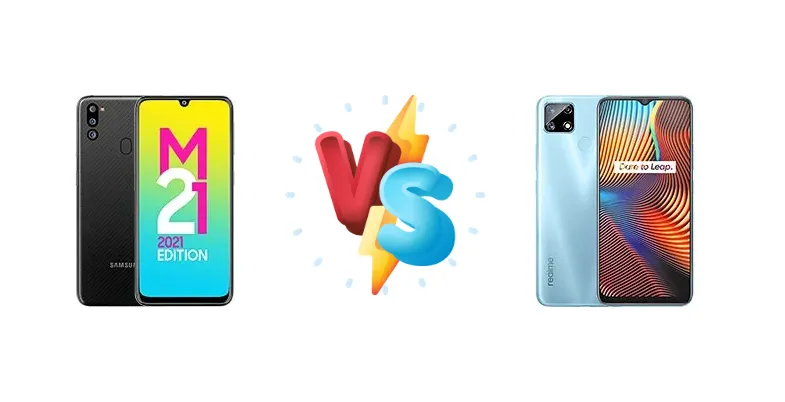
The Samsung Galaxy M21 2021 and Realme 7i represent compelling options in the crowded budget smartphone space. While both aim to deliver essential features at an accessible price, they take different approaches to achieving this. The M21 2021 relies on Samsung’s in-house Exynos 9611, while the Realme 7i leverages MediaTek’s Helio G85. This comparison dissects their key differences to help you determine which device best suits your needs.
🏆 Quick Verdict
For the average user prioritizing consistent performance and a well-established brand ecosystem, the Realme 7i emerges as the slightly better choice. Its Helio G85, built on a more efficient 12nm process, offers a tangible performance edge in gaming and multitasking, coupled with faster 18W charging and reverse charging capabilities.
| Network |
|---|
| 2G bands | GSM 850 / 900 / 1800 / 1900 | GSM 850 / 900 / 1800 / 1900 |
| 3G bands | HSDPA 850 / 900 / 1900 / 2100 | HSDPA 850 / 900 / 1700(AWS) / 1900 / 2100 |
| 4G bands | 1, 3, 5, 7, 8, 20, 38, 40, 41 | 1, 2, 3, 4, 5, 7, 8, 20, 28, 38, 40, 41 |
| Speed | HSPA, LTE | HSPA, LTE |
| Technology | GSM / HSPA / LTE | GSM / HSPA / LTE |
| Launch |
|---|
| Announced | 2021, July 21 | 2020, December 22. Released 2020, December 23 |
| Status | Available. Released 2021, July 26 | Discontinued |
| Body |
|---|
| Build | Glass front, plastic back, plastic frame | - |
| Dimensions | 159 x 75.1 x 9 mm (6.26 x 2.96 x 0.35 in) | 164.5 x 75.9 x 9.8 mm (6.48 x 2.99 x 0.39 in) |
| SIM | Nano-SIM + Nano-SIM | Nano-SIM + Nano-SIM |
| Weight | 192 g (6.77 oz) | 208 g (7.34 oz) |
| Display |
|---|
| Resolution | 1080 x 2340 pixels, 19.5:9 ratio (~403 ppi density) | 720 x 1600 pixels, 20:9 ratio (~270 ppi density) |
| Size | 6.4 inches, 100.5 cm2 (~84.2% screen-to-body ratio) | 6.5 inches, 102.0 cm2 (~81.7% screen-to-body ratio) |
| Type | Super AMOLED, 420 nits (peak) | IPS LCD, 450 nits (typ), 560 nits (peak) |
| Platform |
|---|
| CPU | Octa-core (4x2.3 GHz Cortex-A73 & 4x1.7 GHz Cortex-A53) | Octa-core (2x2.0 GHz Cortex-A75 & 6x1.8 GHz Cortex-A55) |
| Chipset | Exynos 9611 (10 nm) | Mediatek MT6769Z Helio G85 (12 nm) |
| GPU | Mali-G72 MP3 | Mali-G52 MC2 |
| OS | Android 11, One UI 3.1 Core | Android 10, Realme UI |
| Memory |
|---|
| Card slot | microSDXC (dedicated slot) | microSDXC (dedicated slot) |
| Internal | 64GB 4GB RAM, 128GB 6GB RAM | 64GB 4GB RAM |
| | - | eMMC 5.1 |
| Main Camera |
|---|
| Features | LED flash, panorama, HDR | LED flash, HDR, panorama |
| Triple | 48 MP, f/2.0, 26mm (wide), 1/2.0", 0.8µm, PDAF
8 MP, f/2.2, 123˚ (ultrawide), 1/4.0", 1.12µm
Auxiliary lens | 48 MP, f/1.8, 26mm (wide), 1/2.0", 0.8µm, PDAF
8 MP, f/2.3, 16mm, 119˚ (ultrawide), 1/4.0", 1.12µm
2 MP (macro) |
| Video | 4K@30fps, 1080p@30fps, 720p@240fps, gyro-EIS | 1080p@30/60fps |
| Selfie camera |
|---|
| Features | HDR | HDR, panorama |
| Single | 20 MP, f/2.2, 26mm (wide) | 8 MP, f/2.0, 26mm (wide), 1/4.0", 1.12µm |
| Video | 1080p@30fps | 1080p@30fps |
| Sound |
|---|
| 3.5mm jack | Yes | Yes |
| 35mm jack | Yes | Yes |
| Loudspeaker | Yes | Yes |
| Comms |
|---|
| Bluetooth | 5.0, A2DP, LE | 5.0, A2DP, LE, aptX HD |
| NFC | Yes (market/region dependent) | No |
| Positioning | GPS, GLONASS, GALILEO, BDS | GPS, GLONASS, BDS |
| Radio | FM radio, RDS, recording | FM radio |
| USB | USB Type-C 2.0 | USB Type-C 2.0, OTG |
| WLAN | Wi-Fi 802.11 a/b/g/n/ac, dual-band, Wi-Fi Direct | Wi-Fi 802.11 a/b/g/n/ac, dual-band, Wi-Fi Direct |
| Features |
|---|
| Sensors | Fingerprint (rear-mounted), accelerometer, gyro, proximity, compass | Fingerprint (rear-mounted), accelerometer, proximity, compass |
| Battery |
|---|
| Charging | 15W wired | 18W wired
5W reverse wired |
| Type | Li-Po 6000 mAh | 6000 mAh |
| Misc |
|---|
| Colors | Charcoal Black, Arctic Blue | Glory Silver, Victory Blue |
| Models | SM-M215G, SM-M215G/DS | - |
| Price | About 130 EUR | About 190 EUR |
| SAR | 0.47 W/kg (head) | - |
Samsung Galaxy M21 2021
- Samsung’s One UI offers a refined software experience.
- Potential for longer software support from Samsung.
- Established brand reputation.
- Slower 15W charging.
- Less efficient Exynos 9611 chipset.
- No reverse charging.
Realme 7i (Global)
- Faster 18W charging with reverse charging support.
- More efficient MediaTek Helio G85 chipset.
- Gaming-optimized processor.
- Realme UI may not appeal to all users.
- Potentially shorter software support lifecycle compared to Samsung.
Display Comparison
Neither device boasts a standout display. Both likely feature LCD panels, typical for this price bracket. However, the lack of specific display specs (resolution, brightness) necessitates a focus on processing power to drive the UI smoothly. The Realme 7i’s slightly more efficient chipset *could* translate to a marginally smoother experience, especially during scrolling and animations, though this is difficult to quantify without direct testing.
Camera Comparison
Without detailed camera specs beyond the presence of cameras, a direct comparison is challenging. Both phones likely feature a primary camera, ultrawide, and depth sensor. However, the Realme 7i’s image processing algorithms are generally known for producing vibrant, social media-ready images, while Samsung tends towards more natural color reproduction. The absence of Optical Image Stabilization (OIS) on either device suggests reliance on software stabilization, potentially impacting low-light performance. The 2MP macro cameras on both are likely of limited utility, serving primarily as marketing features.
Performance
The core difference lies in the chipsets. The Realme 7i’s MediaTek Helio G85 (12nm) features a dual-core Cortex-A75 setup paired with six Cortex-A55 cores, clocked at 2.0 GHz and 1.8 GHz respectively. This contrasts with the Samsung Galaxy M21 2021’s Exynos 9611 (10nm) which uses a quad-core Cortex-A73 and quad-core Cortex-A53 configuration, clocked at 2.3 GHz and 1.7 GHz. While the Exynos has higher peak clock speeds, the Helio G85’s newer architecture and smaller process node (12nm vs 10nm) generally lead to better sustained performance and thermal efficiency. This means the Realme 7i is less likely to throttle under prolonged gaming loads. The Helio G85 is specifically tuned for gaming, offering a slight advantage in titles like PUBG and Call of Duty Mobile.
Battery Life
The Realme 7i’s 18W charging is a clear advantage over the Samsung Galaxy M21 2021’s 15W charging. This translates to faster top-up times, crucial for users who frequently use their phones throughout the day. Furthermore, the Realme 7i supports 5W reverse wired charging, allowing it to act as a power bank for other devices – a feature absent on the M21 2021. While battery capacity isn’t specified, the efficiency gains of the Helio G85 could offset any potential capacity difference, resulting in comparable real-world battery life.
Buying Guide
Buy the Samsung Galaxy M21 2021 if you prioritize Samsung’s One UI software experience and a potentially longer software support lifecycle. Buy the Realme 7i (Global) if you prefer a more gaming-focused chipset, faster charging speeds, and the convenience of reverse wireless charging, all at a competitive price point.
Frequently Asked Questions
❓ Does the Exynos 9611 in the Samsung Galaxy M21 2021 overheat during extended gaming sessions?
The Exynos 9611, built on a 10nm process, is prone to thermal throttling under sustained load. While it can handle casual gaming, demanding titles may experience frame drops and reduced performance after prolonged play. The Realme 7i’s Helio G85, with its 12nm process, generally manages heat more effectively.
❓ Is the 5W reverse charging on the Realme 7i useful for topping up accessories like earbuds?
Yes, the 5W reverse charging is a convenient feature for charging accessories like wireless earbuds or smartwatches. While it’s not a fast charging solution, it can provide a significant boost to smaller devices when you’re away from a power outlet.
❓ Will I notice a significant difference in performance between the Exynos 9611 and the Helio G85 for everyday tasks like browsing and social media?
For basic tasks, the difference will be minimal. Both chipsets are capable of handling everyday usage smoothly. However, the Helio G85’s more efficient architecture will result in slightly better battery life and potentially smoother multitasking.
❓ How does the image processing differ between the Samsung Galaxy M21 2021 and the Realme 7i?
Samsung typically aims for more natural color reproduction in its images, while Realme tends to boost saturation and contrast for more vibrant, social media-friendly results. This is a matter of personal preference.