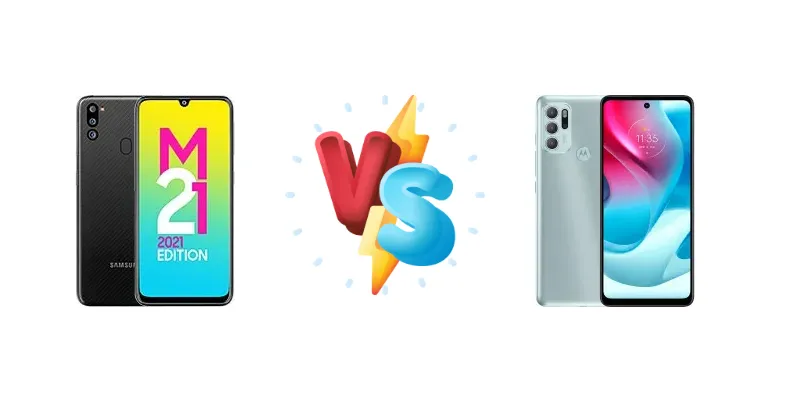
The Motorola Moto G60S and Samsung Galaxy M21 2021 represent compelling options in the crowded budget smartphone space. While both aim to deliver a solid experience without breaking the bank, they take distinctly different approaches to achieving that goal. The G60S prioritizes raw processing power and rapid charging, while the M21 2021 focuses on a more balanced, if less aggressively-priced, package.
🏆 Quick Verdict
For most users, the Motorola Moto G60S emerges as the stronger choice. Its Helio G95 chipset, built on a more efficient 12nm process, offers a noticeable performance advantage over the Exynos 9611 in the M21 2021. Crucially, the 50W fast charging significantly reduces downtime, making it ideal for power users.
| Network |
|---|
| 2G bands | GSM 850 / 900 / 1800 / 1900 | GSM 850 / 900 / 1800 / 1900 |
| 3G bands | HSDPA 850 / 900 / 1900 / 2100 | HSDPA 850 / 900 / 1700(AWS) / 1900 / 2100 |
| 4G bands | 1, 3, 5, 7, 8, 20, 38, 40, 41 | 1, 2, 3, 4, 5, 7, 8, 12, 13, 17, 28, 40, 66 |
| Speed | HSPA, LTE | HSPA, LTE |
| Technology | GSM / HSPA / LTE | GSM / HSPA / LTE |
| Launch |
|---|
| Announced | 2021, July 21 | 2021, August 12 |
| Status | Available. Released 2021, July 26 | Available. Released 2021, August 12 |
| Body |
|---|
| Build | Glass front, plastic back, plastic frame | Glass front, plastic frame, plastic back |
| Dimensions | 159 x 75.1 x 9 mm (6.26 x 2.96 x 0.35 in) | 169.7 x 75.9 x 9.6 mm (6.68 x 2.99 x 0.38 in) |
| SIM | Nano-SIM + Nano-SIM | Nano-SIM + Nano-SIM |
| Weight | 192 g (6.77 oz) | 212 g (7.48 oz) |
| | - | Water repellent design |
| Display |
|---|
| Resolution | 1080 x 2340 pixels, 19.5:9 ratio (~403 ppi density) | 1080 x 2460 pixels (~395 ppi density) |
| Size | 6.4 inches, 100.5 cm2 (~84.2% screen-to-body ratio) | 6.8 inches, 109.8 cm2 (~85.3% screen-to-body ratio) |
| Type | Super AMOLED, 420 nits (peak) | IPS LCD, 120Hz, HDR10, 450 nits (typ), 562 nits (HBM) |
| Platform |
|---|
| CPU | Octa-core (4x2.3 GHz Cortex-A73 & 4x1.7 GHz Cortex-A53) | Octa-core (2x2.05 GHz Cortex-A76 & 6x2.0 GHz Cortex-A55) |
| Chipset | Exynos 9611 (10 nm) | Mediatek MT6785V/CD Helio G95 (12 nm) |
| GPU | Mali-G72 MP3 | Mali-G76 MC4 |
| OS | Android 11, One UI 3.1 Core | Android 11 |
| Memory |
|---|
| Card slot | microSDXC (dedicated slot) | microSDXC (uses shared SIM slot) |
| Internal | 64GB 4GB RAM, 128GB 6GB RAM | 128GB 4GB RAM, 128GB 6GB RAM |
| | - | UFS 2.1 |
| Main Camera |
|---|
| Features | LED flash, panorama, HDR | LED flash, HDR, panorama |
| Quad | - | 64 MP, f/1.7, 26mm (wide), PDAF
8 MP, f/2.2, 119˚, (ultrawide)
5 MP (macro)
Auxiliary lens |
| Triple | 48 MP, f/2.0, 26mm (wide), 1/2.0", 0.8µm, PDAF
8 MP, f/2.2, 123˚ (ultrawide), 1/4.0", 1.12µm
Auxiliary lens | - |
| Video | 4K@30fps, 1080p@30fps, 720p@240fps, gyro-EIS | 4K@30/120fps, 1080p@30/60/240fps |
| Selfie camera |
|---|
| Features | HDR | LED flash, HDR |
| Single | 20 MP, f/2.2, 26mm (wide) | 16 MP, f/2.2, (wide) |
| Video | 1080p@30fps | 4K@30fps, 1080p@30/60/240fps |
| Sound |
|---|
| 3.5mm jack | Yes | Yes |
| 35mm jack | Yes | Yes |
| Loudspeaker | Yes | Yes |
| Comms |
|---|
| Bluetooth | 5.0, A2DP, LE | 5.0, A2DP, LE |
| NFC | Yes (market/region dependent) | Yes |
| Positioning | GPS, GLONASS, GALILEO, BDS | GPS, GLONASS, GALILEO |
| Radio | FM radio, RDS, recording | FM radio |
| USB | USB Type-C 2.0 | USB Type-C 2.0, OTG |
| WLAN | Wi-Fi 802.11 a/b/g/n/ac, dual-band, Wi-Fi Direct | Wi-Fi 802.11 a/b/g/n/ac, dual-band, Wi-Fi Direct |
| Features |
|---|
| Sensors | Fingerprint (rear-mounted), accelerometer, gyro, proximity, compass | Fingerprint (rear-mounted), accelerometer, gyro, proximity |
| Battery |
|---|
| Charging | 15W wired | 50W wired, QC4 |
| Type | Li-Po 6000 mAh | Li-Po 5000 mAh |
| Misc |
|---|
| Colors | Charcoal Black, Arctic Blue | Green, Blue |
| Models | SM-M215G, SM-M215G/DS | XT2133-2, XT2133-1 |
| Price | About 130 EUR | About 200 EUR |
| SAR | 0.47 W/kg (head) | - |
Samsung Galaxy M21 2021
- Familiar Samsung One UI experience
- Potentially lower price point (depending on region)
- Reliable brand reputation
- Older Exynos 9611 chipset
- Slow 15W charging
- Less efficient CPU architecture
Motorola Moto G60S
- Faster MediaTek Helio G95 chipset
- Ultra-fast 50W charging with QC4
- More efficient CPU architecture
- Motorola’s software experience can be less polished
- May have more bloatware
- Less brand recognition than Samsung
Display Comparison
Neither device boasts a particularly standout display. While specific panel details (like peak brightness or color gamut coverage) are unavailable, the focus here is on the underlying processing power impacting UI smoothness. Both likely utilize IPS LCD panels, common in this price bracket. The difference isn't in display quality, but in the chipset's ability to render content efficiently.
Camera Comparison
Without detailed sensor information beyond the presence of a 2MP macro lens (largely irrelevant on both devices), a direct camera comparison is difficult. However, the chipset’s image signal processor (ISP) plays a crucial role. The Helio G95’s ISP is likely more advanced, enabling better noise reduction and dynamic range. The G60S will likely produce more detailed and vibrant photos, especially in challenging lighting conditions. The M21’s Exynos 9611 ISP, while capable, is older technology.
Performance
The Motorola Moto G60S’s MediaTek Helio G95 (12nm) represents a significant architectural leap over the Samsung Galaxy M21 2021’s Exynos 9611 (10nm). The G95 features two Cortex-A76 cores clocked at 2.05 GHz, offering substantially better single-core performance than the M21’s Cortex-A73 cores at 2.3 GHz. While the M21’s clock speed is higher, the A76 architecture is more efficient and powerful. The G95’s 12nm process also contributes to better thermal management, potentially reducing throttling during sustained loads. This translates to smoother gaming and faster app loading times for the G60S.
Battery Life
The Moto G60S’s 50W wired charging with Quick Charge 4 (QC4) is a game-changer. This allows for significantly faster top-ups compared to the M21 2021’s 15W charging. While battery capacity isn’t specified, the faster charging speed effectively mitigates any potential capacity disadvantage. Users can expect to go from 0-100% in under an hour with the G60S, while the M21 2021 will take considerably longer, impacting usability for those who frequently need to recharge.
Buying Guide
Buy the Samsung Galaxy M21 2021 if you prioritize a familiar Samsung user experience and are less concerned with demanding tasks like gaming or heavy multitasking. Buy the Motorola Moto G60S if you value faster performance, quicker charging speeds, and a more modern chipset architecture, even if it means sacrificing some brand recognition.
Frequently Asked Questions
❓ Does the Exynos 9611 in the Galaxy M21 2021 overheat during prolonged gaming sessions?
The Exynos 9611, being built on a 10nm process and having a less efficient CPU architecture, is more prone to thermal throttling during extended gaming. While it won't shut down, users may experience frame rate drops and reduced performance after 30-45 minutes of demanding games.
❓ Is the 50W charging on the Moto G60S compatible with all USB-C chargers?
While the Moto G60S supports Quick Charge 4 (QC4), achieving the full 50W charging speed requires a compatible QC4 charger. Standard USB-C Power Delivery (PD) chargers will still charge the device, but at a slower rate. Motorola typically includes a compatible charger in the box.
❓ How does the software experience differ between the two phones?
The Samsung Galaxy M21 2021 runs Samsung’s One UI, known for its feature-rich interface and generally smooth performance. The Motorola Moto G60S runs a near-stock Android experience with minimal bloatware, appealing to users who prefer a cleaner interface. However, Motorola’s software update support is typically less consistent than Samsung’s.