
Samsung Galaxy M17 vs OnePlus Nord N30 SE: A Deep Dive into Budget Smartphone Performance
| Phones Images | |||||
|---|---|---|---|---|---|
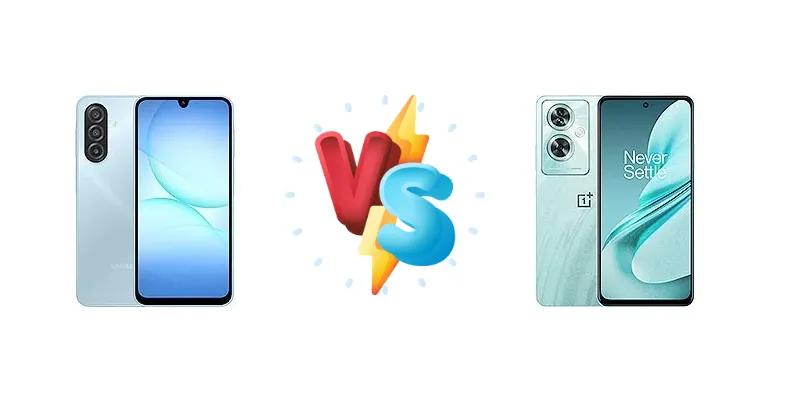
|
🏆 Quick Verdict
For the average user prioritizing faster charging and potentially smoother everyday performance, the OnePlus Nord N30 SE emerges as the better choice. Its 33W charging significantly reduces downtime, and the 7nm Dimensity 6020 offers a slight edge in efficiency over the 5nm Exynos 1330, despite the latter's higher clock speeds.
| PHONES | ||
|---|---|---|
| Phone Names | Samsung Galaxy M17 | OnePlus Nord N30 SE |
| Network | ||
|---|---|---|
| 2G bands | GSM 850 / 900 / 1800 / 1900 | GSM 850 / 900 / 1800 / 1900 |
| 3G bands | HSDPA 850 / 900 / 1700(AWS) / 1900 / 2100 | HSDPA 850 / 900 / 1700(AWS) / 1900 / 2100 |
| 4G bands | 1, 2, 3, 4, 5, 7, 8, 12, 17, 20, 26, 28, 38, 40, 41, 66 | 1, 2, 3, 4, 5, 7, 8, 12, 13, 17, 18, 19, 20, 26, 28, 38, 39, 40, 41, 66 |
| 5G bands | 1, 3, 5, 7, 8, 28, 40, 41, 66, 77, 78 SA/NSA/Sub6 | 1, 3, 5, 7, 8, 20, 28, 38, 40, 41, 66, 77, 78 SA/NSA |
| Speed | HSPA, LTE, 5G | HSPA, LTE, 5G |
| Technology | GSM / HSPA / LTE / 5G | GSM / HSPA / LTE / 5G |
| Launch | ||
|---|---|---|
| Announced | 2025, October 10 | 2024, January 29 |
| Status | Available. Released Exp. release 2025, October 13 | Available. Released 2024, January 31 |
| Body | ||
|---|---|---|
| Build | Glass front (Gorilla Glass Victus), plastic back, plastic frame | Glass front, plastic frame, plastic back |
| Dimensions | 164.4 x 77.9 x 7.5 mm (6.47 x 3.07 x 0.30 in) | 165.6 x 76 x 8 mm (6.52 x 2.99 x 0.31 in) |
| SIM | Nano-SIM + Nano-SIM | Nano-SIM + Nano-SIM |
| Weight | 192 g (6.77 oz) | 193 g (6.81 oz) |
| Display | ||
|---|---|---|
| Protection | Corning Gorilla Glass Victus | - |
| Resolution | 1080 x 2340 pixels, 19.5:9 ratio (~385 ppi density) | 1080 x 2400 pixels, 20:9 ratio (~392 ppi density) |
| Size | 6.7 inches, 110.2 cm2 (~86.0% screen-to-body ratio) | 6.72 inches, 109.0 cm2 (~86.6% screen-to-body ratio) |
| Type | Super AMOLED, 90Hz, 1100 nits (HBM) | IPS LCD |
| Platform | ||
|---|---|---|
| CPU | Octa-core (2x2.4 GHz Cortex-A78 & 6x2.0 GHz Cortex-A55) | Octa-core (2x2.2 GHz Cortex-A76 & 6x2.0 GHz Cortex-A55) |
| Chipset | Exynos 1330 (5 nm) | Mediatek Dimensity 6020 (7 nm) |
| GPU | Mali-G68 MP2 | Mali-G57 MC2 |
| OS | Android 15, up to 6 major Android upgrades, One UI 7 | Android 13, OxygenOS 13.1 |
| Memory | ||
|---|---|---|
| Card slot | microSDXC (uses shared SIM slot) | No |
| Internal | 128GB 4GB RAM, 128GB 6GB RAM, 128GB 8GB RAM | 128GB 4GB RAM |
| Main Camera | ||
|---|---|---|
| Dual | - | 50 MP, f/1.8, (wide), 1/2.76", 0.64µm, PDAF Auxiliary lens |
| Features | LED flash, panorama, HDR | LED flash, HDR, panorama |
| Triple | 50 MP, f/1.8, (wide), 1/2.76", 0.64µm, AF, OIS 5 MP, f/2.2, (ultrawide), 1/5.0", 1.12µm 2 MP (macro) | - |
| Video | 1080p@30fps, gyro-EIS | 1080p@30fps |
| Selfie camera | ||
|---|---|---|
| Single | 13 MP, f/2.0, (wide), 1/3.1", 1.12µm | 8 MP, f/2.0, (wide), 1/4.0", 1.12µm |
| Video | 1080p@30fps | 1080p@30fps |
| Sound | ||
|---|---|---|
| 35mm jack | No | Yes |
| Loudspeaker | Yes | Yes, with stereo speakers |
| Comms | ||
|---|---|---|
| Bluetooth | 5.3, A2DP, LE | 5.3, A2DP, LE |
| NFC | Yes | Yes |
| Positioning | GPS, GALILEO, GLONASS, BDS, QZSS | GPS, GALILEO, GLONASS, BDS |
| Radio | No | No |
| USB | USB Type-C 2.0 | USB Type-C 2.0, OTG |
| WLAN | Wi-Fi 802.11 a/b/g/n/ac, dual-band, Wi-Fi Direct | Wi-Fi 802.11 a/b/g/n/ac, dual-band |
| Features | ||
|---|---|---|
| Sensors | Fingerprint (side-mounted), accelerometer, gyro, proximity, compass | Fingerprint (side-mounted), accelerometer, gyro, proximity, compass |
| Battery | ||
|---|---|---|
| Charging | 25W wired | 33W wired, 51% in 30 min |
| Type | 5000 mAh | 5000 mAh |
| Misc | ||
|---|---|---|
| Colors | Moonlight Silver, Sapphire Black | Black Satin, Cyan |
| Models | - | CPH2605 |
| Price | About 120 EUR | About 510 EUR |
Samsung Galaxy M17
- Samsung ecosystem integration
- Potentially better software support
- Higher CPU clock speeds (on paper)
- Slower 25W charging
- Potentially more thermal throttling
- Exynos chipsets have historically lagged behind Snapdragon/Dimensity in GPU performance
OnePlus Nord N30 SE
- Faster 33W charging with 51% in 30 min
- More power-efficient 7nm Dimensity 6020
- OxygenOS offers a cleaner Android experience
- Potentially less robust software update schedule
- Lower peak CPU clock speeds
- OnePlus's track record with long-term software support is less consistent than Samsung's
Display Comparison
Neither device's display specifications are provided, so a direct comparison is limited. However, given the market segment, both likely utilize LCD panels. The absence of LTPO technology suggests standard refresh rates (likely 60Hz). The user experience will likely hinge on color calibration and brightness, areas where Samsung historically performs well. Bezels are expected to be comparable, focusing on maximizing screen real estate within the budget constraints.
Camera Comparison
Without detailed camera specifications, analysis is limited. Both phones likely feature multi-camera setups, but the quality will depend heavily on sensor size and image processing. The inclusion of a 2MP macro camera on either device is likely a marketing tactic, offering limited practical benefit due to the small sensor size. The primary sensor's aperture and size will be the key determinants of low-light performance. Samsung's image processing tends to be more saturated, while OnePlus often aims for a more natural look.
Performance
The core difference lies in the chipsets: Samsung's Exynos 1330 (5nm) versus the OnePlus Nord N30 SE's MediaTek Dimensity 6020 (7nm). While the Exynos 1330 boasts higher peak CPU clock speeds (2.4 GHz Cortex-A78 vs 2.2 GHz Cortex-A76), the Dimensity 6020's 7nm process node generally translates to better power efficiency. This means the N30 SE may exhibit less thermal throttling during prolonged gaming or demanding tasks. Both CPUs share a similar Cortex-A55 cluster for efficiency cores, suggesting comparable performance in light workloads. The 5nm process of the Exynos 1330 *should* offer some efficiency gains, but the architectural differences and clock speeds favor the Dimensity 6020 in sustained performance.
Battery Life
Battery capacity isn't specified, but the charging speeds are a clear differentiator. The OnePlus Nord N30 SE's 33W wired charging, capable of delivering 51% charge in 30 minutes, significantly outperforms the Samsung Galaxy M17's 25W charging. This faster charging is a substantial convenience factor for users who frequently need to top up their battery. Even with a slightly smaller battery capacity, the N30 SE's faster charging could result in less perceived downtime.
Buying Guide
Buy the Samsung Galaxy M17 if you prioritize the Samsung ecosystem and potentially benefit from future software updates, and are comfortable with slower charging speeds. Buy the OnePlus Nord N30 SE if you value faster charging, a potentially more efficient processor for sustained tasks, and a cleaner Android experience with OxygenOS. The N30 SE is ideal for users who frequently find themselves needing a quick power boost.