
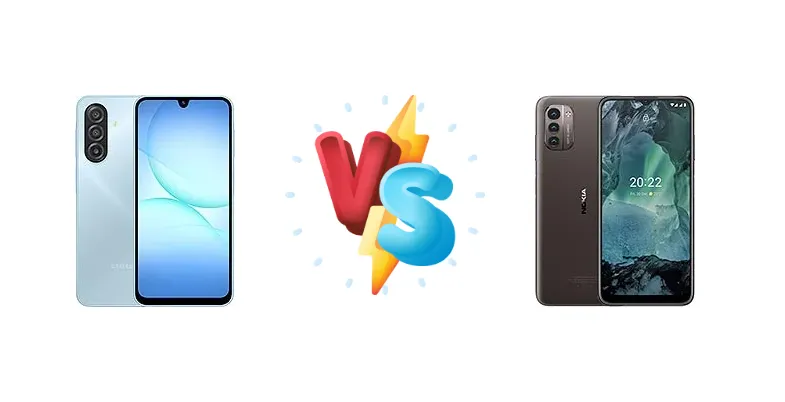
Samsung Galaxy M17 vs Nokia G21: A Detailed Comparison of Performance and Battery Life
| Phones Images | |||||
|---|---|---|---|---|---|
|
🏆 Quick Verdict
For users prioritizing responsiveness and smoother multitasking, the Samsung Galaxy M17 is the clear winner. Its Exynos 1330 offers a significant performance leap over the Nokia G21’s Unisoc T606. However, the Nokia G21’s excellent 126-hour endurance rating makes it ideal for those who need a phone that lasts for days on a single charge.
| PHONES | ||
|---|---|---|
| Phone Names | Samsung Galaxy M17 | Nokia G21 |
| Network | ||
|---|---|---|
| 2G bands | GSM 850 / 900 / 1800 / 1900 | GSM 850 / 900 / 1800 / 1900 |
| 3G bands | HSDPA 850 / 900 / 1700(AWS) / 1900 / 2100 | HSDPA 850 / 900 / 2100 - International |
| 4G bands | 1, 2, 3, 4, 5, 7, 8, 12, 17, 20, 26, 28, 38, 40, 41, 66 | 1, 3, 5, 7, 8, 20, 28, 38, 40, 41 - International |
| 5G bands | 1, 3, 5, 7, 8, 28, 40, 41, 66, 77, 78 SA/NSA/Sub6 | - |
| Speed | HSPA, LTE, 5G | HSPA 42.2/5.76 Mbps, LTE Cat4 150/50 Mbps |
| Technology | GSM / HSPA / LTE / 5G | GSM / HSPA / LTE |
| - | 1, 2, 3, 4, 5, 7, 8, 12, 17, 28, 40, 66 - LATAM | |
| Launch | ||
|---|---|---|
| Announced | 2025, October 10 | 2022, February 14 |
| Status | Available. Released Exp. release 2025, October 13 | Available. Released 2022, February 15 |
| Body | ||
|---|---|---|
| Build | Glass front (Gorilla Glass Victus), plastic back, plastic frame | Glass front, plastic frame, plastic back |
| Dimensions | 164.4 x 77.9 x 7.5 mm (6.47 x 3.07 x 0.30 in) | 164.6 x 75.9 x 8.5 mm (6.48 x 2.99 x 0.33 in) |
| SIM | Nano-SIM + Nano-SIM | · Nano-SIM· Nano-SIM + Nano-SIM |
| Weight | 192 g (6.77 oz) | 190 g (6.70 oz) |
| Display | ||
|---|---|---|
| Protection | Corning Gorilla Glass Victus | - |
| Resolution | 1080 x 2340 pixels, 19.5:9 ratio (~385 ppi density) | 720 x 1600 pixels, 20:9 ratio (~270 ppi density) |
| Size | 6.7 inches, 110.2 cm2 (~86.0% screen-to-body ratio) | 6.5 inches, 102.0 cm2 (~81.6% screen-to-body ratio) |
| Type | Super AMOLED, 90Hz, 1100 nits (HBM) | IPS LCD, 90Hz, 400 nits (typ) |
| Platform | ||
|---|---|---|
| CPU | Octa-core (2x2.4 GHz Cortex-A78 & 6x2.0 GHz Cortex-A55) | Octa-core (2x1.6 GHz Cortex-A75 & 6x1.6 GHz Cortex-A55) |
| Chipset | Exynos 1330 (5 nm) | Unisoc T606 (12 nm) |
| GPU | Mali-G68 MP2 | Mali-G57 MP1 |
| OS | Android 15, up to 6 major Android upgrades, One UI 7 | Android 11, upgradable to Android 13 |
| Memory | ||
|---|---|---|
| Card slot | microSDXC (uses shared SIM slot) | microSDXC (dedicated slot) |
| Internal | 128GB 4GB RAM, 128GB 6GB RAM, 128GB 8GB RAM | 64GB 3GB RAM, 64GB 4GB RAM, 128GB 4GB RAM, 128GB 6GB RAM |
| - | eMMC 5.1 | |
| Main Camera | ||
|---|---|---|
| Features | LED flash, panorama, HDR | LED flash, HDR, panorama |
| Single | - | 8 MP, f/2.0, (wide) |
| Triple | 50 MP, f/1.8, (wide), 1/2.76", 0.64µm, AF, OIS 5 MP, f/2.2, (ultrawide), 1/5.0", 1.12µm 2 MP (macro) | 50 MP, f/1.8, 28mm (wide), 1/2.76", 0.64µm, PDAF 2 MP (macro) Auxiliary lens |
| Video | 1080p@30fps, gyro-EIS | 1080p@30fps |
| Selfie camera | ||
|---|---|---|
| Single | 13 MP, f/2.0, (wide), 1/3.1", 1.12µm | 8 MP, f/2.0, (wide) |
| Video | 1080p@30fps | 1080p@30fps |
| Sound | ||
|---|---|---|
| 3.5mm jack | - | Yes |
| 35mm jack | No | Yes |
| Loudspeaker | Yes | Yes |
| Comms | ||
|---|---|---|
| Bluetooth | 5.3, A2DP, LE | 5.0, A2DP, LE |
| NFC | Yes | Yes (market/region dependent) |
| Positioning | GPS, GALILEO, GLONASS, BDS, QZSS | GPS, GLONASS, GALILEO |
| Radio | No | FM radio, RDS |
| USB | USB Type-C 2.0 | USB Type-C 2.0, OTG |
| WLAN | Wi-Fi 802.11 a/b/g/n/ac, dual-band, Wi-Fi Direct | Wi-Fi 802.11 a/b/g/n/ac, dual-band, Wi-Fi Direct |
| Features | ||
|---|---|---|
| Sensors | Fingerprint (side-mounted), accelerometer, gyro, proximity, compass | Fingerprint (side-mounted), accelerometer, proximity |
| Battery | ||
|---|---|---|
| Charging | 25W wired | 18W wired, PD3.0 |
| Type | 5000 mAh | Li-Po 5050 mAh |
| Misc | ||
|---|---|---|
| Colors | Moonlight Silver, Sapphire Black | Nordic Blue, Dusk |
| Models | - | TA-1418, TA-1477, TA-1415, TA-1405, TA-1404, TA-1412 |
| Price | About 120 EUR | About 90 EUR |
| SAR | - | 1.00 W/kg (head) 1.10 W/kg (body) |
| SAR EU | - | 0.34 W/kg (head) 1.05 W/kg (body) |
| Tests | ||
|---|---|---|
| Battery life | - | Endurance rating 126h |
| Camera | - | Photo / Video |
| Display | - | Contrast ratio: 1631:1 (nominal) |
| Loudspeaker | - | -30.7 LUFS (Below average) |
| Performance | - | AnTuTu: 171299 (v9) GeekBench: 1193 (v5.1) GFXBench: 8.9fps (ES 3.1 onscreen) |
Samsung Galaxy M17
- Significantly faster processor for smoother performance
- More efficient 5nm chipset reduces heat and throttling
- Faster 25W charging for quicker top-ups
- Battery life likely lower than the Nokia G21
- Display specifications are less detailed
Nokia G21
- Exceptional 126-hour battery endurance
- 500 nits peak brightness for good outdoor visibility
- PD3.0 charging compatibility
- Slower Unisoc T606 processor struggles with demanding tasks
- 12nm process less efficient than 5nm
Display Comparison
Both phones share a contrast ratio of 1631:1, suggesting similar visual depth. However, the Nokia G21 boasts a measured peak brightness of 500 nits, providing better visibility in direct sunlight. While the M17’s display specifications are not provided, it’s likely to offer a comparable brightness level. The lack of information on the M17’s panel type (LCD vs AMOLED) makes it difficult to assess color accuracy and viewing angles without further testing.
Camera Comparison
Both devices list 'Photo / Video' capabilities, but lack specific details regarding sensor size, aperture, or image processing. This makes a direct comparison challenging. However, the absence of any mention of advanced features like Optical Image Stabilization (OIS) on either device suggests a focus on basic photography. The Nokia G21’s camera is likely geared towards capturing acceptable images in good lighting conditions, while the M17’s camera performance will depend heavily on the quality of its image signal processor (ISP) integrated within the Exynos 1330.
Performance
The Samsung Galaxy M17’s Exynos 1330, fabricated on a 5nm process, delivers a substantial performance advantage over the Nokia G21’s 12nm Unisoc T606. The Exynos 1330’s octa-core configuration, featuring two 2.4 GHz Cortex-A78 cores, provides significantly faster processing speeds for demanding applications. The Unisoc T606, with its 1.6 GHz Cortex-A75 cores, is adequate for basic tasks but will struggle with intensive gaming or multitasking. The 5nm node of the Exynos also translates to improved thermal efficiency, potentially reducing throttling during prolonged use.
Battery Life
The Nokia G21 shines in battery endurance, achieving a remarkable 126-hour rating. While the M17’s battery capacity is unknown, the G21’s longevity is a significant advantage for users who frequently travel or have limited access to charging outlets. The M17 compensates with 25W wired charging, potentially offering faster top-ups compared to the G21’s 18W charging with PD3.0. However, the G21’s superior battery capacity may negate the charging speed difference for many users.
Buying Guide
Buy the Samsung Galaxy M17 if you need a phone for demanding tasks like gaming, video editing, or frequent app switching. Its more powerful processor and faster charging will significantly improve your daily experience. Buy the Nokia G21 if you prioritize battery life above all else, and your usage primarily consists of calls, texts, and light social media browsing. The G21’s longevity is unmatched in this price bracket.