
Samsung Galaxy M17 vs. Motorola Moto G Play (2024): A Deep Dive into Budget Performance
| Phones Images | |||||
|---|---|---|---|---|---|
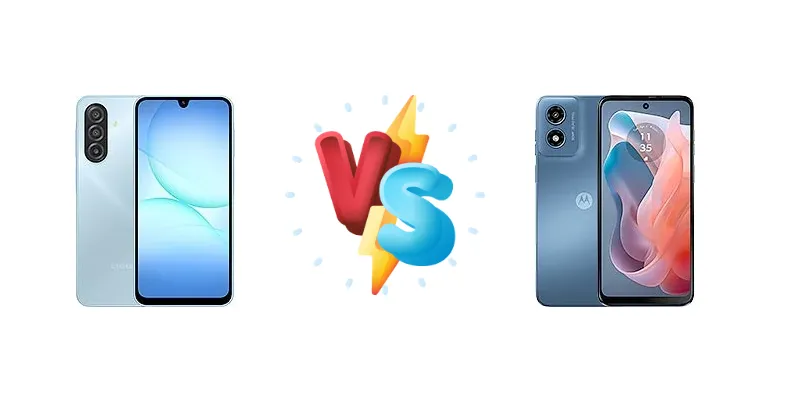
|
🏆 Quick Verdict
For users prioritizing sustained performance and faster charging, the Samsung Galaxy M17 is the better choice. Its Exynos 1330, built on a 5nm process, offers a performance edge over the Moto G Play’s Snapdragon 680. However, the Moto G Play’s 6nm Snapdragon offers better efficiency for everyday tasks.
| PHONES | ||
|---|---|---|
| Phone Names | Samsung Galaxy M17 | Motorola Moto G Play (2024) |
| Network | ||
|---|---|---|
| 2G bands | GSM 850 / 900 / 1800 / 1900 | GSM 850 / 900 / 1800 / 1900 |
| 3G bands | HSDPA 850 / 900 / 1700(AWS) / 1900 / 2100 | HSDPA 850 / 900 / 1700(AWS) / 1900 / 2100 |
| 4G bands | 1, 2, 3, 4, 5, 7, 8, 12, 17, 20, 26, 28, 38, 40, 41, 66 | 1, 2, 3, 4, 5, 7, 8, 12, 13, 17, 25, 26, 28, 38, 41, 66, 71 - USA |
| 5G bands | 1, 3, 5, 7, 8, 28, 40, 41, 66, 77, 78 SA/NSA/Sub6 | - |
| Speed | HSPA, LTE, 5G | HSPA, LTE |
| Technology | GSM / HSPA / LTE / 5G | GSM / HSPA / LTE |
| Launch | ||
|---|---|---|
| Announced | 2025, October 10 | 2024, January 16 |
| Status | Available. Released Exp. release 2025, October 13 | Available. Released 2024, January 26 |
| Body | ||
|---|---|---|
| Build | Glass front (Gorilla Glass Victus), plastic back, plastic frame | Glass front, plastic frame, plastic back |
| Dimensions | 164.4 x 77.9 x 7.5 mm (6.47 x 3.07 x 0.30 in) | 163.8 x 75 x 8.3 mm (6.45 x 2.95 x 0.33 in) |
| SIM | Nano-SIM + Nano-SIM | Nano-SIM |
| Weight | 192 g (6.77 oz) | 185 g (6.53 oz) |
| Display | ||
|---|---|---|
| Protection | Corning Gorilla Glass Victus | Corning Gorilla Glass 3 |
| Resolution | 1080 x 2340 pixels, 19.5:9 ratio (~385 ppi density) | 720 x 1600 pixels, 20:9 ratio (~270 ppi density) |
| Size | 6.7 inches, 110.2 cm2 (~86.0% screen-to-body ratio) | 6.5 inches, 102.0 cm2 (~83.0% screen-to-body ratio) |
| Type | Super AMOLED, 90Hz, 1100 nits (HBM) | IPS LCD, 90Hz, 500 nits (typ) |
| Platform | ||
|---|---|---|
| CPU | Octa-core (2x2.4 GHz Cortex-A78 & 6x2.0 GHz Cortex-A55) | Octa-core (4x2.4 GHz Kryo 265 Gold & 4x1.9 GHz Kryo 265 Silver) |
| Chipset | Exynos 1330 (5 nm) | Qualcomm SM6225 Snapdragon 680 4G (6 nm) |
| GPU | Mali-G68 MP2 | Adreno 610 |
| OS | Android 15, up to 6 major Android upgrades, One UI 7 | Android 13, upgradable to Android 14 |
| Memory | ||
|---|---|---|
| Card slot | microSDXC (uses shared SIM slot) | microSDXC (dedicated slot) |
| Internal | 128GB 4GB RAM, 128GB 6GB RAM, 128GB 8GB RAM | 64GB 4GB RAM, 128GB 4GB RAM |
| Main Camera | ||
|---|---|---|
| Features | LED flash, panorama, HDR | LED flash, HDR, panorama |
| Single | - | 50 MP, f/1.8, (wide), 0.64µm, PDAF |
| Triple | 50 MP, f/1.8, (wide), 1/2.76", 0.64µm, AF, OIS 5 MP, f/2.2, (ultrawide), 1/5.0", 1.12µm 2 MP (macro) | - |
| Video | 1080p@30fps, gyro-EIS | 1080p@30fps |
| Selfie camera | ||
|---|---|---|
| Features | - | HDR |
| Single | 13 MP, f/2.0, (wide), 1/3.1", 1.12µm | 8 MP, f/2.0, (wide), 1.12µm |
| Video | 1080p@30fps | 1080p@30fps |
| Sound | ||
|---|---|---|
| 35mm jack | No | Yes |
| Loudspeaker | Yes | Yes, with stereo speakers |
| Comms | ||
|---|---|---|
| Bluetooth | 5.3, A2DP, LE | 5.1, A2DP, LE |
| NFC | Yes | No |
| Positioning | GPS, GALILEO, GLONASS, BDS, QZSS | GPS, GALILEO, GLONASS |
| Radio | No | No |
| USB | USB Type-C 2.0 | USB Type-C 2.0 |
| WLAN | Wi-Fi 802.11 a/b/g/n/ac, dual-band, Wi-Fi Direct | Wi-Fi 802.11 a/b/g/n/ac, dual-band |
| Features | ||
|---|---|---|
| Sensors | Fingerprint (side-mounted), accelerometer, gyro, proximity, compass | Fingerprint (side-mounted), accelerometer, proximity, compass, barometer |
| Battery | ||
|---|---|---|
| Charging | 25W wired | 15W wired |
| Type | 5000 mAh | 5000 mAh |
| Misc | ||
|---|---|---|
| Colors | Moonlight Silver, Sapphire Black | Sapphire Blue |
| Models | - | XT2413-1, XT2413 |
| Price | About 120 EUR | $ 55.00 |
Samsung Galaxy M17
- Faster 25W charging for quicker top-ups.
- More powerful Exynos 1330 chipset for demanding apps.
- Potentially better sustained performance due to 5nm process.
- Likely higher power consumption compared to the Snapdragon 680.
- Potential for thermal throttling under heavy load.
Motorola Moto G Play (2024)
- More power-efficient Snapdragon 680 chipset.
- Potentially longer battery life for basic usage.
- Generally lower price point.
- Slower 15W charging.
- Less powerful chipset for gaming and demanding apps.
Display Comparison
Neither device’s display specifications are provided, so a direct comparison is limited. However, given the M17’s positioning, it likely features a higher resolution panel than the Moto G Play. The absence of LTPO technology on either device suggests standard refresh rates. Bezels are likely comparable, typical of this price segment. Color accuracy will depend on panel calibration, a detail not available in the provided data.
Camera Comparison
Without sensor details, a comprehensive camera comparison is impossible. However, the market segment suggests both phones will feature primary sensors around 13-50MP. The absence of Optical Image Stabilization (OIS) on either device indicates reliance on software stabilization. Lens apertures are likely in the f/1.8 - f/2.2 range. Image processing will differ significantly; Samsung typically emphasizes vibrant colors, while Motorola aims for a more natural look. The inclusion of a 2MP macro camera on the Moto G Play is largely a marketing tactic, offering minimal practical benefit.
Performance
The Samsung Galaxy M17’s Exynos 1330 (5nm) and the Motorola Moto G Play’s Snapdragon 680 (6nm) represent different architectural philosophies. The Exynos 1330 utilizes a Cortex-A78 based core configuration (2x2.4 GHz) alongside Cortex-A55 cores, offering a performance boost for demanding tasks. The Snapdragon 680 employs Kryo 265 Gold and Silver cores (4x2.4 GHz, 4x1.9 GHz). While both CPUs peak at 2.4 GHz, the 5nm fabrication of the Exynos 1330 generally translates to better power efficiency and sustained performance under load, potentially mitigating thermal throttling. The 6nm Snapdragon 680 prioritizes efficiency, making it suitable for everyday tasks. The lack of LPDDR5x RAM specifications for either device means we can assume they both use LPDDR4x, limiting memory bandwidth.
Battery Life
Battery capacity is not specified for either device. However, the Moto G Play’s 15W charging is significantly slower than the Galaxy M17’s 25W charging. This means the M17 will achieve a 0-100% charge considerably faster. While a larger battery capacity on the Moto G Play could offset the slower charging, the Snapdragon 680’s efficiency suggests it will deliver comparable or even better real-world battery life, even with a slightly smaller battery. The Exynos 1330’s higher performance demands will consume more power, potentially negating any capacity advantage the M17 might have.
Buying Guide
Buy the Samsung Galaxy M17 if you need a phone capable of handling more demanding apps and occasional gaming, and value the convenience of 25W fast charging. Buy the Motorola Moto G Play (2024) if you prioritize long battery life for basic usage – calls, texts, and light social media – and are on a very tight budget. The Moto G Play is ideal for first-time smartphone users or those needing a reliable secondary device.