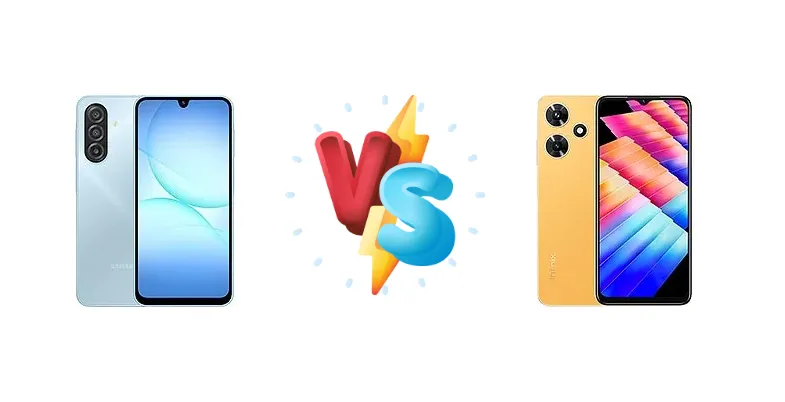
The Samsung Galaxy M17 and Infinix Hot 30i represent two distinct approaches to the budget smartphone market. The M17 leverages Samsung’s in-house Exynos 1330 chipset, aiming for a balance of power and efficiency. Conversely, the Hot 30i opts for the Unisoc T606, prioritizing affordability and potentially battery life. This comparison dissects their key differences to help you determine which device best suits your needs.
🏆 Quick Verdict
For users prioritizing raw performance and future-proofing, the Samsung Galaxy M17 is the clear winner. Its Exynos 1330, built on a 5nm process, offers a significant performance advantage over the Infinix Hot 30i’s 12nm Unisoc T606. However, the Hot 30i provides a compelling value proposition for those on a tighter budget.
| Network |
|---|
| 2G bands | GSM 850 / 900 / 1800 / 1900 | GSM 850 / 900 / 1800 / 1900 |
| 3G bands | HSDPA 850 / 900 / 1700(AWS) / 1900 / 2100 | HSDPA 850 / 900 / 1700(AWS) / 1900 / 2100 |
| 4G bands | 1, 2, 3, 4, 5, 7, 8, 12, 17, 20, 26, 28, 38, 40, 41, 66 | 1, 2, 3, 4, 5, 7, 8, 20, 28, 38, 40, 41 |
| 5G bands | 1, 3, 5, 7, 8, 28, 40, 41, 66, 77, 78 SA/NSA/Sub6 | - |
| Speed | HSPA, LTE, 5G | HSPA, LTE |
| Technology | GSM / HSPA / LTE / 5G | GSM / HSPA / LTE |
| Launch |
|---|
| Announced | 2025, October 10 | 2023, March 31 |
| Status | Available. Released Exp. release 2025, October 13 | Available. Released 2023, March 31 |
| Body |
|---|
| Build | Glass front (Gorilla Glass Victus), plastic back, plastic frame | Glass front, plastic frame, plastic back |
| Dimensions | 164.4 x 77.9 x 7.5 mm (6.47 x 3.07 x 0.30 in) | 164 x 75.8 x 8.4 mm (6.46 x 2.98 x 0.33 in) |
| SIM | Nano-SIM + Nano-SIM | Nano-SIM + Nano-SIM |
| Weight | 192 g (6.77 oz) | 191 g (6.74 oz) |
| Display |
|---|
| Protection | Corning Gorilla Glass Victus | - |
| Resolution | 1080 x 2340 pixels, 19.5:9 ratio (~385 ppi density) | 720 x 1612 pixels, 20:9 ratio (~269 ppi density) |
| Size | 6.7 inches, 110.2 cm2 (~86.0% screen-to-body ratio) | 6.56 inches, 103.4 cm2 (~83.2% screen-to-body ratio) |
| Type | Super AMOLED, 90Hz, 1100 nits (HBM) | IPS LCD, 90Hz, 500 nits (peak) |
| Platform |
|---|
| CPU | Octa-core (2x2.4 GHz Cortex-A78 & 6x2.0 GHz Cortex-A55) | Octa-core (2x1.6 GHz Cortex-A75 & 6x1.6 GHz Cortex-A55) |
| Chipset | Exynos 1330 (5 nm) | Unisoc T606 (12 nm) |
| GPU | Mali-G68 MP2 | Mali-G57 MP1 |
| OS | Android 15, up to 6 major Android upgrades, One UI 7 | Android 12, XOS 10.6 |
| Memory |
|---|
| Card slot | microSDXC (uses shared SIM slot) | microSDXC (dedicated slot) |
| Internal | 128GB 4GB RAM, 128GB 6GB RAM, 128GB 8GB RAM | 64GB 4GB RAM, 128GB 4GB RAM, 128GB 8GB RAM |
| | - | UFS 2.2 |
| Main Camera |
|---|
| Dual | - | 13 MP, f/1.9, (wide), AF
0.08 MP, (depth) |
| Features | LED flash, panorama, HDR | Dual-LED flash, HDR, panorama |
| Single | - | 13 MP, f/1.9, (wide), 1/3.07", AF
Auxiliary lens |
| Triple | 50 MP, f/1.8, (wide), 1/2.76", 0.64µm, AF, OIS
5 MP, f/2.2, (ultrawide), 1/5.0", 1.12µm
2 MP (macro) | - |
| Video | 1080p@30fps, gyro-EIS | 1080p@30fps |
| Selfie camera |
|---|
| Features | - | Dual-LED flash |
| Single | 13 MP, f/2.0, (wide), 1/3.1", 1.12µm | 8 MP, f/2.0, (wide), 1/3.94" |
| Video | 1080p@30fps | 1080p@30fps |
| Sound |
|---|
| 3.5mm jack | - | Yes |
| 35mm jack | No | Yes |
| Loudspeaker | Yes | Yes |
| Comms |
|---|
| Bluetooth | 5.3, A2DP, LE | Yes |
| NFC | Yes | Yes (Hot 30i NFC only) |
| Positioning | GPS, GALILEO, GLONASS, BDS, QZSS | GPS |
| Radio | No | FM radio |
| USB | USB Type-C 2.0 | USB Type-C 2.0, OTG |
| WLAN | Wi-Fi 802.11 a/b/g/n/ac, dual-band, Wi-Fi Direct | Wi-Fi 802.11 a/b/g/n/ac, dual-band |
| Features |
|---|
| Sensors | Fingerprint (side-mounted), accelerometer, gyro, proximity, compass | Fingerprint (side-mounted), accelerometer, proximity, compass |
| Battery |
|---|
| Charging | 25W wired | 18W wired |
| Type | 5000 mAh | 5000 mAh |
| Misc |
|---|
| Colors | Moonlight Silver, Sapphire Black | Mirror Black, Glacier Blue, Diamond White, Marigold |
| Models | - | X669, X669D |
| Price | About 120 EUR | - |
Samsung Galaxy M17
- Significantly faster processor (Exynos 1330)
- More efficient 5nm manufacturing process
- Faster 25W charging
- Potentially better camera image processing
- Likely higher price point
- May have less battery life than the Hot 30i
Infinix Hot 30i
- More affordable price
- Potentially longer battery life due to efficient chipset
- Acceptable performance for basic tasks
- Lightweight and easy to handle
- Slower processor (Unisoc T606)
- Slower 18W charging
- Less capable camera system
Display Comparison
While display specifications are missing, it's reasonable to assume both devices utilize LCD panels given their price points. The key difference will likely be color accuracy and peak brightness. Samsung generally excels in display quality, potentially offering more vibrant colors and better outdoor visibility. However, without specific nit ratings, it's difficult to quantify the advantage. Bezels are also likely to be larger on both devices, reflecting their budget nature.
Camera Comparison
Without detailed camera specs, it’s difficult to make a definitive judgment. However, Samsung typically employs more sophisticated image processing algorithms. It’s likely the M17 will produce more detailed and dynamic photos, especially in challenging lighting conditions. The presence of a larger sensor (likely, though unconfirmed) in the M17 would further enhance its low-light performance. We can assume both phones will include a standard macro camera, but the 2MP resolution on many budget phones renders them largely unusable for practical photography.
Performance
The core difference lies in the chipsets. The Samsung Galaxy M17’s Exynos 1330, fabricated on a 5nm process, boasts a more modern architecture – specifically, Cortex-A78 cores – compared to the Infinix Hot 30i’s Unisoc T606 and its Cortex-A75 cores. This translates to significantly higher single-core and multi-core performance for the M17. The 5nm node also contributes to better thermal efficiency, reducing the likelihood of performance throttling during sustained workloads. The Hot 30i’s T606 will be adequate for everyday tasks, but will struggle with graphically intensive games or multitasking. The M17’s CPU configuration (2x2.4 GHz Cortex-A78 & 6x2.0 GHz Cortex-A55) provides a substantial advantage over the Hot 30i’s (2x1.6 GHz Cortex-A75 & 6x1.6 GHz Cortex-A55).
Battery Life
The Infinix Hot 30i’s 18W charging is slower than the Samsung Galaxy M17’s 25W charging. While battery capacity is unknown for both, the more efficient Exynos 1330 in the M17 could offset a potentially smaller battery size. The 25W charging will allow the M17 to reach a full charge faster, minimizing downtime. The Hot 30i will likely prioritize maximizing battery life through its less power-hungry chipset, but at the cost of charging speed.
Buying Guide
Buy the Samsung Galaxy M17 if you need a phone capable of handling demanding applications, moderate gaming, and benefit from Samsung’s software ecosystem. It’s ideal for users who want a phone that will remain responsive for years to come. Buy the Infinix Hot 30i if you prioritize affordability and long battery life for basic tasks like calling, texting, and social media. It’s a great choice for first-time smartphone users or those seeking a reliable secondary device.
Frequently Asked Questions
❓ Does the Exynos 1330 in the Galaxy M17 tend to overheat during prolonged gaming sessions?
The Exynos 1330, built on a 5nm process, is generally efficient and well-managed. While some heat generation is inevitable during gaming, it's unlikely to experience significant throttling compared to the Unisoc T606 in the Hot 30i, which is built on a less efficient 12nm process. Samsung's thermal management solutions should keep temperatures within acceptable limits.
❓ Is the Unisoc T606 in the Infinix Hot 30i capable of running popular games like PUBG Mobile at acceptable frame rates?
The Unisoc T606 can run PUBG Mobile, but likely at lower graphics settings and frame rates (likely medium or low settings, aiming for 30fps). Expect occasional frame drops during intense action. The Exynos 1330 in the Galaxy M17 will provide a significantly smoother and more enjoyable gaming experience with higher settings and frame rates.
❓ How long will it take to fully charge the Infinix Hot 30i with its 18W charging?
With 18W charging, a full charge from 0% to 100% on the Infinix Hot 30i will likely take around 2.5 to 3.5 hours, depending on battery capacity. The Samsung Galaxy M17’s 25W charging will significantly reduce this time, potentially to around 1.5 to 2 hours.
❓ Will I notice a significant difference in app loading times between these two phones?
Yes, you will. The Exynos 1330’s superior processing power will result in noticeably faster app loading times compared to the Unisoc T606. This difference will be particularly apparent with larger, more complex applications.