
Samsung Galaxy M15 vs Xiaomi Redmi Note 13 Pro 4G: A Detailed Comparison
| Phones Images | |||||
|---|---|---|---|---|---|
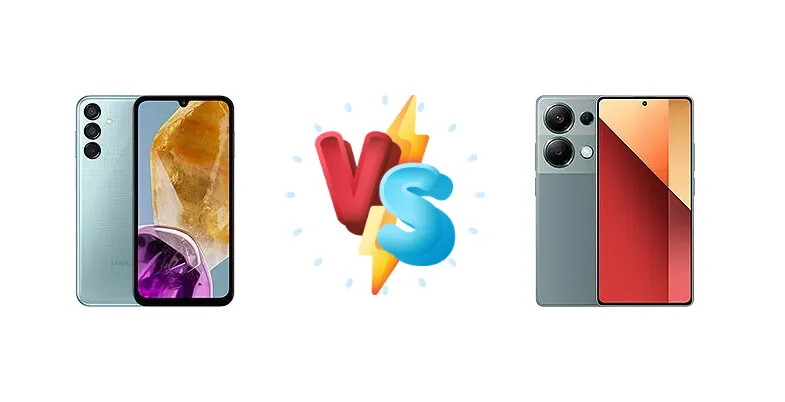
|
🏆 Quick Verdict
For the average user, the Xiaomi Redmi Note 13 Pro 4G emerges as the slightly better choice. Its significantly faster 67W charging – achieving 100% in just 46 minutes – is a major convenience, offsetting the similar processing power offered by the Galaxy M15’s Dimensity 6100+.
| PHONES | ||
|---|---|---|
| Phone Names | Samsung Galaxy M15 | Xiaomi Redmi Note 13 Pro 4G |
| Network | ||
|---|---|---|
| 2G bands | GSM 850 / 900 / 1800 / 1900 | GSM 850 / 900 / 1800 / 1900 |
| 3G bands | HSDPA 850 / 900 / 1700(AWS) / 1900 / 2100 | HSDPA 850 / 900 / 1700(AWS) / 1900 / 2100 |
| 4G bands | 1, 2, 3, 4, 5, 7, 8, 12, 17, 20, 26, 28, 38, 40, 41, 66 | 1, 2, 3, 4, 5, 7, 8, 12, 13, 17, 18, 19, 20, 26, 28, 38, 40, 41, 66 |
| 5G bands | 1, 3, 5, 7, 8, 20, 28, 38, 40, 41, 66, 77, 78 SA/NSA/Sub6 | - |
| Speed | HSPA, LTE, 5G | HSPA, LTE |
| Technology | GSM / HSPA / LTE / 5G | GSM / HSPA / LTE |
| Launch | ||
|---|---|---|
| Announced | 2024, March 09 | 2024, January 15 |
| Status | Available. Released 2024, April 05 | Available. Released 2024, January 15 |
| Body | ||
|---|---|---|
| Build | Glass front, plastic back, plastic frame | Glass front (Gorilla Glass 5), plastic frame, plastic back |
| Dimensions | 160.1 x 76.8 x 9.3 mm (6.30 x 3.02 x 0.37 in) | 161.1 x 75 x 8 mm (6.34 x 2.95 x 0.31 in) |
| SIM | Nano-SIM + Nano-SIM | Nano-SIM + Nano-SIM |
| Weight | 217 g (7.65 oz) | 188 g (6.63 oz) |
| Display | ||
|---|---|---|
| Protection | - | Corning Gorilla Glass 5 |
| Resolution | 1080 x 2340 pixels, 19.5:9 ratio (~396 ppi density) | 1080 x 2400 pixels, 20:9 ratio (~395 ppi density) |
| Size | 6.5 inches, 103.7 cm2 (~84.3% screen-to-body ratio) | 6.67 inches, 107.4 cm2 (~88.9% screen-to-body ratio) |
| Type | Super AMOLED, 90Hz, 800 nits (HBM) | AMOLED, 1B colors, 120Hz, 500 nits (typ), 1000 nits (HBM), 1300 nits (peak) |
| Platform | ||
|---|---|---|
| CPU | Octa-core (2x2.2 GHz Cortex-A76 & 6x2.0 GHz Cortex-A55) | Octa-core (2x2.2 GHz Cortex-A76 & 6x2.0 GHz Cortex-A55) |
| Chipset | Mediatek Dimensity 6100+ (6 nm) | Mediatek Helio G99 Ultra |
| GPU | Mali-G57 MC2 | Mali-G57 MC2 |
| OS | Android 14, up to 4 major Android upgrades, One UI 6 | Android 13, up to 3 major Android upgrades, HyperOS |
| Memory | ||
|---|---|---|
| Card slot | microSDXC (uses shared SIM slot) | microSDXC (uses shared SIM slot) |
| Internal | 128GB 4GB RAM, 128GB 6GB RAM, 128GB 8GB RAM, 256GB 8GB RAM | 128GB 8GB RAM, 256GB 8GB RAM, 256GB 12GB RAM, 512GB 8GB RAM, 512GB 12GB RAM |
| Main Camera | ||
|---|---|---|
| Features | LED flash, panorama, HDR | LED flash, HDR, panorama |
| Triple | 50 MP, f/1.8, (wide), AF 5 MP, f/2.2, (ultrawide) 2 MP (macro) | 200 MP, f/1.7, 23mm (wide), 1/1.4", 0.56µm, multi-directional PDAF, OIS 8 MP, f/2.2, 15mm, 120˚ (ultrawide), 1/4.4", 1.0µm 2 MP (macro) |
| Video | 1080p@30fps, gyro-EIS | 1080p@30/60fps |
| Selfie camera | ||
|---|---|---|
| Single | 13 MP, f/2.0, (wide) | 16 MP, f/2.4, (wide), 1/3.0", 1.0µm |
| Video | 1080p@30fps | 1080p@30/60fps |
| Sound | ||
|---|---|---|
| 35mm jack | Yes | Yes |
| Loudspeaker | Yes | Yes, with dual speakers |
| Comms | ||
|---|---|---|
| Bluetooth | 5.3, A2DP, LE | 5.2, A2DP, LE |
| Infrared port | - | Yes |
| NFC | Yes (market/region dependent) | Yes (market/region dependent) |
| Positioning | GPS, GALILEO, GLONASS, BDS, QZSS | GPS, GLONASS, GALILEO, BDS |
| Radio | No | FM radio |
| USB | USB Type-C 2.0 | USB Type-C 2.0, OTG |
| WLAN | Wi-Fi 802.11 a/b/g/n/ac, dual-band, Wi-Fi Direct | Wi-Fi 802.11 a/b/g/n/ac, dual-band |
| Features | ||
|---|---|---|
| Sensors | Fingerprint (side-mounted), accelerometer, gyro, compass | Fingerprint (under display, optical), accelerometer, gyro, compass |
| Battery | ||
|---|---|---|
| Charging | 25W wired | 67W wired, 50% in 16 min, 100% in 46 min |
| Type | 6000 mAh | 5000 mAh |
| Misc | ||
|---|---|---|
| Colors | Light Blue, Dark Blue, Gray | Midnight Black, Lavender Purple, Forest Green |
| Models | SM-M156B, SM-M156B/DS, SM-M156B/DSN | 23117RA68G, 2312FPCA6G |
| Price | € 179.99 / ₹ 15,999 | € 92.00 / $ 269.99 / £ 299.99 |
| SAR | 0.71 W/kg (head) | 1.09 W/kg (head) 1.09 W/kg (body) |
| SAR EU | 0.78 W/kg (head) 1.19 W/kg (body) | 0.99 W/kg (head) 0.99 W/kg (body) |
Samsung Galaxy M15
- Potentially better sustained performance due to 6nm Dimensity 6100+ chip
- Samsung’s One UI offers a feature-rich software experience
- Likely to receive longer software support from Samsung
- Slower 25W charging
- Display brightness likely lower than Redmi Note 13 Pro 4G
- Camera system potentially less advanced
Xiaomi Redmi Note 13 Pro 4G
- Significantly faster 67W charging (0-100% in 46 minutes)
- Brighter 1047 nit display for outdoor visibility
- Excellent battery life (11:36h active use)
- Helio G99 Ultra may throttle slightly more under sustained load
- Xiaomi’s MIUI can be more cluttered than One UI
- Software update commitment potentially shorter than Samsung
Display Comparison
The Xiaomi Redmi Note 13 Pro 4G boasts a notably brighter display, reaching a measured peak brightness of 1047 nits. This is a significant advantage for outdoor use, where the Galaxy M15’s display specifications are currently unknown. While both likely utilize AMOLED panels given their market segment, the Redmi’s higher brightness translates to better readability in direct sunlight. Bezels are expected to be comparable, typical of this price range, and color accuracy will likely be tuned for vibrant, rather than strictly accurate, visuals on both devices.
Camera Comparison
Detailed camera specifications beyond 'Photo/Video' are absent for both devices. However, given the Redmi Note 13 Pro 4G’s positioning, it’s reasonable to expect a more sophisticated camera system, potentially including a larger main sensor and optical image stabilization (OIS). The inclusion of OIS would be a significant benefit for low-light photography and video recording, reducing blur and improving stability. The Galaxy M15 will likely focus on software processing to enhance image quality, but without hardware advantages like OIS, it may struggle to match the Redmi’s potential in challenging conditions. The presence of a 2MP macro camera on either device is largely a marketing feature with limited practical utility.
Performance
Both the Samsung Galaxy M15 and Xiaomi Redmi Note 13 Pro 4G are powered by Mediatek processors featuring the same CPU core configuration: a 2x2.2 GHz Cortex-A76 and 6x2.0 GHz Cortex-A55 setup. However, the M15 utilizes the Dimensity 6100+ built on a 6nm process, while the Redmi Note 13 Pro 4G features the Helio G99 Ultra. While the CPU is identical, the Dimensity 6100+ *may* offer a slight edge in sustained performance due to the more efficient 6nm node, potentially leading to less thermal throttling during extended gaming sessions. Both devices will likely perform similarly for everyday tasks, but the M15 has a theoretical advantage in demanding scenarios.
Battery Life
The Redmi Note 13 Pro 4G shines in the battery and charging department. While the M15 offers 25W wired charging, the Redmi supports a significantly faster 67W charging solution, capable of reaching 50% charge in just 16 minutes and a full charge in 46 minutes. This is a substantial time saving. The Redmi Note 13 Pro 4G also boasts an active use battery score of 11 hours and 36 minutes, indicating excellent real-world endurance. While the M15’s battery capacity is unknown, the Redmi’s faster charging effectively mitigates any potential capacity disadvantage.
Buying Guide
Buy the Samsung Galaxy M15 if you prioritize a slightly newer chipset architecture and anticipate needing longer sustained performance during demanding tasks. Buy the Xiaomi Redmi Note 13 Pro 4G if you value rapid charging, a brighter display for outdoor visibility, and a more streamlined user experience focused on quick top-ups and media consumption.