
Samsung Galaxy M15 vs A25: A Deep Dive into Samsung's Budget Battle
| Phones Images | |||||
|---|---|---|---|---|---|
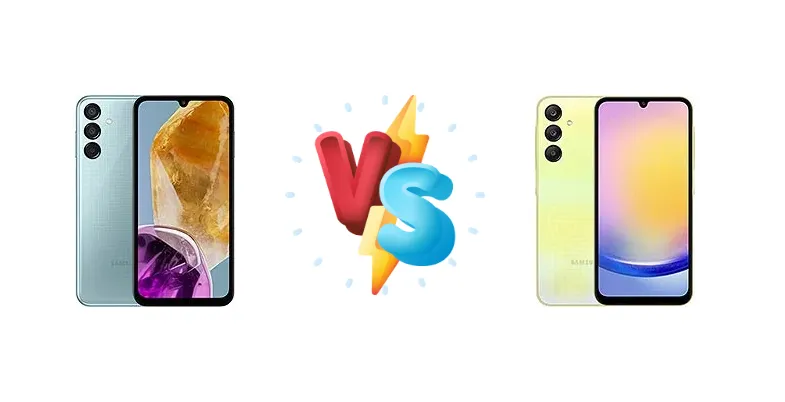
|
🏆 Quick Verdict
For most users, the Samsung Galaxy A25 emerges as the better choice. Its Exynos 1280 chipset provides a noticeable performance uplift over the M15’s Dimensity 6100+, and the brighter 1030 nit display enhances the viewing experience. While battery life is excellent on both, the A25’s measured 10:19h active use score gives it a slight edge.
| PHONES | ||
|---|---|---|
| Phone Names | Samsung Galaxy M15 | Samsung Galaxy A25 |
| Network | ||
|---|---|---|
| 2G bands | GSM 850 / 900 / 1800 / 1900 | GSM 850 / 900 / 1800 / 1900 |
| 3G bands | HSDPA 850 / 900 / 1700(AWS) / 1900 / 2100 | HSDPA 850 / 900 / 1700(AWS) / 1900 / 2100 |
| 4G bands | 1, 2, 3, 4, 5, 7, 8, 12, 17, 20, 26, 28, 38, 40, 41, 66 | 1, 2, 3, 4, 5, 7, 8, 12, 13, 17, 20, 26, 28, 38, 40, 41, 66 |
| 5G bands | 1, 3, 5, 7, 8, 20, 28, 38, 40, 41, 66, 77, 78 SA/NSA/Sub6 | 1, 3, 5, 7, 8, 26, 28, 40, 41, 66, 77, 78 SA/NSA/Sub6 |
| Speed | HSPA, LTE, 5G | HSPA, LTE, 5G |
| Technology | GSM / HSPA / LTE / 5G | GSM / HSPA / LTE / 5G |
| Launch | ||
|---|---|---|
| Announced | 2024, March 09 | 2023, December 11 |
| Status | Available. Released 2024, April 05 | Available. Released 2023, December 16 |
| Body | ||
|---|---|---|
| Build | Glass front, plastic back, plastic frame | Glass front, plastic frame, plastic back |
| Dimensions | 160.1 x 76.8 x 9.3 mm (6.30 x 3.02 x 0.37 in) | 161 x 76.5 x 8.3 mm (6.34 x 3.01 x 0.33 in) |
| SIM | Nano-SIM + Nano-SIM | · Nano-SIM· Nano-SIM + Nano-SIM |
| Weight | 217 g (7.65 oz) | 197 g (6.95 oz) |
| Display | ||
|---|---|---|
| Resolution | 1080 x 2340 pixels, 19.5:9 ratio (~396 ppi density) | 1080 x 2340 pixels, 19.5:9 ratio (~396 ppi density) |
| Size | 6.5 inches, 103.7 cm2 (~84.3% screen-to-body ratio) | 6.5 inches, 103.7 cm2 (~84.2% screen-to-body ratio) |
| Type | Super AMOLED, 90Hz, 800 nits (HBM) | Super AMOLED, 120Hz, 1000 nits (HBM) |
| Platform | ||
|---|---|---|
| CPU | Octa-core (2x2.2 GHz Cortex-A76 & 6x2.0 GHz Cortex-A55) | Octa-core (2x2.4 GHz Cortex-A78 & 6x2.0 GHz Cortex-A55) |
| Chipset | Mediatek Dimensity 6100+ (6 nm) | Exynos 1280 (5 nm) |
| GPU | Mali-G57 MC2 | Mali-G68 |
| OS | Android 14, up to 4 major Android upgrades, One UI 6 | Android 14, up to 4 major Android upgrades, One UI 7 |
| Memory | ||
|---|---|---|
| Card slot | microSDXC (uses shared SIM slot) | microSDXC (uses shared SIM slot) |
| Internal | 128GB 4GB RAM, 128GB 6GB RAM, 128GB 8GB RAM, 256GB 8GB RAM | 128GB 4GB RAM, 128GB 6GB RAM, 128GB 8GB RAM, 256GB 6GB RAM, 256GB 8GB RAM |
| Main Camera | ||
|---|---|---|
| Features | LED flash, panorama, HDR | LED flash, panorama, HDR |
| Triple | 50 MP, f/1.8, (wide), AF 5 MP, f/2.2, (ultrawide) 2 MP (macro) | 50 MP, f/1.8, 27mm (wide), 1/2.76", 0.64µm, PDAF, OIS 8 MP, f/2.2, 120˚ (ultrawide), 1/4", 1.12µm 2 MP (macro) |
| Video | 1080p@30fps, gyro-EIS | 4K@30fps, 1080p@30/60fps, gyro-EIS |
| Selfie camera | ||
|---|---|---|
| Single | 13 MP, f/2.0, (wide) | 13 MP, f/2.2, (wide), 1/3.06", 1.12µm |
| Video | 1080p@30fps | 1080p@30fps |
| Sound | ||
|---|---|---|
| 35mm jack | Yes | Yes |
| Loudspeaker | Yes | Yes, with stereo speakers |
| Comms | ||
|---|---|---|
| Bluetooth | 5.3, A2DP, LE | 5.3, A2DP, LE |
| NFC | Yes (market/region dependent) | Yes (market/region dependent) |
| Positioning | GPS, GALILEO, GLONASS, BDS, QZSS | GPS, GLONASS, GALILEO, BDS, QZSS |
| Radio | No | Market/region dependent |
| USB | USB Type-C 2.0 | USB Type-C 2.0 |
| WLAN | Wi-Fi 802.11 a/b/g/n/ac, dual-band, Wi-Fi Direct | Wi-Fi 802.11 a/b/g/n/ac, dual-band, Wi-Fi Direct |
| Features | ||
|---|---|---|
| Sensors | Fingerprint (side-mounted), accelerometer, gyro, compass | Fingerprint (side-mounted), accelerometer, gyro, compass |
| Battery | ||
|---|---|---|
| Charging | 25W wired | 25W wired |
| Type | 6000 mAh | 5000 mAh |
| Misc | ||
|---|---|---|
| Colors | Light Blue, Dark Blue, Gray | Brave Black, Personality Yellow, Fantasy Blue, Optimistic Blue |
| Models | SM-M156B, SM-M156B/DS, SM-M156B/DSN | SM-A256E, SM-A256E/DS, SM-A256E/DSN, SM-A256B, SM-A256B/DS, SM-A256B/DSN, SM-A256U, SM-A256U1 |
| Price | € 179.99 / ₹ 15,999 | € 175.99 / $ 120.32 / ₹ 18,399 |
| SAR | 0.71 W/kg (head) | - |
| SAR EU | 0.78 W/kg (head) 1.19 W/kg (body) | 0.46 W/kg (head) 1.19 W/kg (body) |
Samsung Galaxy M15
- Potentially better battery efficiency due to Dimensity 6100+.
- Likely more affordable price point.
- Solid performance for everyday tasks.
- Less powerful chipset compared to the Exynos 1280.
- Display likely less bright than the A25.
Samsung Galaxy A25
- More powerful Exynos 1280 chipset for smoother performance.
- Brighter 1030 nit display for better outdoor visibility.
- Longer measured battery life (10:19h active use).
- May be slightly more expensive than the M15.
- Exynos 1280 could potentially run warmer under heavy load.
Display Comparison
The Galaxy A25 boasts a significantly brighter display, reaching a measured peak brightness of 1030 nits. This is a substantial improvement over what we’d expect in this price bracket, making it far more usable outdoors. While both phones likely utilize LCD panels (given the price point), the A25’s higher brightness translates to better visibility in direct sunlight. Details regarding refresh rate and panel technology (like PWM dimming) are missing, but the brightness difference is a clear win for the A25.
Camera Comparison
Context data is limited regarding camera capabilities beyond 'Photo / Video'. However, given the market positioning, we can infer that both phones will feature a multi-camera setup with a primary sensor, ultrawide, and potentially a macro lens. The quality will largely depend on sensor size and image processing algorithms. Without specific sensor details, it’s difficult to declare a clear winner. We anticipate the A25 might benefit from Samsung’s more refined image processing pipeline, but this is speculative. The inclusion of Optical Image Stabilization (OIS) on either device is unlikely at this price point.
Performance
The core difference lies in the chipsets. The Galaxy A25’s Exynos 1280, fabricated on a 5nm process, offers a performance advantage over the M15’s 6nm Mediatek Dimensity 6100+. The Exynos 1280’s CPU features two 2.4 GHz Cortex-A78 cores, a step up from the M15’s 2.2 GHz Cortex-A76 cores. This translates to faster app loading times and smoother multitasking. While both CPUs are octa-core with similar Cortex-A55 efficiency cores, the A25’s architecture is more modern and efficient. The 5nm process also contributes to better thermal management, potentially reducing throttling during sustained workloads.
Battery Life
The Galaxy A25 demonstrates a strong battery performance with a measured 10:19 hours of active use. While the M15’s battery capacity isn’t specified, the Dimensity 6100+ is known for its efficiency. Both phones share the same 25W wired charging, suggesting similar charging speeds. The A25’s longer active use time suggests either a larger battery capacity or more efficient power management, making it the slightly more appealing option for heavy users.
Buying Guide
Buy the Samsung Galaxy M15 if you prioritize long-term efficiency and are primarily focused on everyday tasks like browsing, social media, and light communication. Its Dimensity 6100+ chipset offers a good balance of power and battery life. Buy the Samsung Galaxy A25 if you value smoother multitasking, occasional gaming, and a brighter, more vibrant display. The Exynos 1280 provides a tangible performance advantage for demanding applications.