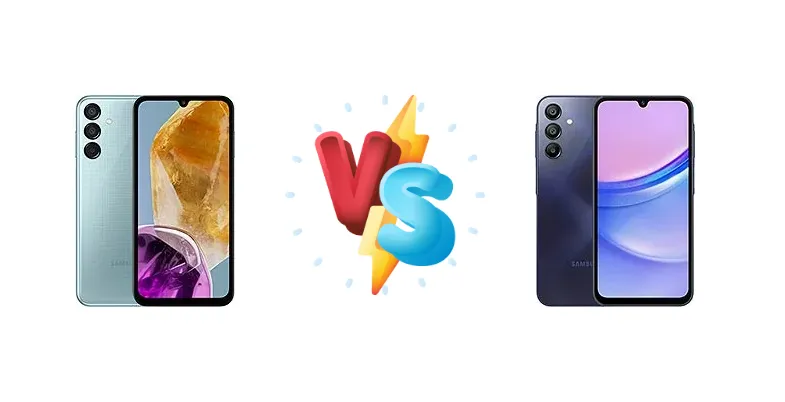
Samsung's A and M series represent the core of their budget and mid-range offerings. The Galaxy M15 and A15 both aim for affordability, but diverge in their internal hardware. The M15 boasts the newer Mediatek Dimensity 6100+ chipset, while the A15 relies on the established Helio G99. This comparison dissects these differences to determine which device delivers the best value for your money.
🏆 Quick Verdict
For users prioritizing sustained performance and future-proofing, the Samsung Galaxy M15 is the better choice. While both phones share a 25W charging rate, the Dimensity 6100+ offers a noticeable performance edge over the Helio G99, making it more suitable for demanding tasks and gaming. However, the A15’s excellent 15:28h battery life is a strong contender for those prioritizing longevity.
| Network |
|---|
| 2G bands | GSM 850 / 900 / 1800 / 1900 | GSM 850 / 900 / 1800 / 1900 |
| 3G bands | HSDPA 850 / 900 / 1700(AWS) / 1900 / 2100 | HSDPA 850 / 900 / 2100 |
| 4G bands | 1, 2, 3, 4, 5, 7, 8, 12, 17, 20, 26, 28, 38, 40, 41, 66 | 1, 3, 5, 7, 8, 20, 28, 38, 40, 41 |
| 5G bands | 1, 3, 5, 7, 8, 20, 28, 38, 40, 41, 66, 77, 78 SA/NSA/Sub6 | - |
| Speed | HSPA, LTE, 5G | HSPA, LTE |
| Technology | GSM / HSPA / LTE / 5G | GSM / HSPA / LTE |
| Launch |
|---|
| Announced | 2024, March 09 | 2023, December 11 |
| Status | Available. Released 2024, April 05 | Available. Released 2023, December 16 |
| Body |
|---|
| Build | Glass front, plastic back, plastic frame | Glass front, plastic back, plastic frame |
| Dimensions | 160.1 x 76.8 x 9.3 mm (6.30 x 3.02 x 0.37 in) | 160.1 x 76.8 x 8.4 mm (6.30 x 3.02 x 0.33 in) |
| SIM | Nano-SIM + Nano-SIM | · Nano-SIM· Nano-SIM + Nano-SIM |
| Weight | 217 g (7.65 oz) | 200 g (7.05 oz) |
| Display |
|---|
| Resolution | 1080 x 2340 pixels, 19.5:9 ratio (~396 ppi density) | 1080 x 2340 pixels, 19.5:9 ratio (~396 ppi density) |
| Size | 6.5 inches, 103.7 cm2 (~84.3% screen-to-body ratio) | 6.5 inches, 103.7 cm2 (~84.3% screen-to-body ratio) |
| Type | Super AMOLED, 90Hz, 800 nits (HBM) | Super AMOLED, 90Hz, 800 nits (HBM) |
| Platform |
|---|
| CPU | Octa-core (2x2.2 GHz Cortex-A76 & 6x2.0 GHz Cortex-A55) | Octa-core (2x2.2 GHz Cortex-A76 & 6x2.0 GHz Cortex-A55) |
| Chipset | Mediatek Dimensity 6100+ (6 nm) | Mediatek Helio G99 (6 nm) |
| GPU | Mali-G57 MC2 | Mali-G57 MC2 |
| OS | Android 14, up to 4 major Android upgrades, One UI 6 | Android 14, up to 4 major Android upgrades, One UI 7 |
| Memory |
|---|
| Card slot | microSDXC (uses shared SIM slot) | microSDXC (uses shared SIM slot) |
| Internal | 128GB 4GB RAM, 128GB 6GB RAM, 128GB 8GB RAM, 256GB 8GB RAM | 128GB 4GB RAM, 128GB 6GB RAM, 128GB 8GB RAM, 256GB 6GB RAM, 256GB 8GB RAM |
| Main Camera |
|---|
| Features | LED flash, panorama, HDR | LED flash, panorama, HDR |
| Triple | 50 MP, f/1.8, (wide), AF
5 MP, f/2.2, (ultrawide)
2 MP (macro) | 50 MP, f/1.8, 26mm (wide), 1/2.8", 0.64µm, PDAF
5 MP, f/2.2, 17mm (ultrawide), 1/5.0", 1.12µm
2 MP (macro) |
| Video | 1080p@30fps, gyro-EIS | 1080p@30fps |
| Selfie camera |
|---|
| Single | 13 MP, f/2.0, (wide) | 13 MP, f/2.0, 26mm (wide), 1/3.06", 1.12µm |
| Video | 1080p@30fps | 1080p@30fps |
| Sound |
|---|
| 35mm jack | Yes | Yes |
| Loudspeaker | Yes | Yes |
| Comms |
|---|
| Bluetooth | 5.3, A2DP, LE | 5.3, A2DP, LE |
| NFC | Yes (market/region dependent) | Yes (market/region dependent) |
| Positioning | GPS, GALILEO, GLONASS, BDS, QZSS | GPS, GALILEO, GLONASS, BDS, QZSS |
| Radio | No | FM radio (market/region dependent) |
| USB | USB Type-C 2.0 | USB Type-C 2.0 |
| WLAN | Wi-Fi 802.11 a/b/g/n/ac, dual-band, Wi-Fi Direct | Wi-Fi 802.11 a/b/g/n/ac, dual-band, Wi-Fi Direct |
| Features |
|---|
| Sensors | Fingerprint (side-mounted), accelerometer, gyro, compass | Fingerprint (side-mounted), accelerometer, compass |
| Battery |
|---|
| Charging | 25W wired | 25W wired |
| Type | 6000 mAh | 5000 mAh |
| Misc |
|---|
| Colors | Light Blue, Dark Blue, Gray | Brave Black, Optimistic Blue, Magical Blue, Personality Yellow |
| Models | SM-M156B, SM-M156B/DS, SM-M156B/DSN | SM-A155F, SM-A155F/DSN, SM-A155M, SM-A155M/DS, SM-A155P, SM-A155R |
| Price | € 179.99 / ₹ 15,999 | € 168.99 / $ 125.00 / £ 113.00 |
| SAR | 0.71 W/kg (head) | - |
| SAR EU | 0.78 W/kg (head) 1.19 W/kg (body) | 0.42 W/kg (head) 1.29 W/kg (body) |
Samsung Galaxy M15
- More powerful Dimensity 6100+ chipset for better performance
- Potentially better thermal management due to chipset efficiency
- Likely better suited for gaming and multitasking
- Battery life may be slightly shorter than the A15
- Specific battery capacity is unknown
Samsung Galaxy A15
- Exceptional battery life (15:28h active use)
- Bright display (808 nits peak brightness)
- Excellent value for users prioritizing longevity
- Less powerful Helio G99 chipset
- May struggle with demanding games or heavy multitasking
Display Comparison
The Samsung Galaxy A15 features a display capable of reaching 808 nits of peak brightness, a strong figure for outdoor visibility in direct sunlight. While the M15’s display specifications are not provided, it’s reasonable to expect a similar brightness level given its positioning. Both phones likely utilize PLS LCD panels, a Samsung staple in this price range. The absence of high refresh rate panels (90Hz or 120Hz) is typical for this segment, focusing instead on power efficiency. Color accuracy is likely comparable, leaning towards Samsung’s vibrant, saturated profile.
Camera Comparison
Without detailed camera specifications, a direct comparison is challenging. However, both phones likely feature a primary camera sensor around the 50MP mark, typical for this price bracket. The image processing algorithms will likely be similar, leaning towards Samsung’s tendency for vibrant colors and boosted contrast. The presence of a 2MP macro camera on both devices is largely a marketing feature, offering limited practical benefit due to its low resolution and fixed focus. The aperture of the main lens and the inclusion of Optical Image Stabilization (OIS) – if present – would be key differentiators, but this information is currently unavailable.
Performance
The core difference lies in the chipsets. The Samsung Galaxy M15’s Mediatek Dimensity 6100+ (6nm) offers a performance advantage over the A15’s Helio G99 (6nm). Both CPUs share the same core configuration – an octa-core setup with 2x2.2 GHz Cortex-A76 and 6x2.0 GHz Cortex-A55 cores – but the Dimensity 6100+ benefits from architectural improvements and a more efficient process node. This translates to better sustained performance under load and improved thermal management. While both are capable of handling everyday tasks, the M15 will exhibit less slowdown during multitasking and more demanding applications. The GPU within the Dimensity 6100+ also provides a boost in gaming performance.
Battery Life
The Samsung Galaxy A15 shines in battery life, achieving an impressive 15:28 hours of active use. While the M15’s battery capacity isn’t specified, the more powerful Dimensity 6100+ chipset may consume slightly more power. Both phones support 25W wired charging, suggesting similar 0-100% charging times – approximately 1.5 to 2 hours. The A15’s longer battery life makes it ideal for users who frequently travel or have limited access to charging outlets.
Buying Guide
Buy the Samsung Galaxy M15 if you need a phone capable of handling moderate multitasking, occasional gaming, and benefit from a slightly more modern chipset. Buy the Samsung Galaxy A15 if you prioritize exceptional battery life above all else, and your usage primarily consists of basic tasks like calling, texting, and light social media browsing. The A15 is ideal for users who want a phone that will reliably last a full day, even with heavy use.
Frequently Asked Questions
❓ Will the Mediatek Dimensity 6100+ in the M15 handle demanding games like PUBG or Call of Duty?
The Dimensity 6100+ is a capable chipset that should handle PUBG and Call of Duty at medium settings with reasonable frame rates. However, don't expect flagship-level performance. You may need to lower graphics settings for a smoother experience, especially during intense firefights. The Helio G99 in the A15 will struggle more with these titles.
❓ How long will the Samsung Galaxy A15 last on a single charge with typical usage?
With typical usage – including browsing, social media, and occasional calls – the Samsung Galaxy A15 should easily last a full day, and potentially even two days, thanks to its impressive 15:28h active use score. This makes it an excellent choice for users who prioritize battery life and don't want to worry about frequent charging.
❓ Does either phone support fast charging beyond 25W?
Neither the Samsung Galaxy M15 nor the A15 supports charging speeds beyond 25W. While 25W is adequate, it's not the fastest charging technology available. Expect a full charge to take approximately 1.5 to 2 hours.
❓ Is the 2MP macro camera on either phone worth using?
The 2MP macro camera on both the M15 and A15 is largely a marketing feature. Its low resolution and fixed focus result in images that lack detail and sharpness. It's best to rely on the main camera for most of your photography needs.