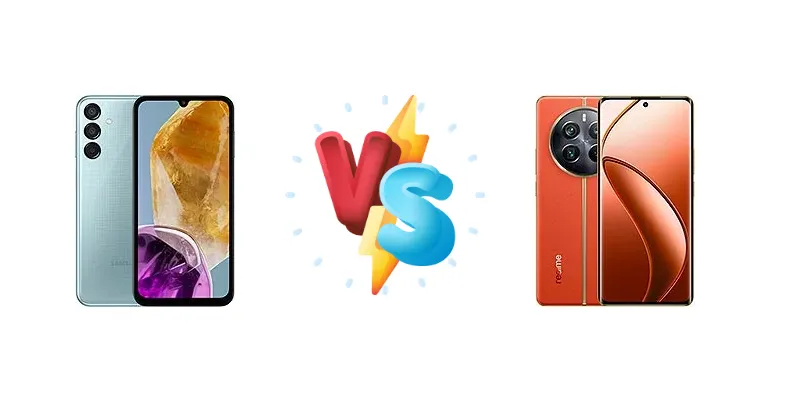
The mid-range smartphone market is fiercely competitive, and the Samsung Galaxy M15 and Realme 12 Pro+ represent compelling options for budget-conscious buyers. The M15 focuses on providing a solid all-around experience, while the 12 Pro+ prioritizes faster charging and a brighter display. This comparison dives deep into the specifications and real-world implications of each device to determine which one best suits your needs.
🏆 Quick Verdict
For the average user prioritizing fast charging and a vibrant display, the Realme 12 Pro+ is the better choice. Its 67W charging significantly reduces downtime, and the 802 nit peak brightness offers superior visibility outdoors. However, the Samsung Galaxy M15 remains a strong contender for those valuing a balanced package and potentially longer software support.
| Network |
|---|
| 2G bands | GSM 850 / 900 / 1800 / 1900 | GSM 850 / 900 / 1800 / 1900 |
| 3G bands | HSDPA 850 / 900 / 1700(AWS) / 1900 / 2100 | HSDPA 850 / 900 / 2100 |
| 4G bands | 1, 2, 3, 4, 5, 7, 8, 12, 17, 20, 26, 28, 38, 40, 41, 66 | 1, 3, 5, 8, 28, 40, 41 |
| 5G bands | 1, 3, 5, 7, 8, 20, 28, 38, 40, 41, 66, 77, 78 SA/NSA/Sub6 | 1, 3, 5, 8, 28, 40, 41, 77, 78 SA/NSA |
| Speed | HSPA, LTE, 5G | HSPA, LTE, 5G |
| Technology | GSM / HSPA / LTE / 5G | GSM / HSPA / LTE / 5G |
| Launch |
|---|
| Announced | 2024, March 09 | 2024, January 29 |
| Status | Available. Released 2024, April 05 | Available. Released 2024, January 29 |
| Body |
|---|
| Build | Glass front, plastic back, plastic frame | - |
| Dimensions | 160.1 x 76.8 x 9.3 mm (6.30 x 3.02 x 0.37 in) | 161.5 x 74 x 8.8 mm (6.36 x 2.91 x 0.35 in) |
| SIM | Nano-SIM + Nano-SIM | Nano-SIM + Nano-SIM |
| Weight | 217 g (7.65 oz) | 196 g (6.91 oz) |
| Display |
|---|
| Resolution | 1080 x 2340 pixels, 19.5:9 ratio (~396 ppi density) | 1080 x 2412 pixels, 20:9 ratio (~394 ppi density) |
| Size | 6.5 inches, 103.7 cm2 (~84.3% screen-to-body ratio) | 6.7 inches, 108.0 cm2 (~90.4% screen-to-body ratio) |
| Type | Super AMOLED, 90Hz, 800 nits (HBM) | AMOLED, 1B colors, 120Hz, 800 nits (HBM), 950 nits (peak) |
| Platform |
|---|
| CPU | Octa-core (2x2.2 GHz Cortex-A76 & 6x2.0 GHz Cortex-A55) | Octa-core (4x2.40 GHz Cortex-A78 & 4x1.95 GHz Cortex-A55) |
| Chipset | Mediatek Dimensity 6100+ (6 nm) | Qualcomm SM7435-AB Snapdragon 7s Gen 2 (4 nm) |
| GPU | Mali-G57 MC2 | Adreno 710 |
| OS | Android 14, up to 4 major Android upgrades, One UI 6 | Android 14, Realme UI 5.0 |
| Memory |
|---|
| Card slot | microSDXC (uses shared SIM slot) | No |
| Internal | 128GB 4GB RAM, 128GB 6GB RAM, 128GB 8GB RAM, 256GB 8GB RAM | 128GB 8GB RAM, 256GB 8GB RAM, 256GB 12GB RAM, 512GB 12GB RAM |
| Main Camera |
|---|
| Features | LED flash, panorama, HDR | LED flash, HDR, panorama |
| Triple | 50 MP, f/1.8, (wide), AF
5 MP, f/2.2, (ultrawide)
2 MP (macro) | 50 MP, f/1.8, 24mm (wide), 1/1.56", 1.0µm, multi-directional PDAF, OIS
64 MP, f/2.8, 71mm, (periscope telephoto), 1/2.0", 0.7µm, PDAF, OIS, 3x optical zoom
8 MP, f/2.2, 16mm, 112˚ (ultrawide), 1/4.0", 1.12µm |
| Video | 1080p@30fps, gyro-EIS | 4K@30fps, 1080p@30/60/120fps, gyro-EIS |
| Selfie camera |
|---|
| Single | 13 MP, f/2.0, (wide) | 32 MP, f/2.4, 22mm (wide) |
| Video | 1080p@30fps | 1080p@30fps |
| Sound |
|---|
| 35mm jack | Yes | No |
| Loudspeaker | Yes | Yes, with stereo speakers |
| Comms |
|---|
| Bluetooth | 5.3, A2DP, LE | 5.2, A2DP, LE |
| NFC | Yes (market/region dependent) | Yes (market/region dependent) |
| Positioning | GPS, GALILEO, GLONASS, BDS, QZSS | GPS, GLONASS, GALILEO, BDS, QZSS |
| Radio | No | No |
| USB | USB Type-C 2.0 | USB Type-C 2.0 |
| WLAN | Wi-Fi 802.11 a/b/g/n/ac, dual-band, Wi-Fi Direct | Wi-Fi 802.11 a/b/g/n/ac/6, dual-band |
| Features |
|---|
| Sensors | Fingerprint (side-mounted), accelerometer, gyro, compass | Fingerprint (under display, optical), accelerometer, gyro, proximity, compass |
| Battery |
|---|
| Charging | 25W wired | 67W wired, 50% in 19 min |
| Type | 6000 mAh | 5000 mAh |
| Misc |
|---|
| Colors | Light Blue, Dark Blue, Gray | Submarine Blue, Navigator Beige, Explorer Red |
| Models | SM-M156B, SM-M156B/DS, SM-M156B/DSN | RMX3840, RMX3841 |
| Price | € 179.99 / ₹ 15,999 | $ 465.00 / £ 299.00 / € 344.26 / ₹ 28,400 |
| SAR | 0.71 W/kg (head) | - |
| SAR EU | 0.78 W/kg (head) 1.19 W/kg (body) | - |
Samsung Galaxy M15
- Potentially longer software support from Samsung
- Balanced feature set for everyday use
- Reliable MediaTek Dimensity 6100+ chipset
- Slower 25W charging
- Likely dimmer display compared to the Realme 12 Pro+
Realme 12 Pro+
- 67W fast charging (50% in 19 minutes)
- Brighter 802 nit display
- More powerful Snapdragon 7s Gen 2 chipset
- Realme UI may not appeal to all users
- Potentially shorter software support compared to Samsung
Display Comparison
The Realme 12 Pro+ boasts a significantly brighter display, reaching a measured peak of 802 nits, compared to an unstated value for the Galaxy M15. This brightness advantage translates to better outdoor visibility, especially in direct sunlight. While both likely utilize AMOLED panels (based on market segment), the Realme’s higher peak brightness is a clear win. We lack information on the M15’s PWM dimming rate, but the 12 Pro+’s brightness is a tangible benefit for everyday use. Bezels are likely comparable given the price points, and color accuracy will depend on software calibration, a factor not specified in the provided data.
Camera Comparison
Without detailed camera specs beyond the main sensors, a direct comparison is limited. However, the Realme 12 Pro+’s marketing often emphasizes camera capabilities, suggesting a more robust image processing pipeline. The absence of sensor size information for either device makes it difficult to assess low-light performance. We can assume both phones will include standard features like HDR and night modes. The focus should be on image samples and real-world testing to determine which phone delivers more pleasing results. Ignoring the likely inclusion of 2MP macro lenses on both devices, the primary sensor and image processing are the key differentiators.
Performance
The Realme 12 Pro+ is equipped with the Qualcomm Snapdragon 7s Gen 2 (4nm), while the Samsung Galaxy M15 features the MediaTek Dimensity 6100+ (6nm). The Snapdragon 7s Gen 2, built on a smaller 4nm process, generally offers superior power efficiency and sustained performance compared to the 6nm Dimensity 6100+. The CPU architecture also favors the Realme: the 7s Gen 2 uses 4x Cortex-A78 cores clocked at 2.40 GHz, offering a performance uplift over the M15’s 2x Cortex-A76 cores at 2.2 GHz. While both are octa-core CPUs, the architectural differences and process node give the edge to the Realme in demanding tasks and gaming. The M15’s chipset is still capable for everyday tasks, but the 12 Pro+ will handle heavier workloads more smoothly.
Battery Life
The Realme 12 Pro+ shines in the battery and charging department. It achieves an impressive 13:24h of active use, and its 67W wired charging can replenish 50% of the battery in just 19 minutes. The Samsung Galaxy M15 is limited to 25W wired charging, meaning significantly longer charging times. While the M15’s battery capacity isn’t specified, the faster charging of the 12 Pro+ mitigates any potential capacity disadvantage. For users who frequently need to top up their battery throughout the day, the Realme 12 Pro+ is the clear winner.
Buying Guide
Buy the Samsung Galaxy M15 if you need a reliable, all-rounder smartphone with a focus on software longevity and a generally balanced feature set. Buy the Realme 12 Pro+ if you prioritize rapid charging speeds, a brighter and more visible display, and are comfortable with Realme's UI. The 12 Pro+ is ideal for users who are frequently on the go and need to quickly top up their battery.
Frequently Asked Questions
❓ Does the Dimensity 6100+ in the Samsung Galaxy M15 overheat during prolonged gaming sessions?
While the Dimensity 6100+ is a capable chipset, its 6nm process node is less efficient than the 4nm Snapdragon 7s Gen 2. This means the M15 is more likely to experience thermal throttling during extended gaming, potentially leading to reduced performance. However, for casual gaming, it should perform adequately.
❓ How does Realme's UI compare to Samsung's One UI in terms of bloatware and user experience?
Realme UI has historically been criticized for including more pre-installed bloatware compared to Samsung's One UI. One UI generally offers a more polished and refined user experience, with a greater emphasis on customization and features. However, Realme has been improving its UI with each iteration, and user preference plays a significant role.
❓ Is the 67W charging on the Realme 12 Pro+ compatible with Power Delivery (PD) chargers?
While the Realme 12 Pro+ supports 67W charging, it utilizes Realme's proprietary SuperVOOC charging protocol. This means you'll get the fastest charging speeds with the included charger. Using a standard Power Delivery (PD) charger will still charge the phone, but at a slower rate.