
Samsung Galaxy M15 vs OnePlus Nord CE 3 Lite: A Deep Dive into Budget 5G Contenders
| Phones Images | |||||
|---|---|---|---|---|---|
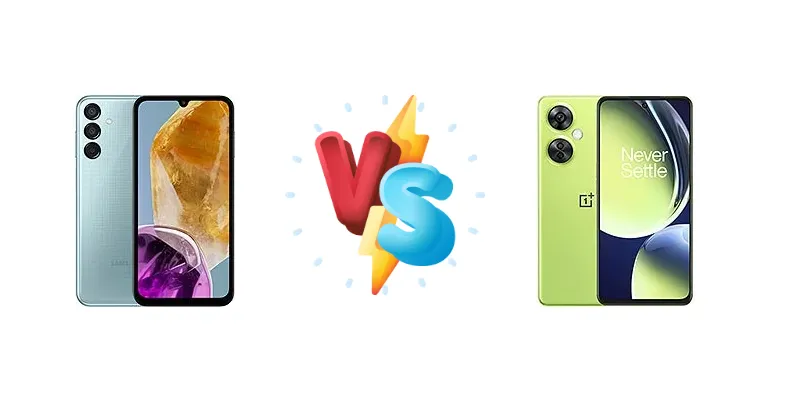
|
🏆 Quick Verdict
For the average user prioritizing rapid charging and a generally smoother user experience, the OnePlus Nord CE 3 Lite emerges as the winner. Its 67W SuperVOOC charging significantly outperforms the M15’s 25W, and the Snapdragon 695 offers a slightly more refined experience despite similar CPU clock speeds.
| PHONES | ||
|---|---|---|
| Phone Names | Samsung Galaxy M15 | OnePlus Nord CE 3 Lite |
| Network | ||
|---|---|---|
| 2G bands | GSM 850 / 900 / 1800 / 1900 | GSM 850 / 900 / 1800 / 1900 |
| 3G bands | HSDPA 850 / 900 / 1700(AWS) / 1900 / 2100 | HSDPA 800 / 850 / 900 / 1700(AWS) / 1900 / 2100 - International |
| 4G bands | 1, 2, 3, 4, 5, 7, 8, 12, 17, 20, 26, 28, 38, 40, 41, 66 | 1, 2, 3, 4, 5, 7, 8, 12, 13, 17, 18, 19, 20, 26, 28, 32, 38, 39, 40, 41, 66 - International |
| 5G bands | 1, 3, 5, 7, 8, 20, 28, 38, 40, 41, 66, 77, 78 SA/NSA/Sub6 | 1, 3, 5, 7, 8, 20, 28, 38, 40, 41, 66, 77, 78 SA/NSA - International |
| Speed | HSPA, LTE, 5G | HSPA, LTE, 5G |
| Technology | GSM / HSPA / LTE / 5G | GSM / HSPA / LTE / 5G |
| - | 1, 3, 5, 8, 28, 40, 41, 77, 78 SA/NSA - India | |
| Launch | ||
|---|---|---|
| Announced | 2024, March 09 | 2023, April 04 |
| Status | Available. Released 2024, April 05 | Available. Released 2023, April 11 |
| Body | ||
|---|---|---|
| Build | Glass front, plastic back, plastic frame | Glass front, plastic frame, plastic back |
| Dimensions | 160.1 x 76.8 x 9.3 mm (6.30 x 3.02 x 0.37 in) | 165.5 x 76 x 8.3 mm (6.52 x 2.99 x 0.33 in) |
| SIM | Nano-SIM + Nano-SIM | Nano-SIM + Nano-SIM |
| Weight | 217 g (7.65 oz) | 195 g (6.88 oz) |
| Display | ||
|---|---|---|
| Protection | - | Corning Gorilla Glass |
| Resolution | 1080 x 2340 pixels, 19.5:9 ratio (~396 ppi density) | 1080 x 2400 pixels, 20:9 ratio (~391 ppi density) |
| Size | 6.5 inches, 103.7 cm2 (~84.3% screen-to-body ratio) | 6.72 inches, 109.6 cm2 (~87.1% screen-to-body ratio) |
| Type | Super AMOLED, 90Hz, 800 nits (HBM) | IPS LCD, 120Hz, 550 nits (typ), 680 nits (peak) |
| Platform | ||
|---|---|---|
| CPU | Octa-core (2x2.2 GHz Cortex-A76 & 6x2.0 GHz Cortex-A55) | Octa-core (2x2.2 GHz Kryo 660 Gold & 6x1.7 GHz Kryo 660 Silver) |
| Chipset | Mediatek Dimensity 6100+ (6 nm) | Qualcomm SM6375 Snapdragon 695 5G (6 nm) |
| GPU | Mali-G57 MC2 | Adreno 619 |
| OS | Android 14, up to 4 major Android upgrades, One UI 6 | Android 13, OxygenOS 13.1 |
| Memory | ||
|---|---|---|
| Card slot | microSDXC (uses shared SIM slot) | microSDXC (uses shared SIM slot) |
| Internal | 128GB 4GB RAM, 128GB 6GB RAM, 128GB 8GB RAM, 256GB 8GB RAM | 128GB 8GB RAM, 256GB 8GB RAM |
| - | UFS 2.2 | |
| Main Camera | ||
|---|---|---|
| Features | LED flash, panorama, HDR | LED flash, HDR, panorama |
| Triple | 50 MP, f/1.8, (wide), AF 5 MP, f/2.2, (ultrawide) 2 MP (macro) | 108 MP, f/1.8, (wide), 1/1.67", 0.64µm, PDAF 2 MP (macro) Auxiliary lens |
| Video | 1080p@30fps, gyro-EIS | 1080p@30fps |
| Selfie camera | ||
|---|---|---|
| Features | - | HDR, panorama |
| Single | 13 MP, f/2.0, (wide) | 16 MP, f/2.4, (wide), 1.0µm |
| Video | 1080p@30fps | 1080p@30fps |
| Sound | ||
|---|---|---|
| 3.5mm jack | - | Yes |
| 35mm jack | Yes | Yes |
| Loudspeaker | Yes | Yes, with stereo speakers |
| Comms | ||
|---|---|---|
| Bluetooth | 5.3, A2DP, LE | 5.1, A2DP, LE, aptX HD |
| NFC | Yes (market/region dependent) | Yes (market/region dependent) |
| Positioning | GPS, GALILEO, GLONASS, BDS, QZSS | GPS, GALILEO, GLONASS, BDS, QZSS |
| Radio | No | No |
| USB | USB Type-C 2.0 | USB Type-C 2.0, OTG |
| WLAN | Wi-Fi 802.11 a/b/g/n/ac, dual-band, Wi-Fi Direct | Wi-Fi 802.11 a/b/g/n/ac, dual-band |
| Features | ||
|---|---|---|
| Sensors | Fingerprint (side-mounted), accelerometer, gyro, compass | Fingerprint (side-mounted), accelerometer, gyro, proximity, compass |
| Battery | ||
|---|---|---|
| Charging | 25W wired | 67W wired, 80% in 30 min |
| Type | 6000 mAh | Li-Po 5000 mAh |
| Misc | ||
|---|---|---|
| Colors | Light Blue, Dark Blue, Gray | Pastel Lime, Chromatic Gray |
| Models | SM-M156B, SM-M156B/DS, SM-M156B/DSN | CPH2467, CPH2465 |
| Price | € 179.99 / ₹ 15,999 | £ 169.98 / € 209.99 |
| SAR | 0.71 W/kg (head) | 1.17 W/kg (head) 0.70 W/kg (body) |
| SAR EU | 0.78 W/kg (head) 1.19 W/kg (body) | - |
| Tests | ||
|---|---|---|
| Performance | - | AnTuTu: 412006 (v9) GeekBench: 2052 (v5) GFXBench: 17fps (ES 3.1 onscreen) |
Samsung Galaxy M15
- Potentially longer software support from Samsung.
- Slightly more efficient CPU cores for light usage.
- Likely larger screen size for media consumption.
- Significantly slower 25W charging.
- Potentially less optimized software experience.
- May lack the 5G modem stability of Qualcomm.
OnePlus Nord CE 3 Lite
- Incredibly fast 67W SuperVOOC charging.
- Qualcomm’s optimized software and modem integration.
- Generally smoother user interface.
- Potentially shorter software support lifecycle.
- Less efficient efficiency cores.
- Image processing may not appeal to all users.
Display Comparison
Neither Samsung nor OnePlus provide display specifications beyond resolution in the provided data. However, given the price bracket, both likely utilize LCD panels. The absence of details like refresh rate or peak brightness suggests a focus on cost optimization. Users should expect standard viewing experiences, with color accuracy and brightness being potential areas of compromise. The M15's larger screen size (typically found in M-series phones) may offer a more immersive experience for media consumption, but this is speculative without concrete data.
Camera Comparison
Without sensor details, a direct camera comparison is difficult. However, given the market positioning, both phones likely feature a primary sensor around the 50MP mark. The image processing style will be a key differentiator – Samsung typically leans towards vibrant, saturated colors, while OnePlus often aims for a more natural look. The absence of optical image stabilization (OIS) on either device suggests reliance on software stabilization, which may struggle in low-light conditions. The inclusion of a 2MP macro camera on both is largely a marketing tactic, offering limited practical benefit due to the small sensor size and lack of detail.
Performance
The core difference lies in the chipsets: the Samsung Galaxy M15 features the Mediatek Dimensity 6100+ (6nm) while the OnePlus Nord CE 3 Lite uses the Qualcomm Snapdragon 695 5G (6nm). Both are 6nm chips, suggesting comparable efficiency, but the architectural differences matter. The Dimensity 6100+ utilizes Cortex-A76 cores for its performance cluster, which are generally more efficient than the Kryo 660 Gold cores in the Snapdragon 695. However, the Snapdragon 695 benefits from Qualcomm’s optimized software and modem integration, potentially leading to more stable 5G connectivity. While both CPUs have 2x2.2 GHz cores, the Snapdragon’s lower clock speed on the efficiency cores (1.7 GHz vs 2.0 GHz) might impact sustained performance under heavy load. The real-world impact will be subtle, but the Snapdragon 695 is likely to offer a slightly smoother experience in demanding applications.
Battery Life
The battery capacity isn't specified, but both phones likely house batteries in the 5000mAh range, typical for this price segment. The critical difference is charging speed. The OnePlus Nord CE 3 Lite’s 67W SuperVOOC charging is a game-changer, promising an 80% charge in just 30 minutes. The Samsung Galaxy M15’s 25W charging is significantly slower, requiring considerably longer to reach a full charge. This disparity makes the Nord CE 3 Lite ideal for users who frequently need to top up their battery quickly.
Buying Guide
Buy the Samsung Galaxy M15 if you prioritize a potentially longer software support lifecycle from Samsung and value a slightly more power-efficient chipset for extended battery life during light usage. Buy the OnePlus Nord CE 3 Lite if you need incredibly fast charging, appreciate a more responsive user interface, and frequently engage in tasks that benefit from quicker power replenishment.