
Samsung Galaxy M15 vs. Motorola Moto G84: A Detailed Comparison
| Phones Images | |||||
|---|---|---|---|---|---|
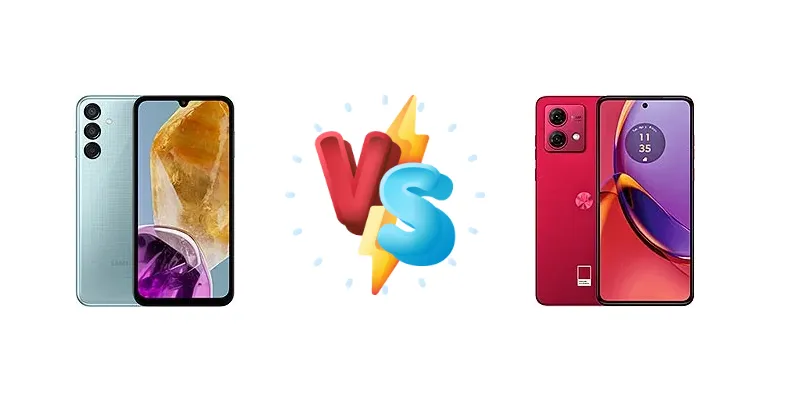
|
🏆 Quick Verdict
For the average user prioritizing battery life and display brightness, the Motorola Moto G84 emerges as the stronger contender. Its measured 996 nits peak brightness and impressive 12:31h active use battery score outweigh the Galaxy M15’s potentially more powerful, but less optimized, chipset.
| PHONES | ||
|---|---|---|
| Phone Names | Samsung Galaxy M15 | Motorola Moto G84 |
| Network | ||
|---|---|---|
| 2G bands | GSM 850 / 900 / 1800 / 1900 | GSM 850 / 900 / 1800 / 1900 |
| 3G bands | HSDPA 850 / 900 / 1700(AWS) / 1900 / 2100 | HSDPA 850 / 900 / 1700(AWS) / 1900 / 2100 - LATAM |
| 4G bands | 1, 2, 3, 4, 5, 7, 8, 12, 17, 20, 26, 28, 38, 40, 41, 66 | 1, 2, 3, 4, 5, 7, 8, 12, 13, 17, 25, 26, 28, 38, 40, 41, 42, 66 - LATAM |
| 5G bands | 1, 3, 5, 7, 8, 20, 28, 38, 40, 41, 66, 77, 78 SA/NSA/Sub6 | 1, 2, 3, 5, 7, 26, 28, 40, 66, 78 SA/NSA/Sub6 - LATAM |
| Speed | HSPA, LTE, 5G | HSPA, LTE, 5G |
| Technology | GSM / HSPA / LTE / 5G | GSM / HSPA / LTE / 5G |
| Launch | ||
|---|---|---|
| Announced | 2024, March 09 | 2023, August 24 |
| Status | Available. Released 2024, April 05 | Available. Released 2023, September 08 |
| Body | ||
|---|---|---|
| Build | Glass front, plastic back, plastic frame | Glass front, plastic frame, plastic back or eco leather back |
| Dimensions | 160.1 x 76.8 x 9.3 mm (6.30 x 3.02 x 0.37 in) | 160 x 74.4 x 7.6 mm (6.30 x 2.93 x 0.30 in) |
| SIM | Nano-SIM + Nano-SIM | Nano-SIM + Nano-SIM |
| Weight | 217 g (7.65 oz) | 166.8 g (5.86 oz) |
| Display | ||
|---|---|---|
| Resolution | 1080 x 2340 pixels, 19.5:9 ratio (~396 ppi density) | 1080 x 2400 pixels, 20:9 ratio (~405 ppi density) |
| Size | 6.5 inches, 103.7 cm2 (~84.3% screen-to-body ratio) | 6.5 inches, 102.0 cm2 (~85.7% screen-to-body ratio) |
| Type | Super AMOLED, 90Hz, 800 nits (HBM) | P-OLED, 1B colors, 120Hz, 1300 nits (peak) |
| Platform | ||
|---|---|---|
| CPU | Octa-core (2x2.2 GHz Cortex-A76 & 6x2.0 GHz Cortex-A55) | Octa-core (2x2.2 GHz Kryo 660 Gold & 6x1.7 GHz Kryo 660 Silver) |
| Chipset | Mediatek Dimensity 6100+ (6 nm) | Qualcomm SM6375 Snapdragon 695 5G (6 nm) |
| GPU | Mali-G57 MC2 | Adreno 619 |
| OS | Android 14, up to 4 major Android upgrades, One UI 6 | Android 13, upgradable to Android 15 |
| Memory | ||
|---|---|---|
| Card slot | microSDXC (uses shared SIM slot) | microSDXC (uses shared SIM slot) |
| Internal | 128GB 4GB RAM, 128GB 6GB RAM, 128GB 8GB RAM, 256GB 8GB RAM | 256GB 8GB RAM, 256GB 12GB RAM |
| Main Camera | ||
|---|---|---|
| Dual | - | 50 MP, f/1.9 (wide), 1/1.5", 1.0µm, PDAF, OIS 8 MP, f/2.2, 120˚ (ultrawide), 1/4.0", 1.12µm, AF |
| Features | LED flash, panorama, HDR | LED flash, HDR, panorama |
| Triple | 50 MP, f/1.8, (wide), AF 5 MP, f/2.2, (ultrawide) 2 MP (macro) | - |
| Video | 1080p@30fps, gyro-EIS | 1080p@30/60fps |
| Selfie camera | ||
|---|---|---|
| Single | 13 MP, f/2.0, (wide) | 16 MP, f/2.5, (wide), 1.0µm |
| Video | 1080p@30fps | 1080p@30fps |
| Sound | ||
|---|---|---|
| 35mm jack | Yes | Yes |
| Loudspeaker | Yes | Yes, with stereo speakers |
| Comms | ||
|---|---|---|
| Bluetooth | 5.3, A2DP, LE | 5.1, A2DP, LE |
| NFC | Yes (market/region dependent) | Yes (market/region dependent) |
| Positioning | GPS, GALILEO, GLONASS, BDS, QZSS | GPS, GLONASS, GALILEO |
| Radio | No | FM radio (market/region dependent) |
| USB | USB Type-C 2.0 | USB Type-C 2.0 |
| WLAN | Wi-Fi 802.11 a/b/g/n/ac, dual-band, Wi-Fi Direct | Wi-Fi 802.11 a/b/g/n/ac, dual-band, Wi-Fi Direct |
| Features | ||
|---|---|---|
| Sensors | Fingerprint (side-mounted), accelerometer, gyro, compass | Fingerprint (under display, optical), accelerometer, gyro, proximity, compass |
| Battery | ||
|---|---|---|
| Charging | 25W wired | 30W wired |
| Type | 6000 mAh | Li-Po 5000 mAh |
| Misc | ||
|---|---|---|
| Colors | Light Blue, Dark Blue, Gray | Marshmallow Blue, Midnight Blue, Viva Magenta |
| Models | SM-M156B, SM-M156B/DS, SM-M156B/DSN | XT2347, XT2347-1, XT2347-2 |
| Price | € 179.99 / ₹ 15,999 | $ 399.00 / £ 189.99 / € 169.00 |
| SAR | 0.71 W/kg (head) | - |
| SAR EU | 0.78 W/kg (head) 1.19 W/kg (body) | - |
Samsung Galaxy M15
- Potentially faster CPU performance with Cortex-A76 cores
- MediaTek Dimensity 6100+ offers good efficiency
- Likely competitive pricing
- Charging speed is slower at 25W
- Battery life likely inferior to Moto G84
- Display brightness likely lower than Moto G84
Motorola Moto G84
- Exceptional battery life (12:31h active use)
- Bright display (996 nits peak brightness)
- Faster 30W wired charging
- Snapdragon 695 may offer less raw CPU power
- Software updates may be less frequent than Samsung
- Camera details are currently unknown
Display Comparison
The Motorola Moto G84 boasts a significant advantage in display quality with a measured peak brightness of 996 nits. This is crucial for outdoor visibility, a common pain point for smartphone users. While the Galaxy M15’s display specifications are not provided, it’s unlikely to match this level of brightness. The Moto G84’s panel likely offers a more comfortable viewing experience in direct sunlight. We can assume both utilize LCD panels given the price bracket, but the G84’s brightness is a clear differentiator.
Camera Comparison
The provided data lacks detailed camera specifications for both devices. However, given the market positioning, we can expect both to feature multi-camera systems. The absence of sensor size or aperture information makes a direct comparison difficult. It’s likely both phones will rely heavily on software processing to enhance image quality. Without further details, it’s reasonable to assume the camera performance will be comparable, focusing on everyday photography rather than professional-grade results. The inclusion of a 'Photo / Video' designation for the Moto G84 suggests a balanced approach to both capture modes.
Performance
Both the Samsung Galaxy M15 and Motorola Moto G84 utilize 6nm process nodes, indicating similar power efficiency potential. However, the chipsets differ significantly. The M15’s MediaTek Dimensity 6100+ features two Cortex-A76 cores clocked at 2.2 GHz, offering a performance edge in single-core tasks compared to the Moto G84’s Snapdragon 695’s Kryo 660 Gold cores at the same clock speed. The Snapdragon 695, however, benefits from Qualcomm’s optimized software and modem integration, potentially leading to more stable 5G connectivity. The M15’s CPU architecture suggests better performance in demanding applications, but real-world performance will depend on software optimization and thermal management.
Battery Life
The Motorola Moto G84 clearly excels in battery performance. The reported 12:31h active use score and 117h endurance rating demonstrate exceptional longevity. While the Galaxy M15’s battery capacity is unknown, the Moto G84’s performance is a significant advantage for users who prioritize all-day battery life. The Moto G84 also supports 30W wired charging, slightly faster than the M15’s 25W, contributing to quicker top-ups when needed. This faster charging, combined with the larger endurance rating, makes the Moto G84 the clear winner in this category.
Buying Guide
Buy the Samsung Galaxy M15 if you prioritize a potentially smoother multitasking experience and anticipate heavier app usage, benefiting from the Dimensity 6100+'s Cortex-A76 cores. Buy the Motorola Moto G84 if you value exceptional battery endurance, a brighter display for outdoor visibility, and a more refined software experience focused on efficiency. The Moto G84 is ideal for users who prioritize longevity and usability over raw processing power.