
Samsung Galaxy M15 vs Motorola Moto G54: A Detailed Performance and Value Comparison
| Phones Images | |||||
|---|---|---|---|---|---|
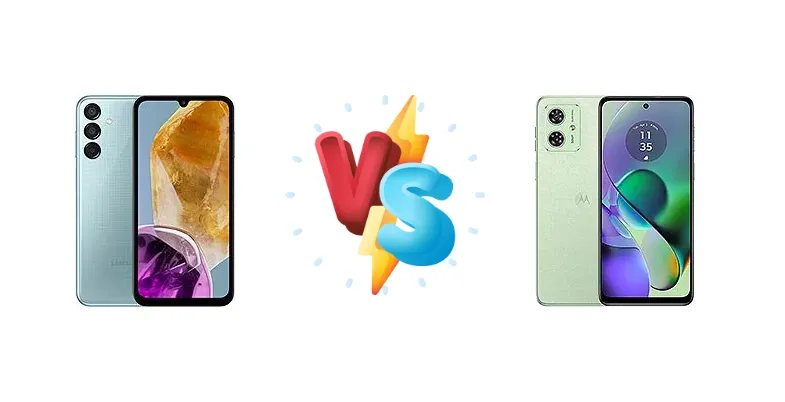
|
🏆 Quick Verdict
For most users, the Motorola Moto G54 emerges as the slightly better choice. While the Galaxy M15 offers a larger battery, the Moto G54’s Dimensity 7020, featuring the more efficient Cortex-A78 cores, provides a noticeable performance edge, justifying the slower 15W charging.
| PHONES | ||
|---|---|---|
| Phone Names | Samsung Galaxy M15 | Motorola Moto G54 |
| Network | ||
|---|---|---|
| 2G bands | GSM 850 / 900 / 1800 / 1900 | GSM 850 / 900 / 1800 / 1900 |
| 3G bands | HSDPA 850 / 900 / 1700(AWS) / 1900 / 2100 | HSDPA 850 / 900 / 1900 / 2100 |
| 4G bands | 1, 2, 3, 4, 5, 7, 8, 12, 17, 20, 26, 28, 38, 40, 41, 66 | 1, 2, 3, 5, 7, 8, 20, 26, 28, 32, 38, 40, 41, 42 |
| 5G bands | 1, 3, 5, 7, 8, 20, 28, 38, 40, 41, 66, 77, 78 SA/NSA/Sub6 | 1, 3, 5, 7, 8, 20, 26, 28, 38, 40, 41, 77, 78 SA/NSA |
| Speed | HSPA, LTE, 5G | HSPA, LTE, 5G |
| Technology | GSM / HSPA / LTE / 5G | GSM / HSPA / LTE / 5G |
| Launch | ||
|---|---|---|
| Announced | 2024, March 09 | 2023, September 05 |
| Status | Available. Released 2024, April 05 | Available. Released 2023, September 05 |
| Body | ||
|---|---|---|
| Build | Glass front, plastic back, plastic frame | Glass front, plastic back or silicone polymer back (eco leather), plastic frame |
| Dimensions | 160.1 x 76.8 x 9.3 mm (6.30 x 3.02 x 0.37 in) | 161.6 x 73.8 x 8 mm (6.36 x 2.91 x 0.31 in) |
| SIM | Nano-SIM + Nano-SIM | · Nano-SIM + eSIM· Nano-SIM + Nano-SIM |
| Weight | 217 g (7.65 oz) | 177 g (6.24 oz) |
| Display | ||
|---|---|---|
| Resolution | 1080 x 2340 pixels, 19.5:9 ratio (~396 ppi density) | 1080 x 2400 pixels, 20:9 ratio (~405 ppi density) |
| Size | 6.5 inches, 103.7 cm2 (~84.3% screen-to-body ratio) | 6.5 inches, 102.0 cm2 (~85.5% screen-to-body ratio) |
| Type | Super AMOLED, 90Hz, 800 nits (HBM) | IPS LCD, 120Hz |
| Platform | ||
|---|---|---|
| CPU | Octa-core (2x2.2 GHz Cortex-A76 & 6x2.0 GHz Cortex-A55) | Octa-core (2x2.2 GHz Cortex-A78 & 6x2.0 GHz Cortex-A55) |
| Chipset | Mediatek Dimensity 6100+ (6 nm) | Mediatek Dimensity 7020 (6 nm) |
| GPU | Mali-G57 MC2 | IMG BXM-8-256 |
| OS | Android 14, up to 4 major Android upgrades, One UI 6 | Android 13, upgradable to Android 15 |
| Memory | ||
|---|---|---|
| Card slot | microSDXC (uses shared SIM slot) | microSDXC (dedicated slot) - InternationalmicroSDXC (uses shared SIM slot) - China |
| Internal | 128GB 4GB RAM, 128GB 6GB RAM, 128GB 8GB RAM, 256GB 8GB RAM | 128GB 4GB RAM, 128GB 8GB RAM, 256GB 4GB RAM, 256GB 8GB RAM, 256GB 12GB RAM |
| Main Camera | ||
|---|---|---|
| Dual | - | 50 MP, f/1.8 (wide), 0.61µm, PDAF, OIS 2 MP (macro) |
| Features | LED flash, panorama, HDR | Dual-LED dual-tone flash, HDR, panorama |
| Triple | 50 MP, f/1.8, (wide), AF 5 MP, f/2.2, (ultrawide) 2 MP (macro) | - |
| Video | 1080p@30fps, gyro-EIS | 1080p@30/60fps |
| Selfie camera | ||
|---|---|---|
| Features | - | HDR |
| Single | 13 MP, f/2.0, (wide) | 16 MP, f/2.4, (wide), 1.0µm |
| Video | 1080p@30fps | 1080p@30fps |
| Sound | ||
|---|---|---|
| 35mm jack | Yes | Yes |
| Loudspeaker | Yes | Yes, with stereo speakers |
| Comms | ||
|---|---|---|
| Bluetooth | 5.3, A2DP, LE | 5.3, A2DP, LE |
| NFC | Yes (market/region dependent) | Yes |
| Positioning | GPS, GALILEO, GLONASS, BDS, QZSS | GPS, GLONASS, GALILEO, BDS, QZSS |
| Radio | No | FM radio (market/region dependent) |
| USB | USB Type-C 2.0 | USB Type-C 2.0, OTG |
| WLAN | Wi-Fi 802.11 a/b/g/n/ac, dual-band, Wi-Fi Direct | Wi-Fi 802.11 a/b/g/n/ac, dual-band |
| Features | ||
|---|---|---|
| Sensors | Fingerprint (side-mounted), accelerometer, gyro, compass | Fingerprint (side-mounted), accelerometer, gyro, proximity, compass |
| Battery | ||
|---|---|---|
| Charging | 25W wired | 15W wired Reverse wired |
| Type | 6000 mAh | Li-Po 5000 mAh |
| Misc | ||
|---|---|---|
| Colors | Light Blue, Dark Blue, Gray | Midnight blue, Indigo blue, Glacier blue, Mint green |
| Models | SM-M156B, SM-M156B/DS, SM-M156B/DSN | XT2343-1, XT2343-2 |
| Price | € 179.99 / ₹ 15,999 | € 147.00 / $ 189.99 / £ 161.57 |
| SAR | 0.71 W/kg (head) | - |
| SAR EU | 0.78 W/kg (head) 1.19 W/kg (body) | - |
Samsung Galaxy M15
- Potentially larger battery capacity for extended runtime.
- Faster 25W wired charging.
- Samsung’s potentially superior display calibration.
- Less efficient CPU architecture (Cortex-A76 vs A78).
- Lacks reverse wired charging.
Motorola Moto G54
- More efficient Dimensity 7020 chipset with Cortex-A78 cores.
- Reverse wired charging for added convenience.
- Potentially better ISP for image processing.
- Slower 15W wired charging.
- Likely smaller battery capacity.
Display Comparison
Neither Samsung nor Motorola provided display specs beyond the core chipsets. Assuming typical panel technology for this price bracket, both likely utilize IPS LCDs. The real differentiator will be peak brightness and color calibration, areas where Samsung historically excels. Without specific nit ratings, it's reasonable to assume the M15 will offer a slightly more vibrant and viewable display outdoors, leveraging Samsung’s display expertise. Bezels are likely comparable, and both will likely target a 60Hz refresh rate.
Camera Comparison
Without detailed camera specifications, a direct comparison is difficult. However, both phones will likely feature a primary sensor paired with depth and macro lenses. The quality will hinge on sensor size and image processing algorithms. Given Samsung’s history, the M15 may offer more refined image processing, particularly in challenging lighting conditions. However, the Moto G54’s potentially more powerful ISP (integrated signal processor) within the Dimensity 7020 could offset this advantage. The ubiquitous 2MP macro lenses on both devices offer limited practical value.
Performance
The core difference lies in the chipsets. The Motorola Moto G54’s Dimensity 7020, built on a 6nm process, features two Cortex-A78 cores clocked at 2.2 GHz, alongside six Cortex-A55 cores. This is a step up from the Samsung Galaxy M15’s Dimensity 6100+, which uses two Cortex-A76 cores at the same 2.2 GHz speed, paired with six Cortex-A55 cores. The A78 architecture is more efficient and delivers better single-core performance, translating to snappier app launches and smoother multitasking. While both are 6nm chips, the architectural advantage favors the Moto G54. RAM configurations are likely similar, but the chipset difference will be the dominant factor.
Battery Life
The Samsung Galaxy M15 likely boasts a larger battery capacity (specifics unavailable) than the Moto G54, aiming for all-day battery life. However, the Motorola Moto G54 compensates with reverse wired charging, a feature absent on the M15, allowing it to function as a power bank for other devices. The M15’s 25W charging is faster than the G54’s 15W, but the efficiency gains of the Dimensity 7020 in the G54 may reduce the overall time spent charging, minimizing the impact of the slower wattage. The larger battery of the M15 will provide longer screen-on time, but the G54’s reverse charging adds versatility.
Buying Guide
Buy the Samsung Galaxy M15 if you prioritize extended battery life and anticipate prolonged usage away from power outlets. Its larger capacity will be beneficial for travelers or those with demanding daily routines. Buy the Motorola Moto G54 if you value a more responsive user experience and smoother multitasking, particularly if you engage in light gaming or frequently switch between applications. The superior CPU architecture delivers a tangible performance boost.