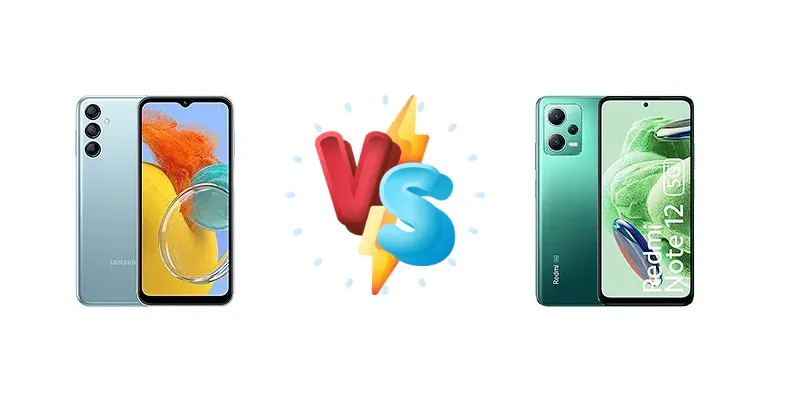
The budget smartphone market is fiercely competitive, and the Samsung Galaxy M14 and Xiaomi Redmi Note 12 are two strong contenders. Both offer compelling features at an attractive price point, but which one reigns supreme? This comprehensive comparison will break down every aspect, helping you make the right choice.
🏆 Quick Verdict
The Redmi Note 12 edges out the M14 thanks to its faster charging, brighter display, and impressive battery endurance. While the M14 boasts a slightly more powerful chipset, the Note 12's overall package delivers a more polished and user-friendly experience for most users.
| Network |
|---|
| 2G bands | GSM 850 / 900 / 1800 / 1900 | GSM 850 / 900 / 1800 / 1900 |
| 3G bands | HSDPA 850 / 900 / 1700(AWS) / 1900 / 2100 | HSDPA 850 / 900 / 2100 |
| 4G bands | 1, 2, 3, 4, 5, 7, 8, 12, 17, 20, 26, 28, 38, 40, 41, 66 | 1, 3, 5, 8, 40, 41 |
| 5G bands | 1, 3, 5, 7, 8, 20, 28, 38, 40, 41, 66, 77, 78 SA/NSA | 1, 3, 5, 8, 28, 40, 78 SA/NSA |
| Speed | HSPA, LTE, 5G | HSPA, LTE, 5G |
| Technology | GSM / HSPA / LTE / 5G | GSM / HSPA / LTE / 5G |
| Launch |
|---|
| Announced | 2023, March 08 | 2022, October 27 |
| Status | Available. Released 2023, March 08 | Available. Released 2023, January 11 |
| Body |
|---|
| Build | Glass front (Gorilla Glass 5), plastic back, plastic frame | - |
| Dimensions | 166.8 x 77.2 x 9.4 mm (6.57 x 3.04 x 0.37 in) | 165.9 x 76.2 x 8 mm (6.53 x 3.00 x 0.31 in) |
| SIM | · Nano-SIM· Nano-SIM + Nano-SIM | Nano-SIM + Nano-SIM |
| Weight | 206 g (7.27 oz) | 188 g (6.63 oz) |
| | - | IP53, dust and splash resistant |
| Display |
|---|
| Protection | Corning Gorilla Glass 5 | Corning Gorilla Glass 3 |
| Resolution | 1080 x 2408 pixels, 20:9 ratio (~400 ppi density) | 1080 x 2400 pixels, 20:9 ratio (~395 ppi density) |
| Size | 6.6 inches, 104.9 cm2 (~81.5% screen-to-body ratio) | 6.67 inches, 107.4 cm2 (~85.0% screen-to-body ratio) |
| Type | PLS LCD, 90Hz | AMOLED, 120Hz, 1200 nits (peak) |
| Platform |
|---|
| CPU | Octa-core (2x2.4 GHz Cortex-A78 & 6x2.0 GHz Cortex-A55) | Octa-core (2x2.0 GHz Cortex-A78 & 6x1.8 GHz Cortex-A55) |
| Chipset | Exynos 1330 (5 nm) | Qualcomm SM4375 Snapdragon 4 Gen 1 (6 nm) |
| GPU | Mali-G68 MP2 | Adreno 619 |
| OS | Android 13, One UI core 5.1 | Android 12, MIUI 14 (International), MIUI 13 (India) |
| Memory |
|---|
| Card slot | microSDHC (dedicated slot) | microSDXC (uses shared SIM slot) |
| Internal | 64GB 4GB RAM, 128GB 4GB RAM, 128GB 6GB RAM | 128GB 4GB RAM, 128GB 6GB RAM, 256GB 8GB RAM |
| | - | UFS 2.2 |
| Main Camera |
|---|
| Features | LED flash, panorama, HDR | Dual-LED dual-tone flash, HDR, panorama |
| Single | 13 MP, f/2.0, (wide) | - |
| Triple | 50 MP, f/1.8, (wide), PDAF
2 MP (macro)
Auxiliary lens | 48 MP, f/1.8, (wide), PDAF
8 MP, f/2.2, 120˚ (ultrawide), 1/4.0", 1.12µm
2 MP (macro) |
| Video | 1080p@30fps | 1080p@30fps |
| Selfie camera |
|---|
| Features | - | HDR |
| Single | 13 MP, f/2.0, (wide) | 13 MP, f/2.5, (wide), 1/3.0" |
| Video | 1080p@30fps | 1080p@30fps |
| Sound |
|---|
| 3.5mm jack | Yes | Yes |
| 35mm jack | Yes | Yes |
| Loudspeaker | Yes | Yes |
| | - | 24-bit/192kHz audio |
| Comms |
|---|
| Bluetooth | 5.2, A2DP, LE | 5.1, A2DP, LE |
| Infrared port | - | Yes |
| NFC | Yes | Yes (market/region dependent) |
| Positioning | GPS, GLONASS, GALILEO, BDS, QZSS, NavIC | GPS, GLONASS |
| Radio | Unspecified | Unspecified |
| USB | USB Type-C 2.0 | USB Type-C 2.0, OTG |
| WLAN | Wi-Fi 802.11 a/b/g/n/ac, dual-band, Wi-Fi Direct | Wi-Fi 802.11 a/b/g/n/ac, dual-band |
| Features |
|---|
| Sensors | Fingerprint (side-mounted), accelerometer, gyro, proximity, compass | Fingerprint (side-mounted), accelerometer, gyro, proximity, compass |
| Battery |
|---|
| Charging | 15W wired - international
25W wired - India | 33W wired, 50% in 22 min |
| Type | Li-Po 6000 mAh | Li-Po 5000 mAh |
| Misc |
|---|
| Colors | Navy Blue, Light Blue, Silver | Frosted Green, Matte Black, Mystique Blue |
| Models | SM-M146B, SM-M146B/DS, SM-M146B/DSN | 22111317I, 22111317G |
| Price | ₹ 10,990 | € 151.99 / $ 219.99 / ₹ 11,999 |
| SAR | - | 1.09 W/kg (head) 1.05 W/kg (body) |
| SAR EU | 0.48 W/kg (head) 1.53 W/kg (body) | 0.68 W/kg (head) 0.91 W/kg (body) |
| Tests |
|---|
| Battery life | - |
Endurance rating 101h
|
| Camera | - |
Photo / Video |
| Display | - |
Contrast ratio: Infinite (nominal) |
| Loudspeaker | - |
-28.0 LUFS (Good)
|
| Performance | - |
AnTuTu: 360745 (v9)
GeekBench: 1998 (v5.1), 2017 (v6) |
Samsung Galaxy M14
- Slightly more powerful chipset
- Large battery capacity
- Expandable storage (likely)
- Samsung's One UI
- Slower charging speed
- Less bright display
- Design may be less premium
Xiaomi Redmi Note 12
- Faster charging (33W)
- Brighter display (706 nits)
- Excellent battery life (101h endurance)
- Sleek design
- Chipset slightly less powerful
- Software experience (MIUI) can be polarizing
- Expandable storage may be limited
Display Comparison
The Redmi Note 12 takes the display crown with a measured peak brightness of 706 nits, offering significantly better visibility in sunlight compared to the M14. While the M14's display is adequate, the Note 12's infinite contrast ratio (nominal) contributes to richer colors and deeper blacks. Both feature FHD+ resolution, ensuring sharp visuals.
Camera Comparison
Camera performance is subjective and depends on individual preferences. Both phones offer decent camera setups for their price range, but neither excels significantly. The Redmi Note 12 might offer slightly better image processing in certain scenarios. Detailed camera tests would be needed for a definitive conclusion.
Performance
The Samsung Galaxy M14's Exynos 1330 chipset holds a slight advantage in raw processing power, particularly in multi-core performance. However, the Redmi Note 12's Snapdragon 4 Gen 1 is still capable for everyday tasks and light gaming. Real-world performance differences are likely to be minimal for most users.
Battery Life
The Redmi Note 12 shines in the battery department, boasting an impressive endurance rating of 101 hours and an active use score of 10:58 hours. The M14 also has a large battery, but the Note 12's optimization appears superior. The Note 12's 33W charging is also faster than the M14's 15W (international) / 25W (India).
Buying Guide
The Samsung Galaxy M14 is ideal for users prioritizing raw processing power for gaming or demanding apps. The Xiaomi Redmi Note 12 is a better choice for those seeking a vibrant display, fast charging, and exceptional battery life for everyday use and media consumption.
Frequently Asked Questions
❓ Which phone is better for gaming?
The Samsung Galaxy M14's slightly more powerful chipset might offer a marginal advantage in demanding games, but both phones are primarily suited for casual gaming.
❓ Does the Redmi Note 12 have expandable storage?
Expandable storage availability on the Redmi Note 12 varies by region. Check the specific model's specifications before purchasing.