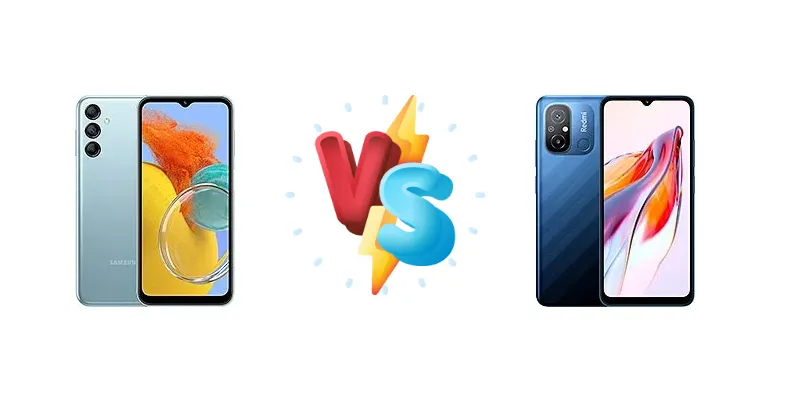
The Samsung Galaxy M14 and Xiaomi Redmi 12C represent two distinct approaches to the ultra-budget smartphone market. The M14, with its newer Exynos 1330 chipset, aims for a balance of performance and efficiency. The Redmi 12C, leveraging the Helio G85, focuses on delivering a functional experience at the lowest possible price point. This comparison dissects their key differences to help you choose the right device.
🏆 Quick Verdict
For most users, the Samsung Galaxy M14 is the superior choice. Its more modern Exynos 1330 chipset, built on a 5nm process, delivers noticeably better performance and efficiency than the Redmi 12C’s 12nm Helio G85. While the Redmi 12C is cheaper, the M14’s improved processing power and potentially faster charging (depending on region) justify the price difference.
| Network |
|---|
| 2G bands | GSM 850 / 900 / 1800 / 1900 | GSM 850 / 900 / 1800 / 1900 |
| 3G bands | HSDPA 850 / 900 / 1700(AWS) / 1900 / 2100 | HSDPA 850 / 900 / 2100 |
| 4G bands | 1, 2, 3, 4, 5, 7, 8, 12, 17, 20, 26, 28, 38, 40, 41, 66 | 1, 3, 5, 7, 8, 20, 28, 38, 40, 41 - International |
| 5G bands | 1, 3, 5, 7, 8, 20, 28, 38, 40, 41, 66, 77, 78 SA/NSA | - |
| Speed | HSPA, LTE, 5G | HSPA, LTE |
| Technology | GSM / HSPA / LTE / 5G | GSM / CDMA / HSPA / EVDO / LTE |
| | - | CDMA2000 1xEV-DO |
| Launch |
|---|
| Announced | 2023, March 08 | 2022, December 31 |
| Status | Available. Released 2023, March 08 | Available. Released 2023, January 01 |
| Body |
|---|
| Build | Glass front (Gorilla Glass 5), plastic back, plastic frame | - |
| Dimensions | 166.8 x 77.2 x 9.4 mm (6.57 x 3.04 x 0.37 in) | 168.8 x 76.4 x 8.8 mm (6.65 x 3.01 x 0.35 in) |
| SIM | · Nano-SIM· Nano-SIM + Nano-SIM | Nano-SIM + Nano-SIM |
| Weight | 206 g (7.27 oz) | 192 g (6.77 oz) |
| Display |
|---|
| Protection | Corning Gorilla Glass 5 | - |
| Resolution | 1080 x 2408 pixels, 20:9 ratio (~400 ppi density) | 720 x 1650 pixels (~268 ppi density) |
| Size | 6.6 inches, 104.9 cm2 (~81.5% screen-to-body ratio) | 6.71 inches, 106.5 cm2 (~82.6% screen-to-body ratio) |
| Type | PLS LCD, 90Hz | IPS LCD, 500 nits (typ) |
| Platform |
|---|
| CPU | Octa-core (2x2.4 GHz Cortex-A78 & 6x2.0 GHz Cortex-A55) | Octa-core (2x2.0 GHz Cortex-A75 & 6x1.8 GHz Cortex-A55) |
| Chipset | Exynos 1330 (5 nm) | Mediatek MT6769Z Helio G85 (12 nm) |
| GPU | Mali-G68 MP2 | Mali-G52 MC2 |
| OS | Android 13, One UI core 5.1 | Android 12, MIUI 13 |
| Memory |
|---|
| Card slot | microSDHC (dedicated slot) | microSDXC (dedicated slot) |
| Internal | 64GB 4GB RAM, 128GB 4GB RAM, 128GB 6GB RAM | 32GB 2GB RAM, 32GB 3GB RAM, 32GB 4GB RAM, 64GB 3GB RAM, 64GB 4GB RAM, 128GB 3GB RAM, 128GB 4GB RAM, 128GB 6GB RAM |
| | - | eMMC 5.1 |
| Main Camera |
|---|
| Dual | - | 50 MP, (wide), PDAF
0.08 MP (depth) |
| Features | LED flash, panorama, HDR | LED flash, HDR |
| Single | 13 MP, f/2.0, (wide) | 50 MP, f/1.8, (wide), 1/2.76", PDAF
Auxiliary lens |
| Triple | 50 MP, f/1.8, (wide), PDAF
2 MP (macro)
Auxiliary lens | - |
| Video | 1080p@30fps | 1080p@30fps |
| Selfie camera |
|---|
| Single | 13 MP, f/2.0, (wide) | 5 MP, f/2.2, (wide) |
| Video | 1080p@30fps | 1080p@30fps |
| Sound |
|---|
| 3.5mm jack | Yes | Yes |
| 35mm jack | Yes | Yes |
| Loudspeaker | Yes | Yes |
| Comms |
|---|
| Bluetooth | 5.2, A2DP, LE | 5.1, A2DP, LE |
| NFC | Yes | Yes (market/region dependent) |
| Positioning | GPS, GLONASS, GALILEO, BDS, QZSS, NavIC | GPS, GLONASS, BDS, GALILEO |
| Radio | Unspecified | FM radio |
| USB | USB Type-C 2.0 | microUSB 2.0 |
| WLAN | Wi-Fi 802.11 a/b/g/n/ac, dual-band, Wi-Fi Direct | Wi-Fi 802.11 a/b/g/n/ac, dual-band, Wi-Fi Direct |
| Features |
|---|
| Sensors | Fingerprint (side-mounted), accelerometer, gyro, proximity, compass | Fingerprint (rear-mounted), accelerometer |
| | - | Virtual proximity sensing |
| Battery |
|---|
| Charging | 15W wired - international
25W wired - India | 10W wired |
| Type | Li-Po 6000 mAh | Li-Po 5000 mAh |
| Misc |
|---|
| Colors | Navy Blue, Light Blue, Silver | Graphite Gray, Ocean Blue, Mint Green, Lavender Purple |
| Models | SM-M146B, SM-M146B/DS, SM-M146B/DSN | 22120RN86G, 22120RN86I, 22126RN91Y, 2212ARNC4L |
| Price | ₹ 10,990 | £ 132.99 / € 107.41 |
| SAR | - | 1.08 W/kg (head) 0.64 W/kg (body) |
| SAR EU | 0.48 W/kg (head) 1.53 W/kg (body) | 0.98 W/kg (head) 0.99 W/kg (body) |
Samsung Galaxy M14
- More powerful Exynos 1330 chipset
- Potentially faster 25W charging (India)
- Better power efficiency due to 5nm process
- May be slightly more expensive
- Battery capacity unknown
Xiaomi Redmi 12C
- Lower price point
- Large 5000mAh battery
- Simple and functional Android experience
- Less powerful Helio G85 chipset
- Slow 10W charging
- 12nm process less efficient
Display Comparison
Neither device boasts a standout display. Both likely utilize LCD panels, common in this price bracket. However, the lack of detailed display specs (resolution, brightness) necessitates focusing on the chipset's impact on UI smoothness. The M14’s Exynos 1330, with its more powerful GPU, will likely provide a more responsive experience when scrolling and navigating the interface, even if the panel characteristics are similar. The Redmi 12C’s Helio G85 may exhibit slight lag in demanding UI transitions.
Camera Comparison
Without detailed camera specs, a direct comparison is difficult. However, it’s safe to assume both phones feature basic camera setups geared towards casual photography. The Redmi 12C often includes a 50MP main sensor, while the M14’s main sensor resolution is unknown. The Exynos 1330’s image signal processor (ISP) is likely more advanced than the Helio G85’s, potentially resulting in better image processing, dynamic range, and low-light performance on the M14. The inclusion of a 2MP macro camera on the Redmi 12C is largely a marketing gimmick and offers limited practical value.
Performance
The core difference lies in the chipsets. The Samsung Galaxy M14’s Exynos 1330 (5nm) features a more modern CPU architecture – Cortex-A78 cores – compared to the Redmi 12C’s Helio G85 (12nm) with Cortex-A75 cores. This translates to a significant performance advantage for the M14 in CPU-intensive tasks. The 5nm fabrication process of the Exynos 1330 also means better power efficiency and less heat generation, crucial for sustained performance. While both are octa-core CPUs, the architectural improvements and process node give the M14 a clear edge. The Redmi 12C will handle basic tasks adequately, but will struggle with demanding applications or multitasking.
Battery Life
The Samsung Galaxy M14’s battery capacity is unknown, but the Redmi 12C typically features a 5000mAh battery. The M14’s charging speed varies – 15W internationally and 25W in India – while the Redmi 12C is limited to 10W. While the Redmi 12C’s larger battery *might* offer slightly longer screen-on time in very light usage, the Exynos 1330’s superior power efficiency in the M14 will likely close the gap, and potentially surpass it, in real-world scenarios. The faster charging options on the M14 (especially the 25W variant) significantly reduce downtime.
Buying Guide
Buy the Samsung Galaxy M14 if you prioritize sustained performance for multitasking, moderate gaming, and future-proofing. Its 5nm chipset offers better thermal management and potential for software updates. Buy the Xiaomi Redmi 12C if your primary needs are basic communication – calls, texts, and light social media – and you are on an extremely tight budget. It’s a functional device for those who prioritize affordability above all else.
Frequently Asked Questions
❓ Does the Exynos 1330 in the Galaxy M14 overheat during prolonged gaming sessions?
The Exynos 1330’s 5nm process is designed for improved thermal efficiency. While it will get warm during intensive gaming, it’s less likely to experience significant throttling compared to the Redmi 12C’s Helio G85, which is built on a less efficient 12nm process. Expect playable frame rates for longer periods on the M14.
❓ Is the 2MP macro camera on the Redmi 12C actually useful for taking detailed close-up photos?
Generally, 2MP macro cameras on budget phones offer limited practical benefit. The low resolution results in images lacking detail and sharpness. It’s primarily a marketing feature and won’t deliver professional-quality macro photography. The main camera on either phone will likely produce better results even when zoomed in.
❓ Can the Samsung Galaxy M14 handle demanding games like PUBG Mobile at high frame rates?
The Exynos 1330 should be capable of running PUBG Mobile at medium to high settings with stable frame rates. However, achieving consistently high frame rates (60fps or above) may require adjusting graphics settings. The Redmi 12C will likely struggle to maintain smooth performance at higher settings in PUBG Mobile.
❓ Which phone is better for watching videos and streaming content?
While both phones can handle video playback, the Samsung Galaxy M14’s more powerful chipset will provide a smoother and more responsive experience, especially when streaming high-resolution content. The Exynos 1330’s GPU will decode videos more efficiently, reducing lag and stuttering.