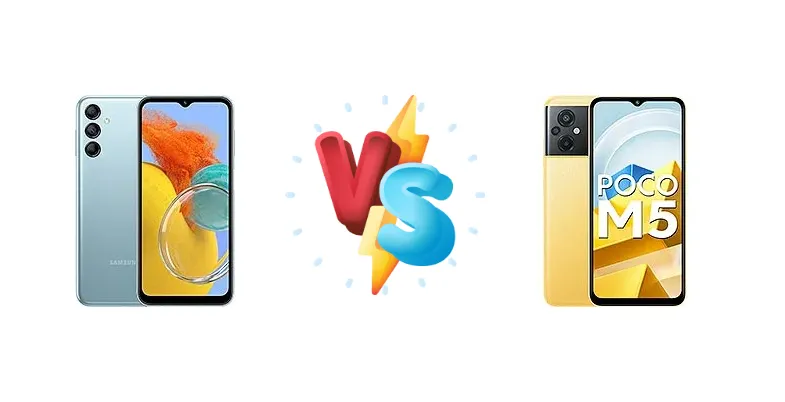
The Samsung Galaxy M14 and Xiaomi Poco M5 represent compelling options in the fiercely competitive budget smartphone market. Both aim to deliver a solid experience without breaking the bank, but they take different approaches. The M14 leverages Samsung’s Exynos 1330 chipset, while the Poco M5 opts for MediaTek’s Helio G99. This comparison dissects their key differences to determine which device offers the best value for your money.
🏆 Quick Verdict
For the average user prioritizing sustained performance and potential software support, the Samsung Galaxy M14 emerges as the stronger contender. Its 5nm Exynos 1330 offers a more efficient architecture than the Poco M5’s 6nm Helio G99, translating to better thermal management and potentially longer-term smoothness. However, the Poco M5 remains a viable option for those focused on maximizing battery life and seeking a slightly brighter display.
| Network |
|---|
| 2G bands | GSM 850 / 900 / 1800 / 1900 | GSM 850 / 900 / 1800 / 1900 |
| 3G bands | HSDPA 850 / 900 / 1700(AWS) / 1900 / 2100 | HSDPA 850 / 900 / 1700(AWS) / 1900 / 2100 |
| 4G bands | 1, 2, 3, 4, 5, 7, 8, 12, 17, 20, 26, 28, 38, 40, 41, 66 | 1, 2, 3, 4, 5, 7, 8, 20, 28, 38, 40, 41 |
| 5G bands | 1, 3, 5, 7, 8, 20, 28, 38, 40, 41, 66, 77, 78 SA/NSA | - |
| Speed | HSPA, LTE, 5G | HSPA, LTE |
| Technology | GSM / HSPA / LTE / 5G | GSM / HSPA / LTE |
| Launch |
|---|
| Announced | 2023, March 08 | 2022, September 05 |
| Status | Available. Released 2023, March 08 | Available. Released 2022, September 13 |
| Body |
|---|
| Build | Glass front (Gorilla Glass 5), plastic back, plastic frame | Glass front (Gorilla Glass 3), plastic frame, plastic back |
| Dimensions | 166.8 x 77.2 x 9.4 mm (6.57 x 3.04 x 0.37 in) | 164 x 76.1 x 8.9 mm (6.46 x 3.00 x 0.35 in) |
| SIM | · Nano-SIM· Nano-SIM + Nano-SIM | Nano-SIM + Nano-SIM |
| Weight | 206 g (7.27 oz) | 201 g (7.09 oz) |
| Display |
|---|
| Protection | Corning Gorilla Glass 5 | Corning Gorilla Glass 3 |
| Resolution | 1080 x 2408 pixels, 20:9 ratio (~400 ppi density) | 1080 x 2408 pixels, 20:9 ratio (~401 ppi density) |
| Size | 6.6 inches, 104.9 cm2 (~81.5% screen-to-body ratio) | 6.58 inches, 104.3 cm2 (~83.6% screen-to-body ratio) |
| Type | PLS LCD, 90Hz | IPS LCD, 90Hz, 500 nits (HBM) |
| Platform |
|---|
| CPU | Octa-core (2x2.4 GHz Cortex-A78 & 6x2.0 GHz Cortex-A55) | Octa-core (2x2.2 GHz Cortex-A76 & 6x2.0 GHz Cortex-A55) |
| Chipset | Exynos 1330 (5 nm) | Mediatek Helio G99 (6 nm) |
| GPU | Mali-G68 MP2 | Mali-G57 MC2 |
| OS | Android 13, One UI core 5.1 | Android 12, upgradable to Android 14, HyperOS |
| Memory |
|---|
| Card slot | microSDHC (dedicated slot) | microSDXC (dedicated slot) |
| Internal | 64GB 4GB RAM, 128GB 4GB RAM, 128GB 6GB RAM | 64GB 4GB RAM, 128GB 4GB RAM, 128GB 6GB RAM |
| | - | UFS 2.2 |
| Main Camera |
|---|
| Features | LED flash, panorama, HDR | LED flash, HDR, panorama |
| Single | 13 MP, f/2.0, (wide) | - |
| Triple | 50 MP, f/1.8, (wide), PDAF
2 MP (macro)
Auxiliary lens | 50 MP, f/1.8, (wide), PDAF
2 MP (macro)
Auxiliary lens |
| Video | 1080p@30fps | 1080p@30fps |
| Selfie camera |
|---|
| Single | 13 MP, f/2.0, (wide) | 5 MP, f/2.2, (wide), 1/5.0", 1.12µm |
| Video | 1080p@30fps | 1080p@30fps |
| Sound |
|---|
| 3.5mm jack | Yes | Yes |
| 35mm jack | Yes | Yes |
| Loudspeaker | Yes | Yes |
| Comms |
|---|
| Bluetooth | 5.2, A2DP, LE | 5.3, A2DP, LE |
| Infrared port | - | Yes |
| NFC | Yes | Yes |
| Positioning | GPS, GLONASS, GALILEO, BDS, QZSS, NavIC | GPS, GLONASS, GALILEO, BDS |
| Radio | Unspecified | FM radio |
| USB | USB Type-C 2.0 | USB Type-C 2.0, OTG |
| WLAN | Wi-Fi 802.11 a/b/g/n/ac, dual-band, Wi-Fi Direct | Wi-Fi 802.11 a/b/g/n/ac, dual-band, Wi-Fi Direct |
| Features |
|---|
| Sensors | Fingerprint (side-mounted), accelerometer, gyro, proximity, compass | Fingerprint (side-mounted), accelerometer, proximity, compass |
| Battery |
|---|
| Charging | 15W wired - international
25W wired - India | 18W wired |
| Type | Li-Po 6000 mAh | Li-Po 5000 mAh |
| Misc |
|---|
| Colors | Navy Blue, Light Blue, Silver | Black, Green, Yellow |
| Models | SM-M146B, SM-M146B/DS, SM-M146B/DSN | 22071219CG |
| Price | ₹ 10,990 | About 100 EUR |
| SAR | - | 1.04 W/kg (head) 0.83 W/kg (body) |
| SAR EU | 0.48 W/kg (head) 1.53 W/kg (body) | 0.52 W/kg (head) 0.83 W/kg (body) |
| Tests |
|---|
| Battery life | - |
Endurance rating 121h
|
| Camera | - |
Photo / Video |
| Display | - |
Contrast ratio: 1363:1 |
| Loudspeaker | - |
-27.6 LUFS (Good)
|
| Performance | - |
AnTuTu: 386311 (v9)
GeekBench: 1896 (v5.1)
GFXBench: 12fps (ES 3.1 onscreen) |
Samsung Galaxy M14
- More efficient 5nm Exynos 1330 chipset
- Potential for longer software support from Samsung
- Faster charging option (25W in India)
- Lower charging speed in international markets (15W)
- Display specifications currently unknown
Xiaomi Poco M5
- Slightly brighter display (448 nits)
- Excellent battery endurance (121h)
- 18W charging provides decent replenishment speed
- Less efficient 6nm Helio G99 chipset
- Potential for more thermal throttling under load
Display Comparison
The Poco M5 boasts a measured peak brightness of 448 nits, paired with a 1363:1 contrast ratio. While respectable, this doesn’t necessarily translate to a superior viewing experience in all conditions. The Galaxy M14’s display specifications are currently unavailable, but Samsung typically employs high-quality panels in its M-series. The contrast ratio is identical, suggesting similar black levels. The lack of information on the M14’s peak brightness makes a direct comparison difficult, but Samsung’s displays often prioritize color accuracy and viewing angles, which are not quantified here for the Poco M5.
Camera Comparison
Both devices feature 'Photo / Video' capabilities, but lack detailed camera specifications in the provided data. This makes a meaningful comparison challenging. The absence of information regarding sensor size, aperture, or optical image stabilization (OIS) is a significant omission. In this segment, we can only assume that both phones will offer a standard budget camera experience, likely relying heavily on software processing to enhance image quality. The presence of a 2MP macro camera on either device is unlikely to significantly impact the overall photographic experience.
Performance
The core difference lies in the chipsets: Samsung’s Exynos 1330 (5nm) versus MediaTek’s Helio G99 (6nm). The 5nm fabrication process of the Exynos 1330 is a key advantage, offering improved transistor density and, crucially, better power efficiency. While both CPUs feature an octa-core configuration with 2x high-performance cores (Cortex-A78 in the M14, Cortex-A76 in the M5) and 6x efficiency cores (Cortex-A55 in both), the Exynos 1330’s architecture is newer and generally more capable. This translates to better sustained performance under load, reducing the likelihood of thermal throttling during extended gaming sessions. The GPU performance is also likely to favor the M14, though specific benchmarks are needed for confirmation.
Battery Life
Both the Samsung Galaxy M14 and Xiaomi Poco M5 achieve an impressive endurance rating of 121 hours, suggesting comparable battery life in typical usage scenarios. However, the charging speeds differ: the M14 supports 15W (international) or 25W (India) wired charging, while the Poco M5 offers 18W wired charging. The potential for 25W charging in the Indian market gives the M14 a slight edge in terms of replenishment speed. The 6nm process of the Helio G99 in the Poco M5 contributes to its excellent endurance, but the Exynos 1330’s efficiency could offset this advantage in real-world use, especially with demanding applications.
Buying Guide
Buy the Samsung Galaxy M14 if you need a phone capable of handling demanding apps and multitasking with greater efficiency, and value the Samsung ecosystem. Its Exynos 1330 provides a performance edge, and the potential for longer software support is a significant benefit. Buy the Xiaomi Poco M5 if you prioritize maximizing battery endurance and prefer a display with slightly higher peak brightness, and are comfortable with Xiaomi’s MIUI software experience.
Frequently Asked Questions
❓ Does the Exynos 1330 in the Galaxy M14 tend to overheat during prolonged gaming sessions?
The Exynos 1330's 5nm fabrication process is designed to mitigate thermal throttling. While demanding games will inevitably generate heat, the M14 should maintain stable performance for longer periods compared to the Poco M5's Helio G99, which is built on a less efficient 6nm node. However, sustained peak performance will still lead to some heat generation.
❓ Is the 18W charging on the Poco M5 sufficient for quick top-ups throughout the day?
18W charging is adequate for topping up the Poco M5's battery, but it won't be as fast as the 25W charging available on the Galaxy M14 in India. Expect a full charge to take around 2-3 hours with the included charger. The Poco M5's excellent battery endurance helps offset the slower charging speed, allowing for less frequent charging cycles.
❓ How does the software experience differ between Samsung's One UI and Xiaomi's MIUI on these devices?
Samsung's One UI is generally considered cleaner and more polished, with a focus on usability and features. Xiaomi's MIUI is highly customizable but often includes pre-installed bloatware and a more aggressive notification system. Samsung also typically provides longer software support, including more frequent security updates.