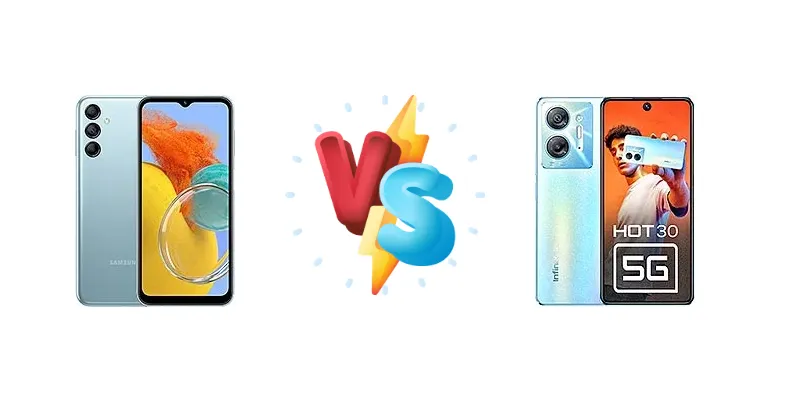
The Samsung Galaxy M14 and Infinix Hot 30 5G represent compelling options in the increasingly competitive budget 5G smartphone market. While both aim to deliver 5G connectivity at an accessible price point, they take different approaches to achieving this, primarily through chipset selection and charging implementation. This comparison dissects these differences to determine which device offers the best overall experience.
🏆 Quick Verdict
For the average user prioritizing sustained performance and brand reliability, the Samsung Galaxy M14 emerges as the stronger choice. Its Exynos 1330, built on a 5nm process, offers a slight edge in CPU performance and potentially better thermal management compared to the Infinix Hot 30 5G’s Dimensity 6020, despite the latter’s faster charging.
| Network |
|---|
| 2G bands | GSM 850 / 900 / 1800 / 1900 | GSM 850 / 900 / 1800 / 1900 |
| 3G bands | HSDPA 850 / 900 / 1700(AWS) / 1900 / 2100 | HSDPA 850 / 900 / 1700(AWS) / 1900 / 2100 |
| 4G bands | 1, 2, 3, 4, 5, 7, 8, 12, 17, 20, 26, 28, 38, 40, 41, 66 | LTE |
| 5G bands | 1, 3, 5, 7, 8, 20, 28, 38, 40, 41, 66, 77, 78 SA/NSA | 1, 3, 5, 8, 28, 38, 40, 41, 77, 78 SA/NSA |
| Speed | HSPA, LTE, 5G | HSPA, LTE, 5G |
| Technology | GSM / HSPA / LTE / 5G | GSM / HSPA / LTE / 5G |
| Launch |
|---|
| Announced | 2023, March 08 | 2023, July 14 |
| Status | Available. Released 2023, March 08 | Available. Released 2023, July 18 |
| Body |
|---|
| Build | Glass front (Gorilla Glass 5), plastic back, plastic frame | Glass front, plastic frame, plastic back |
| Dimensions | 166.8 x 77.2 x 9.4 mm (6.57 x 3.04 x 0.37 in) | 168.5 x 76.5 x 9.2 mm (6.63 x 3.01 x 0.36 in) |
| SIM | · Nano-SIM· Nano-SIM + Nano-SIM | Nano-SIM + Nano-SIM |
| Weight | 206 g (7.27 oz) | 215 g (7.58 oz) |
| Display |
|---|
| Protection | Corning Gorilla Glass 5 | - |
| Resolution | 1080 x 2408 pixels, 20:9 ratio (~400 ppi density) | 1080 x 2460 pixels (~396 ppi density) |
| Size | 6.6 inches, 104.9 cm2 (~81.5% screen-to-body ratio) | 6.78 inches, 109.2 cm2 (~84.7% screen-to-body ratio) |
| Type | PLS LCD, 90Hz | IPS LCD, 120Hz, 580 nits (peak) |
| Platform |
|---|
| CPU | Octa-core (2x2.4 GHz Cortex-A78 & 6x2.0 GHz Cortex-A55) | Octa-core (2x2.2 GHz Cortex-A76 & 6x2.0 GHz Cortex-A55) |
| Chipset | Exynos 1330 (5 nm) | Mediatek Dimensity 6020 (7 nm) |
| GPU | Mali-G68 MP2 | Mali-G57 MC2 |
| OS | Android 13, One UI core 5.1 | Android 13, XOS 13 |
| Memory |
|---|
| Card slot | microSDHC (dedicated slot) | microSDXC (dedicated slot) |
| Internal | 64GB 4GB RAM, 128GB 4GB RAM, 128GB 6GB RAM | 128GB 4GB RAM, 128GB 8GB RAM |
| Main Camera |
|---|
| Features | LED flash, panorama, HDR | Quad-LED flash, HDR, panorama |
| Single | 13 MP, f/2.0, (wide) | 50 MP, f/1.6, (wide), 1/2.55", AF
Auxiliary lens |
| Triple | 50 MP, f/1.8, (wide), PDAF
2 MP (macro)
Auxiliary lens | - |
| Video | 1080p@30fps | 1440p@30fps, 1080p@30fps |
| Selfie camera |
|---|
| Features | - | Dual-LED flash |
| Single | 13 MP, f/2.0, (wide) | 8 MP, f/2.0, (wide) |
| Video | 1080p@30fps | 1080p@30fps |
| Sound |
|---|
| 3.5mm jack | Yes | - |
| 35mm jack | Yes | Yes |
| Loudspeaker | Yes | Yes, with stereo speakers |
| Comms |
|---|
| Bluetooth | 5.2, A2DP, LE | 5.1, A2DP, LE |
| NFC | Yes | No |
| Positioning | GPS, GLONASS, GALILEO, BDS, QZSS, NavIC | GPS, GLONASS, GALILEO, BDS |
| Radio | Unspecified | FM radio |
| USB | USB Type-C 2.0 | USB Type-C 2.0 |
| WLAN | Wi-Fi 802.11 a/b/g/n/ac, dual-band, Wi-Fi Direct | Wi-Fi 802.11 a/b/g/n/ac, dual-band |
| Features |
|---|
| Sensors | Fingerprint (side-mounted), accelerometer, gyro, proximity, compass | Fingerprint (side-mounted), accelerometer, proximity, compass |
| Battery |
|---|
| Charging | 15W wired - international
25W wired - India | 18W wired |
| Type | Li-Po 6000 mAh | 5000 mAh |
| Misc |
|---|
| Colors | Navy Blue, Light Blue, Silver | Knight Black, Aurora Blue |
| Models | SM-M146B, SM-M146B/DS, SM-M146B/DSN | X6832 |
| Price | ₹ 10,990 | About 140 EUR |
| SAR EU | 0.48 W/kg (head) 1.53 W/kg (body) | - |
Samsung Galaxy M14
- Potentially better sustained performance due to 5nm Exynos 1330.
- Stronger brand reputation and software update support.
- Likely better image processing and camera quality.
- Slower charging speed (15W international variant).
- May be slightly more expensive than the Infinix Hot 30 5G.
Infinix Hot 30 5G
- Faster 18W wired charging.
- Potentially more aggressive pricing.
- Good value for money if performance needs are moderate.
- Dimensity 6020 may throttle under sustained load.
- Less established brand and potentially less frequent software updates.
Display Comparison
Neither Samsung nor Infinix provide display specifications beyond the basic resolution. However, the choice of panel technology and quality will likely be similar at this price point. The absence of high refresh rates is expected. The key difference will likely be peak brightness and color accuracy, areas where Samsung typically holds an advantage. Bezels are expected to be comparable, focusing on maximizing screen real estate within the budget constraints.
Camera Comparison
Without detailed camera specs, a direct comparison is difficult. However, both phones likely employ a primary camera sensor paired with auxiliary lenses for depth and macro photography. The image processing algorithms will be a key differentiator. Samsung’s image processing tends to prioritize vibrant colors and detail enhancement, while Infinix often aims for a more natural look. The larger sensor (if present in the M14) will capture more light, resulting in better low-light performance. The 2MP macro cameras on both devices are likely to offer limited utility.
Performance
The core of the difference lies in the chipsets. The Samsung Galaxy M14’s Exynos 1330 (5nm) features a 2x2.4 GHz Cortex-A78 and 6x2.0 GHz Cortex-A55 configuration. The Infinix Hot 30 5G utilizes the MediaTek Dimensity 6020 (7nm) with a 2x2.2 GHz Cortex-A76 and 6x2.0 GHz Cortex-A55 setup. While clock speeds are close, the 5nm fabrication process of the Exynos 1330 should translate to improved power efficiency and potentially better sustained performance under load, reducing the likelihood of thermal throttling. The Dimensity 6020, while on a larger 7nm node, is still a capable chip, but may struggle with prolonged intensive tasks. Both phones likely utilize LPDDR4X RAM, limiting memory bandwidth.
Battery Life
The battery capacity is not specified, but both phones will likely feature batteries in the 5000mAh range. The Infinix Hot 30 5G boasts 18W wired charging, while the Samsung Galaxy M14 offers 15W (international) or 25W (India) charging. The 18W charging on the Infinix will result in faster 0-100% charge times compared to the 15W Samsung variant. The 25W variant of the M14 narrows the gap, but the Dimensity 6020’s potentially lower power consumption could offset the charging speed difference in real-world usage.
Buying Guide
Buy the Samsung Galaxy M14 if you need a phone with a proven track record for software updates, a slightly more powerful processor for demanding tasks, and value long-term reliability. Buy the Infinix Hot 30 5G if you prioritize faster charging speeds and are comfortable with a less established brand ecosystem, potentially benefiting from aggressive pricing and a focus on delivering key features at a lower cost.
Frequently Asked Questions
❓ Does the Exynos 1330 in the Galaxy M14 overheat during prolonged gaming sessions?
The Exynos 1330's 5nm process should mitigate overheating concerns compared to older or less efficient chipsets. While some throttling is possible during extended gaming, it's unlikely to be severe enough to significantly impact the experience, especially given the phone's likely thermal design.
❓ Is the 18W charging on the Infinix Hot 30 5G significantly faster than the 15W charging on the international Samsung Galaxy M14?
Yes, 18W charging will noticeably reduce charge times compared to 15W. Expect a difference of approximately 30-60 minutes for a full 0-100% charge, depending on battery capacity and usage patterns. The 25W variant of the M14 (India) closes this gap considerably.
❓ How does the Dimensity 6020 handle multitasking compared to the Exynos 1330?
The Exynos 1330, with its Cortex-A78 cores, generally offers better multitasking performance than the Dimensity 6020. While both chips can handle everyday tasks, the Exynos 1330 will likely maintain smoother performance when switching between multiple apps or running demanding applications in the background.
❓ Are software updates guaranteed for both devices, and for how long?
Samsung typically provides more consistent and longer-term software support than Infinix. Expect at least two major Android updates and several years of security patches for the Galaxy M14. Infinix's update schedule is less predictable, and the duration of support may be shorter.