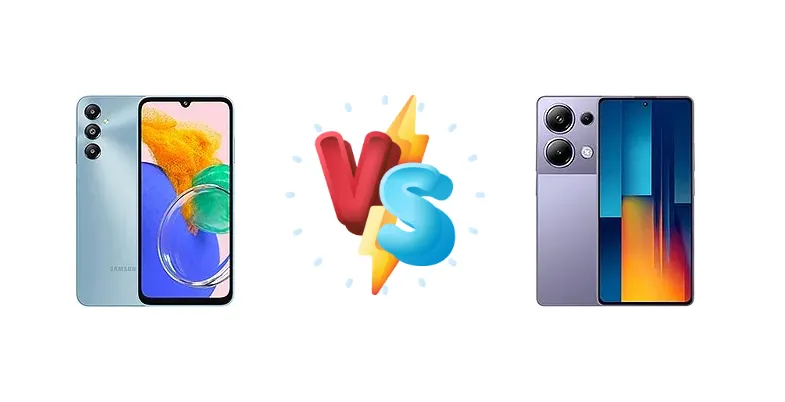
The Samsung Galaxy M14 4G and Xiaomi Poco M6 Pro 4G represent compelling options in the crowded budget 4G smartphone market. The M14 leverages Qualcomm’s efficiency, while the Poco M6 Pro aims for a performance edge with MediaTek’s Helio G99 Ultra. This comparison dissects their key differences to help you determine which device best suits your needs.
🏆 Quick Verdict
For the average user prioritizing sustained performance and faster charging, the Xiaomi Poco M6 Pro 4G emerges as the stronger contender. Its Helio G99 Ultra chipset and 67W charging significantly outperform the Snapdragon 680 and 25W charging of the Samsung Galaxy M14 4G, despite the M14’s potentially more efficient processor.
| Network |
|---|
| 2G bands | GSM 850 / 900 / 1800 / 1900 | GSM 850 / 900 / 1800 / 1900 |
| 3G bands | HSDPA 850 / 900 / 2100 | HSDPA 800 / 850 / 900 / 1700(AWS) / 1900 / 2100 |
| 4G bands | 1, 3, 5, 7, 8, 20, 28, 38, 40, 41 | 1, 2, 3, 4, 5, 7, 8, 12, 13, 17, 18, 19, 20, 26, 28, 38, 40, 41, 66 |
| Speed | HSPA, LTE | HSPA, LTE |
| Technology | GSM / HSPA / LTE | GSM / HSPA / LTE |
| Launch |
|---|
| Announced | 2024, March 07 | 2024, January 11 |
| Status | Available. Released 2024, March 07 | Available. Released 2024, January 12 |
| Body |
|---|
| Build | - | Glass front (Gorilla Glass 5), plastic frame |
| Dimensions | 168 x 77.8 x 8.8 mm (6.61 x 3.06 x 0.35 in) | 161.1 x 75 x 8 mm (6.34 x 2.95 x 0.31 in) |
| SIM | Nano-SIM + Nano-SIM | Nano-SIM + Nano-SIM |
| Weight | 194 g (6.84 oz) | 179 g (6.31 oz) |
| Display |
|---|
| Protection | - | Corning Gorilla Glass 5 |
| Resolution | 1080 x 2400 pixels, 20:9 ratio (~394 ppi density) | 1080 x 2400 pixels, 20:9 ratio (~395 ppi density) |
| Size | 6.7 inches, 107.8 cm2 (~82.5% screen-to-body ratio) | 6.67 inches, 107.4 cm2 (~88.9% screen-to-body ratio) |
| Type | PLS LCD, 90Hz | AMOLED, 120Hz, 1000 nits (HBM), 1300 nits (peak) |
| Platform |
|---|
| CPU | Octa-core (4x2.4 GHz Kryo 265 Gold & 4x1.9 GHz Kryo 265 Silver) | Octa-core (2x2.2 GHz Cortex-A76 & 6x2.0 GHz Cortex-A55) |
| Chipset | Qualcomm SM6225 Snapdragon 680 4G (6 nm) | Mediatek Helio G99 Ultra |
| GPU | Adreno 610 | Mali-G57 MC2 |
| OS | Android 13, up to 2 major Android upgrades, One UI 5.1 | Android 13, MIUI 14, planned upgrade to Android 14, HyperOS |
| Memory |
|---|
| Card slot | microSDXC (dedicated slot) | microSDXC (uses shared SIM slot) |
| Internal | 64GB 4GB RAM, 128GB 6GB RAM | 256GB 8GB RAM, 512GB 12GB RAM |
| Main Camera |
|---|
| Features | LED flash, panorama, HDR | LED flash, HDR, panorama |
| Triple | 50 MP, f/1.8, (wide), PDAF
2 MP (macro)
Auxiliary lens | 64 MP, f/1.8, 25mm (wide), 1/2.0", 0.7µm, PDAF, OIS
8 MP, f/2.2, (ultrawide)
2 MP (macro) |
| Video | 1080p@30/60fps | 1080p@30/60fps, gyro-EIS |
| Selfie camera |
|---|
| Single | 13 MP, f/2.0, (wide) | 16 MP, f/2.5, (wide) |
| Video | 1080p@30fps | 1080p@30/60fps |
| Sound |
|---|
| 35mm jack | Yes | Yes |
| Loudspeaker | Yes | Yes, with dual speakers |
| Comms |
|---|
| Bluetooth | 5.1, A2DP, LE | 5.2, A2DP, LE |
| Infrared port | - | Yes |
| NFC | No | Yes (market/region dependent) |
| Positioning | GPS, GALILEO, GLONASS, BDS, QZSS | GPS, GALILEO, GLONASS, BDS |
| Radio | Unspecified | FM radio |
| USB | USB Type-C 2.0 | USB Type-C 2.0, OTG |
| WLAN | Wi-Fi 802.11 a/b/g/n/ac, dual-band, Wi-Fi Direct | Wi-Fi 802.11 a/b/g/n/ac, dual-band |
| Features |
|---|
| Sensors | Fingerprint (side-mounted), accelerometer, proximity | Fingerprint (under display, optical), accelerometer, gyro, compass |
| Battery |
|---|
| Charging | 25W wired | 67W wired, 100% in 44 min |
| Type | Li-Ion 5000 mAh | 5000 mAh |
| Misc |
|---|
| Colors | Arctic Blue, Sapphire Blue | Black, Blue, Purple |
| Models | SM-M145F, SM-M145F/DS | 2312FPCA6G |
| Price | About 90 EUR | $ 170.00 |
| SAR | 0.56 W/kg (head) | 1.09 W/kg (head) 1.09 W/kg (body) |
| SAR EU | - | 0.99 W/kg (head) 0.99 W/kg (body) |
Samsung Galaxy M14 4G
- Potentially better thermal management due to 6nm Snapdragon 680.
- Samsung’s brand reputation and software support.
- Likely more natural color reproduction in photos.
- Slower 25W charging.
- Less powerful CPU and GPU compared to the Poco M6 Pro.
- Display likely lacks the peak brightness of the Poco M6 Pro.
Xiaomi Poco M6 Pro 4G
- Faster 67W charging with a 44-minute full charge time.
- More powerful MediaTek Helio G99 Ultra chipset.
- Brighter display for better outdoor visibility.
- Xiaomi’s MIUI software may not appeal to all users.
- Potentially less efficient chipset leading to higher temperatures under sustained load.
- Long-term software support may be less extensive than Samsung.
Display Comparison
The Poco M6 Pro 4G boasts a significantly brighter display, reaching a measured peak of 1053 nits. This is a substantial advantage over what we’d expect from the M14, making the Poco more usable outdoors under direct sunlight. While the M14’s panel specifications aren’t provided, Samsung typically employs quality displays, but likely won’t match the peak brightness of the Poco. Bezels and color accuracy are unknown for both, but the brightness difference is a clear win for the Poco.
Camera Comparison
Detailed camera specs beyond 'Photo/Video' are absent for both devices. However, given the market positioning, it’s safe to assume both will feature a primary camera and supporting lenses. The Poco M6 Pro’s image processing is likely tuned for vibrant, social media-ready shots, while Samsung typically aims for more natural color reproduction. Without sensor size or aperture information, a definitive camera comparison is impossible, but the Poco’s processing may appeal to a wider audience.
Performance
The core difference lies in the chipsets. The Poco M6 Pro’s MediaTek Helio G99 Ultra, with its 2x2.2 GHz Cortex-A76 cores, offers a more potent CPU configuration than the Samsung Galaxy M14 4G’s Snapdragon 680. The Snapdragon 680’s 6nm process *should* provide better power efficiency, but the Helio G99 Ultra’s architecture is geared towards higher peak performance. The Snapdragon 680’s Kryo 265 Gold cores, clocked at 2.4 GHz, are offset by the Helio G99’s more modern core design. RAM speed isn’t specified for either, but the G99’s GPU will likely deliver a more noticeable gaming advantage.
Battery Life
The Poco M6 Pro 4G shines in battery charging, supporting 67W wired charging and achieving a full charge in just 44 minutes. The Samsung Galaxy M14 4G, with its 25W charging, will take considerably longer. While the M14’s battery capacity isn’t specified, the Poco M6 Pro’s active use score of 11:46h demonstrates excellent battery life. The faster charging of the Poco mitigates any potential capacity disadvantage, making it more convenient for users who need to quickly top up their device.
Buying Guide
Buy the Samsung Galaxy M14 4G if you prioritize long-term software support from a well-established brand and value a potentially more thermally stable experience during extended, less demanding tasks. Buy the Xiaomi Poco M6 Pro 4G if you prefer a more responsive user experience, faster charging speeds, and are comfortable with Xiaomi’s MIUI software, and need a phone that can handle more intensive gaming sessions.
Frequently Asked Questions
❓ Will the Helio G99 in the Poco M6 Pro overheat during prolonged gaming sessions?
While the Helio G99 is a capable chipset, it's known to generate more heat than the Snapdragon 680. However, Xiaomi often implements thermal management solutions. Expect some throttling during extended gaming, but the Poco M6 Pro should still provide a playable experience, especially with moderate graphics settings.
❓ Is the 25W charging on the Samsung Galaxy M14 4G slow compared to other phones?
Yes, 25W charging is relatively slow compared to the 67W charging on the Poco M6 Pro. Expect a full charge to take well over 1.5 hours, making it less convenient for users who need a quick top-up. This is a significant trade-off for the M14.
❓ Does the Poco M6 Pro support any form of fast storage like UFS 2.2 or higher?
While not explicitly stated, phones in this price range often utilize UFS 2.2 storage. This would contribute to faster app loading times and smoother multitasking compared to older storage standards. Confirming this specification would require a teardown or official confirmation from Xiaomi.
❓ How does the software experience differ between Samsung's One UI and Xiaomi's MIUI on these devices?
Samsung's One UI is generally considered cleaner and more intuitive, with a focus on usability. Xiaomi's MIUI is highly customizable but can include pre-installed bloatware and a more aggressive notification system. Preference is subjective, but One UI is often favored by users seeking a simpler experience.