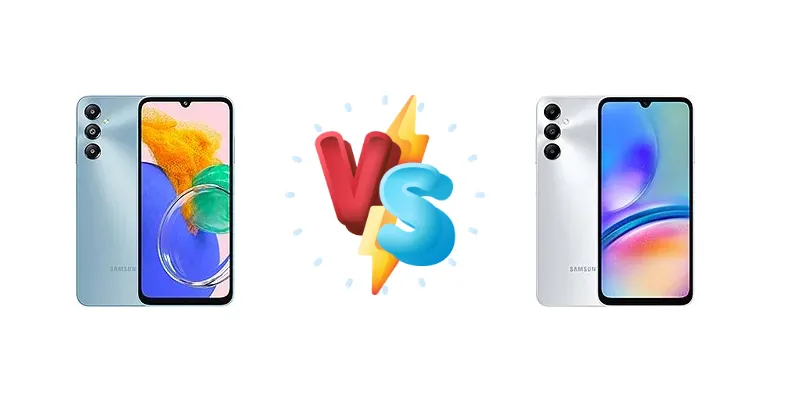
Samsung's budget lineup can be confusing. Both the Galaxy M14 4G and A05s target the entry-level smartphone market, but despite similar price points, they offer slightly different strengths. This comparison dissects their specifications to determine which device delivers the best overall experience for your money.
🏆 Quick Verdict
For most users, the Samsung Galaxy A05s emerges as the slightly better choice. While both phones share the same Snapdragon 680 chipset and 25W charging, the A05s boasts a brighter, higher-contrast display, making it more enjoyable for media consumption. The M14 4G doesn't offer enough additional features to justify its potential price premium.
| Network |
|---|
| 2G bands | GSM 850 / 900 / 1800 / 1900 | GSM 850 / 900 / 1800 / 1900 |
| 3G bands | HSDPA 850 / 900 / 2100 | HSDPA 850 / 900 / 2100 |
| 4G bands | 1, 3, 5, 7, 8, 20, 28, 38, 40, 41 | 1, 3, 5, 7, 8, 20, 28, 38, 40, 41 |
| Speed | HSPA, LTE | HSPA, LTE |
| Technology | GSM / HSPA / LTE | GSM / HSPA / LTE |
| Launch |
|---|
| Announced | 2024, March 07 | 2023, September 25 |
| Status | Available. Released 2024, March 07 | Available. Released 2023, October 18 |
| Body |
|---|
| Build | - | Glass front, plastic back, plastic frame |
| Dimensions | 168 x 77.8 x 8.8 mm (6.61 x 3.06 x 0.35 in) | 168 x 77.8 x 8.8 mm (6.61 x 3.06 x 0.35 in) |
| SIM | Nano-SIM + Nano-SIM | · Nano-SIM· Nano-SIM + Nano-SIM |
| Weight | 194 g (6.84 oz) | 194 g (6.84 oz) |
| Display |
|---|
| Resolution | 1080 x 2400 pixels, 20:9 ratio (~394 ppi density) | 1080 x 2400 pixels, 20:9 ratio (~393 ppi density) |
| Size | 6.7 inches, 107.8 cm2 (~82.5% screen-to-body ratio) | 6.7 inches, 108.4 cm2 (~82.9% screen-to-body ratio) |
| Type | PLS LCD, 90Hz | PLS LCD, 90Hz |
| Platform |
|---|
| CPU | Octa-core (4x2.4 GHz Kryo 265 Gold & 4x1.9 GHz Kryo 265 Silver) | Octa-core (4x2.4 GHz Kryo 265 Gold & 4x1.9 GHz Kryo 265 Silver) |
| Chipset | Qualcomm SM6225 Snapdragon 680 4G (6 nm) | Qualcomm SM6225 Snapdragon 680 4G (6 nm) |
| GPU | Adreno 610 | Adreno 610 |
| OS | Android 13, up to 2 major Android upgrades, One UI 5.1 | Android 13, up to 2 major Android upgrades, One UI 7 |
| Memory |
|---|
| Card slot | microSDXC (dedicated slot) | microSDXC (dedicated slot) |
| Internal | 64GB 4GB RAM, 128GB 6GB RAM | 64GB 4GB RAM, 128GB 4GB RAM, 128GB 6GB RAM |
| Main Camera |
|---|
| Features | LED flash, panorama, HDR | LED flash |
| Triple | 50 MP, f/1.8, (wide), PDAF
2 MP (macro)
Auxiliary lens | 50 MP, f/1.8, (wide), 1/2.8", 0.64µm, AF
2 MP (macro)
Auxiliary lens |
| Video | 1080p@30/60fps | 1080p@30/60fps |
| Selfie camera |
|---|
| Single | 13 MP, f/2.0, (wide) | 13 MP, f/2.0, (wide), 1/3.X", 1.12µm |
| Video | 1080p@30fps | 1080p@30fps |
| Sound |
|---|
| 35mm jack | Yes | Yes |
| Loudspeaker | Yes | Yes |
| Comms |
|---|
| Bluetooth | 5.1, A2DP, LE | 5.1, A2DP, LE |
| NFC | No | Yes (market/region dependent) |
| Positioning | GPS, GALILEO, GLONASS, BDS, QZSS | GPS, GLONASS, GALILEO, BDS, QZSS |
| Radio | Unspecified | Unspecified |
| USB | USB Type-C 2.0 | USB Type-C 2.0 |
| WLAN | Wi-Fi 802.11 a/b/g/n/ac, dual-band, Wi-Fi Direct | Wi-Fi 802.11 a/b/g/n/ac, dual-band, Wi-Fi Direct |
| Features |
|---|
| Sensors | Fingerprint (side-mounted), accelerometer, proximity | Fingerprint (side-mounted), accelerometer, proximity |
| Battery |
|---|
| Charging | 25W wired | 25W wired |
| Type | Li-Ion 5000 mAh | Li-Po 5000 mAh |
| Misc |
|---|
| Colors | Arctic Blue, Sapphire Blue | Black, Silver, Light Green, Violet |
| Models | SM-M145F, SM-M145F/DS | SM-A057F, SM-A057F/DS, SM-A057M, SM-A057M/DS, SM-A057G/DSN, SM-A057G |
| Price | About 90 EUR | $ 134.00 / C$ 146.99 / £ 83.94 / € 100.99 |
| SAR | 0.56 W/kg (head) | - |
| SAR EU | - | 0.58 W/kg (head) 1.31 W/kg (body) |
Samsung Galaxy M14 4G
- Brighter and higher contrast display (468 nits, 1418:1)
- Identical Snapdragon 680 performance
- Solid battery life (11:32h active use)
- Camera details are limited
- May lack features found in slightly higher-tier models
Samsung Galaxy A05s
- Snapdragon 680 provides adequate performance for daily tasks
- 25W fast charging support
- Potentially larger battery capacity (typical of 'M' series)
- Display specifications are unknown, potentially inferior to A05s
- Camera performance likely similar to A05s, with limited details
Display Comparison
The Samsung Galaxy A05s distinguishes itself with a measured peak brightness of 468 nits and a 1418:1 contrast ratio. This translates to a more vivid and readable display, especially outdoors. The M14 4G’s display specifications are currently unavailable, but typically, 'M' series phones prioritize battery life over display quality. The higher contrast ratio on the A05s will result in deeper blacks and a more immersive viewing experience. Without knowing the M14 4G’s panel type or brightness, the A05s clearly holds an advantage for visual clarity.
Camera Comparison
Both phones feature a 'Photo / Video' camera system, but detailed sensor information is lacking. It's safe to assume both will include a primary camera and potentially depth or macro sensors. Given the budget nature of these devices, image quality will likely be adequate in good lighting conditions but struggle in low light. The absence of Optical Image Stabilization (OIS) on either model suggests reliance on software processing for stabilization. Without specific sensor details, it’s difficult to declare a clear winner, but the A05s’ potential for better image preview due to its brighter screen could aid composition.
Performance
Both the Galaxy M14 4G and A05s are powered by the Qualcomm Snapdragon 680 4G (6 nm) chipset, featuring an octa-core CPU configuration with 4x2.4 GHz Kryo 265 Gold and 4x1.9 GHz Kryo 265 Silver cores. This means performance will be virtually identical for everyday tasks like browsing, social media, and light gaming. The 6nm process node contributes to reasonable power efficiency. However, neither phone is a powerhouse; demanding games will require reduced settings. RAM configurations are not specified, but this will be a key differentiator in real-world multitasking performance.
Battery Life
The Galaxy A05s boasts an active use battery score of 11 hours and 32 minutes, providing a solid foundation for all-day battery life. While the M14 4G’s battery capacity isn’t specified, the 'M' series historically prioritizes larger batteries. Both phones support 25W wired charging, suggesting similar charging speeds – approximately 1.5 to 2 hours for a full charge. The A05s’ proven battery performance gives it a slight edge, but the M14 4G could potentially offer longer runtimes depending on its actual battery size.
Buying Guide
Buy the Samsung Galaxy M14 4G if you prioritize a potentially larger battery capacity (though not explicitly stated, the 'M' series often focuses on battery life) and anticipate heavier multitasking. Buy the Samsung Galaxy A05s if you prefer a more vibrant viewing experience with its 468 nits of brightness and 1418:1 contrast ratio, making it ideal for streaming videos and browsing the web.
Frequently Asked Questions
❓ Will the Snapdragon 680 handle popular games like PUBG Mobile?
The Snapdragon 680 can run PUBG Mobile, but you'll likely need to lower the graphics settings to medium or low to achieve a smooth frame rate. Don't expect a high-end gaming experience, but casual gaming is certainly possible.
❓ Is the 25W charging fast enough to quickly top up the battery during a short break?
25W charging is a decent speed for these budget devices. While it won't be as fast as some flagship phones, you can expect to gain a significant charge (around 50%) in approximately 30 minutes, providing enough power for several hours of use.
❓ How does the display on the A05s perform in direct sunlight?
The A05s' 468 nits of peak brightness is respectable and should provide adequate visibility even in direct sunlight, though you may still need to shield the screen slightly for optimal viewing.
❓ Are there any significant software differences between the M14 4G and A05s?
Both devices run Samsung's One UI, based on Android. Software experience will be very similar, with the same features and interface. Updates may vary slightly in timing, but both should receive regular security patches.