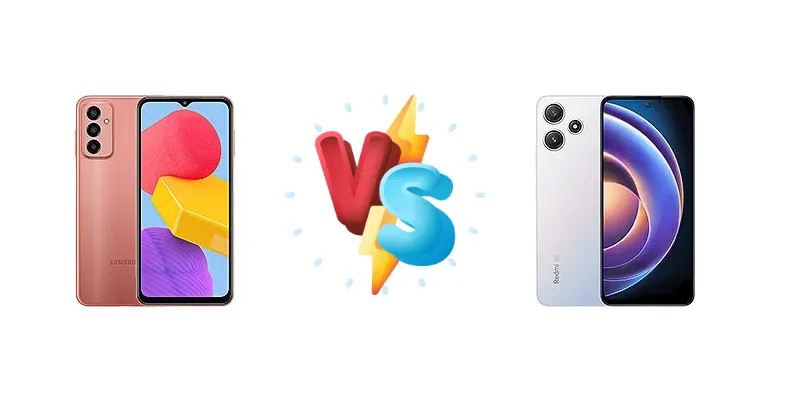
The Samsung Galaxy M13 and Xiaomi Redmi Note 12R represent compelling options in the fiercely competitive budget smartphone market. While both aim to deliver essential features at an accessible price point, they take distinctly different approaches to achieving this goal, primarily through their chipset choices. This comparison dissects these differences to determine which device offers the best overall experience.
🏆 Quick Verdict
For most users, the Xiaomi Redmi Note 12R emerges as the superior choice. Its Snapdragon 4 Gen 2 chipset, built on a more efficient 4nm process, delivers noticeably better performance and thermal management compared to the Samsung Galaxy M13’s Exynos 850. The inclusion of Power Delivery (PD) charging is a welcome bonus, despite the slightly lower battery capacity.
| Network |
|---|
| 2G bands | GSM 850 / 900 / 1800 / 1900 | GSM 850 / 900 / 1800 / 1900 |
| 3G bands | HSDPA 850 / 900 / 2100 | HSDPA 850 / 900 / 2100 |
| 4G bands | 1, 3, 5, 7, 8, 20, 28, 38, 40, 41 | 1, 3, 5, 8, 34, 38, 39, 40, 41 |
| 5G bands | - | 1, 5, 8, 28, 41, 78 SA/NSA |
| Speed | HSPA, LTE | HSPA, LTE, 5G |
| Technology | GSM / HSPA / LTE | GSM / CDMA / HSPA / EVDO / LTE / 5G |
| Launch |
|---|
| Announced | 2022, May 27 | 2023, June 28 |
| Status | Available. Released 2022, July 01 | Available. Released 2023, June 28 |
| Body |
|---|
| Build | Glass front, plastic back, plastic frame | Glass front, plastic frame, glass back |
| Dimensions | 165.4 x 76.9 x 8.4 mm (6.51 x 3.03 x 0.33 in) | 168.6 x 76.3 x 8.2 mm (6.64 x 3.00 x 0.32 in) |
| SIM | Nano-SIM + Nano-SIM | Nano-SIM + Nano-SIM |
| Weight | 192 g (6.77 oz) | 199 g (7.02 oz) |
| Display |
|---|
| Resolution | 1080 x 2408 pixels, 20:9 ratio (~400 ppi density) | 1080 x 2460 pixels (~396 ppi density) |
| Size | 6.6 inches, 104.9 cm2 (~82.5% screen-to-body ratio) | 6.79 inches, 109.5 cm2 (~85.1% screen-to-body ratio) |
| Type | PLS LCD | IPS LCD, 90Hz, 550 nits |
| Platform |
|---|
| CPU | Octa-core (4x2.0 GHz Cortex-A55 & 4x2.0 GHz Cortex-A55) | Octa-core (2x2.2 GHz Cortex-A78 & 6x1.95 GHz Cortex-A55) |
| Chipset | Exynos 850 (8 nm) | Qualcomm SM4450 Snapdragon 4 Gen 2 (4 nm) |
| GPU | Mali-G52 | Adreno 613 |
| OS | Android 12, One UI Core 4.1 | Android 13, MIUI 14 |
| Memory |
|---|
| Card slot | microSDXC (dedicated slot) | microSDXC (uses shared SIM slot) |
| Internal | 64GB 4GB RAM, 128GB 4GB RAM | 128GB 4GB RAM, 128GB 6GB RAM, 128GB 8GB RAM, 256GB 8GB RAM |
| | eMMC 5.1 | - |
| Main Camera |
|---|
| Dual | - | 50 MP, f/1.8, (wide), PDAF
2 MP (macro) |
| Features | LED flash, panorama, HDR | LED flash, HDR |
| Single | 8 MP, f/2.2, (wide) | - |
| Triple | 50 MP, f/1.8, (wide), PDAF
5 MP, f/2.2, 123˚ (ultrawide)
Auxiliary lens | - |
| Video | 1080p@30fps | 1080p@30fps |
| Selfie camera |
|---|
| Features | HDR | HDR |
| Single | 8 MP, f/2.2, (wide) | 5 MP, f/2.2, (wide), 1/5.0", 1.12µm |
| Video | 1080p@30fps | 1080p@30fps |
| Sound |
|---|
| 3.5mm jack | Yes | - |
| 35mm jack | Yes | Yes |
| Loudspeaker | Yes | Yes |
| Comms |
|---|
| Bluetooth | 5.0, A2DP, LE | 5.3, A2DP, LE |
| Infrared port | - | Yes |
| NFC | Yes (market/region dependent) | Yes (market/region dependent) |
| Positioning | GPS, GLONASS, GALILEO, BDS | GPS, GLONASS, GALILEO, BDS |
| Radio | No | No |
| USB | USB Type-C 2.0 | USB Type-C |
| WLAN | Wi-Fi 802.11 a/b/g/n/ac, dual-band | Wi-Fi 802.11 a/b/g/n/ac, dual-band |
| Features |
|---|
| Sensors | Fingerprint (side-mounted), accelerometer, compass | Fingerprint (side-mounted), accelerometer, compass |
| | Virtual proximity sensing | - |
| Battery |
|---|
| Charging | 15W wired | 18W wired, PD |
| Type | Li-Po 5000 mAh | Li-Po 5000 mAh |
| Misc |
|---|
| Colors | Deep Green, Orange Copper, Light Blue | Black, Blue, Silver |
| Models | SM-M135F, SM-M135F/DSN | 23076RA4BC |
| Price | £ 139.99 / € 135.81 | About 150 EUR |
| SAR EU | 0.45 W/kg (head) 1.36 W/kg (body) | - |
Samsung Galaxy M13
- Potentially longer software support from Samsung
- Larger battery capacity (on paper)
- Established brand reputation
- Less powerful Exynos 850 chipset
- Slower 15W charging
- Less efficient 8nm process
Xiaomi Redmi Note 12R
- More powerful Snapdragon 4 Gen 2 chipset
- Faster 18W charging with PD support
- More efficient 4nm process
- MIUI software may not appeal to all users
- Slightly smaller battery capacity
Display Comparison
Neither device boasts a standout display. Both likely feature LCD panels, typical for this price bracket. However, detailed specs like resolution and refresh rate are missing. The focus here is on internal differences. The Redmi Note 12R’s chipset, being newer, may offer slightly better image processing capabilities, potentially resulting in more vibrant colors. Bezels are likely comparable, and without specific data, it’s difficult to assess color accuracy beyond general expectations for budget LCDs.
Camera Comparison
Without detailed camera specs, a direct comparison is limited. However, the market segment suggests both will feature a primary camera alongside depth and macro sensors. The Redmi Note 12R’s image signal processor (ISP), integrated within the Snapdragon 4 Gen 2, is likely more advanced than the Exynos 850’s ISP, potentially leading to better image quality, especially in low-light conditions. The presence of Optical Image Stabilization (OIS) would be a significant advantage, but is not confirmed for either device. The 2MP macro cameras on both are likely of limited utility.
Performance
The core difference lies in the chipsets. The Xiaomi Redmi Note 12R’s Qualcomm Snapdragon 4 Gen 2 (4nm) is a significant upgrade over the Samsung Galaxy M13’s Exynos 850 (8nm). The 4nm process node translates to improved power efficiency and reduced heat generation, meaning the Redmi Note 12R will likely sustain peak performance for longer periods. Furthermore, the Snapdragon 4 Gen 2 features two Cortex-A78 cores clocked at 2.2 GHz, offering a substantial performance boost over the Exynos 850’s all Cortex-A55 configuration. This will be noticeable in app launch times, multitasking, and gaming. While both have 8 cores, the architectural difference is key.
Battery Life
The Samsung Galaxy M13 offers a larger battery capacity, but the Redmi Note 12R compensates with faster 18W charging and Power Delivery (PD) support. PD allows for compatibility with a wider range of chargers and potentially faster charging speeds with compatible adapters. While the M13’s 15W charging is adequate, the Redmi Note 12R’s faster charging will reduce downtime. The Snapdragon 4 Gen 2’s efficiency also contributes to better battery life, potentially offsetting the slightly smaller battery capacity.
Buying Guide
Buy the Samsung Galaxy M13 if you prioritize brand recognition and a potentially wider software support lifespan within the Samsung ecosystem, and your usage is limited to basic tasks like calling, texting, and light social media. Buy the Xiaomi Redmi Note 12R if you prioritize performance for the price, enjoy faster charging speeds with PD support, and are comfortable with Xiaomi’s MIUI software experience. The Redmi Note 12R is the better option for mobile gaming and multitasking.
Frequently Asked Questions
❓ Does the Exynos 850 in the Galaxy M13 overheat during prolonged gaming sessions?
The Exynos 850, built on an 8nm process, is prone to thermal throttling under sustained load. While it can handle casual gaming, demanding titles will likely experience frame drops and reduced performance after a short period. The Redmi Note 12R’s Snapdragon 4 Gen 2, with its 4nm process, manages heat much more effectively, allowing for longer and more consistent gaming sessions.
❓ Is the 2MP macro camera on either phone worth using?
Generally, 2MP macro cameras on budget smartphones offer limited image quality. The small sensor size and fixed focus result in images that lack detail and sharpness. They are primarily a marketing feature and are unlikely to produce satisfying results in most scenarios. Focusing on the main camera is recommended for better photos.
❓ Can the Redmi Note 12R handle games like PUBG Mobile at high frame rates?
The Redmi Note 12R’s Snapdragon 4 Gen 2 is capable of running PUBG Mobile, but achieving consistently high frame rates (60fps or higher) will depend on the graphics settings. Expect to play at medium settings for a smooth experience. The Exynos 850 in the Galaxy M13 will struggle to maintain stable frame rates even at lower settings.
❓ What type of charger does the Samsung Galaxy M13 include in the box, and can I use a faster charger?
The Samsung Galaxy M13 includes a 15W charger in the box. While you can use a charger with higher wattage (e.g., 25W), the phone will only draw up to 15W. Using a faster charger won't significantly reduce charging time, but it won't damage the device.