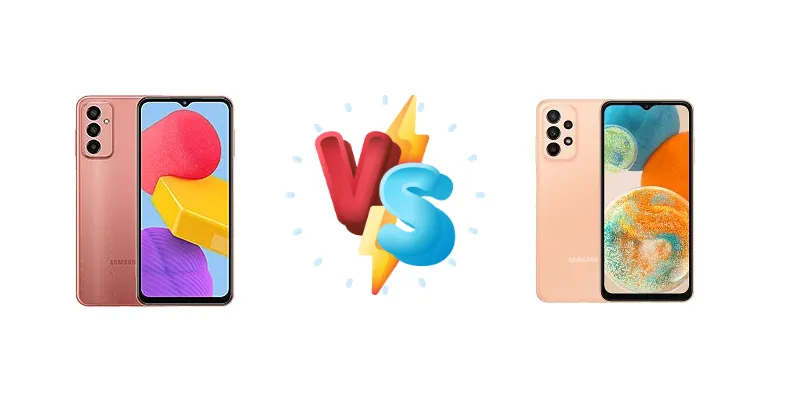
Samsung's budget lineup can be confusing. The Galaxy A23 5G and M13 both aim for affordability, but cater to slightly different needs. The A23 5G adds 5G connectivity and a more powerful processor, while the M13 focuses on delivering core functionality at an even lower price point. This comparison dives deep into the specs to reveal which phone offers the best value.
🏆 Quick Verdict
For most users, the Samsung Galaxy A23 5G is the better choice. Its Snapdragon 695 chipset provides a noticeable performance boost over the M13’s Exynos 850, and the inclusion of 5G future-proofs the device. While the M13 is cheaper, the A23 5G’s advantages justify the price difference.
| Network |
|---|
| 2G bands | GSM 850 / 900 / 1800 / 1900 | GSM 850 / 900 / 1800 / 1900 |
| 3G bands | HSDPA 850 / 900 / 2100 | HSDPA 850 / 900 / 1700(AWS) / 1900 / 2100 |
| 4G bands | 1, 3, 5, 7, 8, 20, 28, 38, 40, 41 | 1, 2, 3, 4, 5, 7, 8, 12, 17, 20, 26, 28, 32, 38, 40, 41, 66 - International |
| 5G bands | - | 1, 3, 7, 8, 20, 28, 38, 40, 41, 77, 78 SA/NSA/Sub6 - International |
| Speed | HSPA, LTE | HSPA, LTE, 5G |
| Technology | GSM / HSPA / LTE | GSM / HSPA / LTE / 5G |
| | - | 2, 5, 30, 66, 77 SA/NSA/Sub6/mmWave - USA |
| Launch |
|---|
| Announced | 2022, May 27 | 2022, August 05 |
| Status | Available. Released 2022, July 01 | Available. Released 2022, September 02 |
| Body |
|---|
| Build | Glass front, plastic back, plastic frame | Glass front (Gorilla Glass 5), plastic frame, plastic back |
| Dimensions | 165.4 x 76.9 x 8.4 mm (6.51 x 3.03 x 0.33 in) | 165.4 x 76.9 x 8.4 mm (6.51 x 3.03 x 0.33 in) |
| SIM | Nano-SIM + Nano-SIM | · Nano-SIM· Nano-SIM + Nano-SIM |
| Weight | 192 g (6.77 oz) | 197 g (6.95 oz) |
| Display |
|---|
| Protection | - | Corning Gorilla Glass 5 |
| Resolution | 1080 x 2408 pixels, 20:9 ratio (~400 ppi density) | 1080 x 2408 pixels, 20:9 ratio (~400 ppi density) |
| Size | 6.6 inches, 104.9 cm2 (~82.5% screen-to-body ratio) | 6.6 inches, 104.9 cm2 (~82.5% screen-to-body ratio) |
| Type | PLS LCD | PLS LCD, 120Hz |
| Platform |
|---|
| CPU | Octa-core (4x2.0 GHz Cortex-A55 & 4x2.0 GHz Cortex-A55) | Octa-core (2x2.2 GHz Kryo 660 Gold & 6x1.7 GHz Kryo 660 Silver) |
| Chipset | Exynos 850 (8 nm) | Qualcomm SM6375 Snapdragon 695 5G (6 nm) |
| GPU | Mali-G52 | Adreno 619 |
| OS | Android 12, One UI Core 4.1 | Android 12, upgradable to Android 14, One UI 6 |
| Memory |
|---|
| Card slot | microSDXC (dedicated slot) | microSDXC (dedicated slot) |
| Internal | 64GB 4GB RAM, 128GB 4GB RAM | 64GB 4GB RAM, 64GB 6GB RAM, 128GB 4GB RAM, 128GB 6GB RAM, 128GB 8GB RAM |
| | eMMC 5.1 | - |
| Main Camera |
|---|
| Features | LED flash, panorama, HDR | LED flash, panorama, HDR |
| Quad | - | 50 MP, f/1.8, 26mm (wide), 1/2.76", 0.64µm, PDAF, OIS
5 MP, f/2.2, 13mm, 123˚ (ultrawide), 1/5.0", 1.12µm
2 MP (macro)
Auxiliary lens |
| Single | 8 MP, f/2.2, (wide) | - |
| Triple | 50 MP, f/1.8, (wide), PDAF
5 MP, f/2.2, 123˚ (ultrawide)
Auxiliary lens | - |
| Video | 1080p@30fps | 1080p@30fps |
| Selfie camera |
|---|
| Features | HDR | - |
| Single | 8 MP, f/2.2, (wide) | 8 MP, f/2.0, 25mm (wide), 1/4.0", 1.12µm - USA
8 MP, f/2.2, 25mm (wide), 1/4.0", 1.12µm - International |
| Video | 1080p@30fps | 1080p@30fps |
| Sound |
|---|
| 3.5mm jack | Yes | Yes |
| 35mm jack | Yes | Yes |
| Loudspeaker | Yes | Yes |
| Comms |
|---|
| Bluetooth | 5.0, A2DP, LE | 5.1, A2DP, LE |
| NFC | Yes (market/region dependent) | Yes |
| Positioning | GPS, GLONASS, GALILEO, BDS | GPS, GLONASS, GALILEO, BDS |
| Radio | No | FM radio (market/region dependent) |
| USB | USB Type-C 2.0 | USB Type-C 2.0 |
| WLAN | Wi-Fi 802.11 a/b/g/n/ac, dual-band | Wi-Fi 802.11 a/b/g/n/ac, dual-band, Wi-Fi Direct |
| Features |
|---|
| Sensors | Fingerprint (side-mounted), accelerometer, compass | Fingerprint (side-mounted), accelerometer, gyro, compass, barometer (USA only) |
| | Virtual proximity sensing | Virtual proximity sensing |
| Battery |
|---|
| Charging | 15W wired | 25W wired |
| Type | Li-Po 5000 mAh | Li-Po 5000 mAh |
| Misc |
|---|
| Colors | Deep Green, Orange Copper, Light Blue | Black, White, Peach, Blue |
| Models | SM-M135F, SM-M135F/DSN | SM-A236U, SM-A236U1, SM-A236B, SM-A236B/DS, SM-A236B/DSN, SM-A236E, SM-S236DL |
| Price | £ 139.99 / € 135.81 | $ 84.44 / £ 129.00 / € 125.28 / ₹ 21,000 |
| SAR | - | 0.68 W/kg (head) 0.57 W/kg (body) |
| SAR EU | 0.45 W/kg (head) 1.36 W/kg (body) | 1.49 W/kg (head) 1.25 W/kg (body) |
| Tests |
|---|
| Battery life | - |
Endurance rating 138h
|
| Camera | - |
Photo / Video |
| Display | - |
Contrast ratio: 1328:1 (nominal) |
| Loudspeaker | - |
-25.9 LUFS (Very good)
|
| Performance | - |
AnTuTu: 318821 (v9)
GeekBench: 1940 (v5.1)
GFXBench: 16fps (ES 3.1 onscreen) |
Samsung Galaxy M13
- Faster Snapdragon 695 processor for smoother performance
- 5G connectivity for future-proofed data speeds
- 25W fast charging for quicker top-ups
- Potentially higher price point than the M13
- May not offer significantly better camera performance without detailed sensor specs
Samsung Galaxy A23 5G
- More affordable price point
- Comparable battery endurance to the A23 5G
- Acceptable performance for basic tasks
- Slower Exynos 850 processor
- Lacks 5G connectivity
- Slower 15W charging
Display Comparison
Both the Galaxy A23 5G and M13 share a 1328:1 contrast ratio, suggesting similar image quality in terms of dynamic range. However, the A23 5G boasts a measured peak brightness of 508 nits, which will translate to better visibility outdoors compared to the M13, whose brightness is not specified. While both likely utilize LCD panels, the A23 5G’s higher brightness is a clear advantage for users who frequently use their phones in sunlight.
Camera Comparison
Both phones feature a 'Photo / Video' camera system, but detailed sensor information is lacking. Without specifics, it’s difficult to make a definitive judgment. However, given Samsung’s typical segmentation, the A23 5G likely benefits from a more sophisticated image signal processor (ISP) within the Snapdragon 695, potentially leading to better image quality, especially in low-light conditions. The inclusion of Optical Image Stabilization (OIS) on the A23 5G (a common feature in this price range) would further enhance its photographic capabilities, a feature likely absent on the M13.
Performance
The core difference lies in the chipsets. The Galaxy A23 5G’s Qualcomm Snapdragon 695 (6nm) is built on a smaller fabrication process than the M13’s Exynos 850 (8nm). This 6nm process generally leads to improved power efficiency and thermal performance, meaning the A23 5G is less likely to throttle under sustained load. The Snapdragon 695’s CPU configuration – 2x2.2 GHz Kryo 660 Gold & 6x1.7 GHz Kryo 660 Silver – also offers a performance edge over the M13’s octa-core setup of 4x2.0 GHz Cortex-A55 & 4x2.0 GHz Cortex-A55. This translates to faster app loading times and smoother multitasking on the A23 5G.
Battery Life
Both devices share an endurance rating of 138 hours, indicating comparable battery life under typical usage. However, the A23 5G supports 25W wired charging, significantly faster than the M13’s 15W charging. This means the A23 5G can replenish its battery much quicker, reducing downtime. While battery capacity isn't specified, the faster charging speed is a practical advantage for users who need to top up their phones quickly.
Buying Guide
Buy the Samsung Galaxy M13 if you prioritize absolute affordability and don't require 5G connectivity. It's ideal for basic smartphone tasks like calling, texting, and light social media use. Buy the Samsung Galaxy A23 5G if you want a smoother user experience, faster download speeds with 5G, and a phone that will handle more demanding apps and games without significant lag.
Frequently Asked Questions
❓ Does the Exynos 850 in the Galaxy M13 overheat during prolonged gaming sessions?
The Exynos 850, being built on an 8nm process, is more prone to thermal throttling than the Snapdragon 695 (6nm). While it won't likely get dangerously hot, expect performance to dip after extended gaming, leading to frame drops and a less enjoyable experience.
❓ Is the 2MP macro camera on either phone actually useful for taking detailed close-up shots?
Generally, 2MP macro cameras on budget phones offer limited detail and image quality. They are often included for marketing purposes but rarely deliver truly impressive macro photography. Expect soft images and limited dynamic range.
❓ Does the Galaxy A23 5G support 90fps gameplay in popular titles like PUBG Mobile?
While the Snapdragon 695 is capable, achieving a consistent 90fps in PUBG Mobile will depend on the graphics settings used. Expect to need to lower the settings to medium or low to maintain a smooth 90fps experience. The M13 will likely struggle to maintain even 60fps on higher settings.
❓ What type of SIM cards do these phones support?
Both the Galaxy A23 5G and M13 support Nano-SIM cards. The A23 5G also supports 5G SIMs, while the M13 is limited to 4G SIMs. Both support dual SIM functionality.