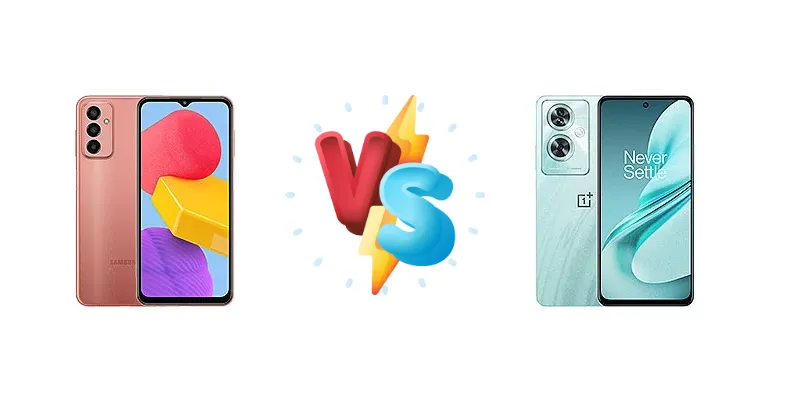
The sub-$200 smartphone market is fiercely competitive. The Samsung Galaxy M13, a mainstay in Samsung’s budget lineup, faces a new challenger in the OnePlus Nord N30 SE. While both aim to deliver essential smartphone functionality at an accessible price, they take different approaches to achieving this, particularly in chipset choice and charging technology. This comparison dissects these differences to determine which device offers the best value.
🏆 Quick Verdict
For the average user prioritizing quick top-ups and slightly better performance, the OnePlus Nord N30 SE is the stronger choice. Its Mediatek Dimensity 6020, fabricated on a more efficient 7nm process, and 33W charging significantly outperform the Galaxy M13’s Exynos 850 and 15W charging, making it more convenient for daily use.
| Network |
|---|
| 2G bands | GSM 850 / 900 / 1800 / 1900 | GSM 850 / 900 / 1800 / 1900 |
| 3G bands | HSDPA 850 / 900 / 2100 | HSDPA 850 / 900 / 1700(AWS) / 1900 / 2100 |
| 4G bands | 1, 3, 5, 7, 8, 20, 28, 38, 40, 41 | 1, 2, 3, 4, 5, 7, 8, 12, 13, 17, 18, 19, 20, 26, 28, 38, 39, 40, 41, 66 |
| 5G bands | - | 1, 3, 5, 7, 8, 20, 28, 38, 40, 41, 66, 77, 78 SA/NSA |
| Speed | HSPA, LTE | HSPA, LTE, 5G |
| Technology | GSM / HSPA / LTE | GSM / HSPA / LTE / 5G |
| Launch |
|---|
| Announced | 2022, May 27 | 2024, January 29 |
| Status | Available. Released 2022, July 01 | Available. Released 2024, January 31 |
| Body |
|---|
| Build | Glass front, plastic back, plastic frame | Glass front, plastic frame, plastic back |
| Dimensions | 165.4 x 76.9 x 8.4 mm (6.51 x 3.03 x 0.33 in) | 165.6 x 76 x 8 mm (6.52 x 2.99 x 0.31 in) |
| SIM | Nano-SIM + Nano-SIM | Nano-SIM + Nano-SIM |
| Weight | 192 g (6.77 oz) | 193 g (6.81 oz) |
| Display |
|---|
| Resolution | 1080 x 2408 pixels, 20:9 ratio (~400 ppi density) | 1080 x 2400 pixels, 20:9 ratio (~392 ppi density) |
| Size | 6.6 inches, 104.9 cm2 (~82.5% screen-to-body ratio) | 6.72 inches, 109.0 cm2 (~86.6% screen-to-body ratio) |
| Type | PLS LCD | IPS LCD |
| Platform |
|---|
| CPU | Octa-core (4x2.0 GHz Cortex-A55 & 4x2.0 GHz Cortex-A55) | Octa-core (2x2.2 GHz Cortex-A76 & 6x2.0 GHz Cortex-A55) |
| Chipset | Exynos 850 (8 nm) | Mediatek Dimensity 6020 (7 nm) |
| GPU | Mali-G52 | Mali-G57 MC2 |
| OS | Android 12, One UI Core 4.1 | Android 13, OxygenOS 13.1 |
| Memory |
|---|
| Card slot | microSDXC (dedicated slot) | No |
| Internal | 64GB 4GB RAM, 128GB 4GB RAM | 128GB 4GB RAM |
| | eMMC 5.1 | - |
| Main Camera |
|---|
| Dual | - | 50 MP, f/1.8, (wide), 1/2.76", 0.64µm, PDAF
Auxiliary lens |
| Features | LED flash, panorama, HDR | LED flash, HDR, panorama |
| Single | 8 MP, f/2.2, (wide) | - |
| Triple | 50 MP, f/1.8, (wide), PDAF
5 MP, f/2.2, 123˚ (ultrawide)
Auxiliary lens | - |
| Video | 1080p@30fps | 1080p@30fps |
| Selfie camera |
|---|
| Features | HDR | - |
| Single | 8 MP, f/2.2, (wide) | 8 MP, f/2.0, (wide), 1/4.0", 1.12µm |
| Video | 1080p@30fps | 1080p@30fps |
| Sound |
|---|
| 3.5mm jack | Yes | - |
| 35mm jack | Yes | Yes |
| Loudspeaker | Yes | Yes, with stereo speakers |
| Comms |
|---|
| Bluetooth | 5.0, A2DP, LE | 5.3, A2DP, LE |
| NFC | Yes (market/region dependent) | Yes |
| Positioning | GPS, GLONASS, GALILEO, BDS | GPS, GALILEO, GLONASS, BDS |
| Radio | No | No |
| USB | USB Type-C 2.0 | USB Type-C 2.0, OTG |
| WLAN | Wi-Fi 802.11 a/b/g/n/ac, dual-band | Wi-Fi 802.11 a/b/g/n/ac, dual-band |
| Features |
|---|
| Sensors | Fingerprint (side-mounted), accelerometer, compass | Fingerprint (side-mounted), accelerometer, gyro, proximity, compass |
| | Virtual proximity sensing | - |
| Battery |
|---|
| Charging | 15W wired | 33W wired, 51% in 30 min |
| Type | Li-Po 5000 mAh | 5000 mAh |
| Misc |
|---|
| Colors | Deep Green, Orange Copper, Light Blue | Black Satin, Cyan |
| Models | SM-M135F, SM-M135F/DSN | CPH2605 |
| Price | £ 139.99 / € 135.81 | About 510 EUR |
| SAR EU | 0.45 W/kg (head) 1.36 W/kg (body) | - |
Samsung Galaxy M13
- Established Samsung brand reputation
- Potentially more software updates (Samsung's update policy)
- Reliable, if basic, performance for everyday tasks
- Slower Exynos 850 chipset
- Significantly slower 15W charging
- Less efficient 8nm fabrication process
OnePlus Nord N30 SE
- Faster Mediatek Dimensity 6020 chipset
- Much faster 33W charging (51% in 30 min)
- More efficient 7nm fabrication process
- OnePlus's software update history can be inconsistent
- Less brand recognition compared to Samsung
Display Comparison
Neither device boasts a standout display. While specific panel details (like peak brightness or color gamut coverage) are absent, the focus here is on the underlying processing power impacting UI smoothness. Both likely utilize LCD panels common in this price bracket. The real difference lies in how efficiently the chipsets can render the UI; a smoother experience is expected on the N30 SE due to its more capable processor.
Camera Comparison
Without detailed camera specs, a direct comparison is difficult. However, it’s safe to assume both phones feature basic camera setups geared towards social media sharing. The presence of a 2MP macro camera on both devices suggests limited utility; these sensors typically lack the resolution and quality to produce truly detailed macro shots. Image processing will likely differ, with Samsung historically favoring more saturated colors and OnePlus aiming for a more natural look. The chipset’s ISP (Image Signal Processor) capabilities will also play a role, with the Dimensity 6020 likely offering more advanced processing features.
Performance
The core difference lies in the chipsets. The OnePlus Nord N30 SE’s Mediatek Dimensity 6020, built on a 7nm process, offers a clear advantage over the Samsung Galaxy M13’s Exynos 850 (8nm). The Dimensity 6020 features a more modern CPU configuration with 2x2.2 GHz Cortex-A76 cores alongside 6x2.0 GHz Cortex-A55 cores, compared to the M13’s 4x2.0 GHz Cortex-A55 and another 4x2.0 GHz Cortex-A55. This translates to noticeably faster application loading times and smoother multitasking on the N30 SE. The 7nm fabrication process also contributes to better thermal efficiency, potentially reducing throttling during sustained workloads.
Battery Life
While battery capacity isn’t specified, the charging speeds are a significant differentiator. The OnePlus Nord N30 SE’s 33W wired charging is a substantial upgrade over the Samsung Galaxy M13’s 15W charging. OnePlus claims a 51% charge in 30 minutes, which is a game-changer for users who need a quick power boost. Even with a similar battery capacity, the faster charging speed makes the N30 SE more convenient. The Exynos 850’s less efficient power draw may also mean the M13 requires more frequent charging, even with a comparable battery size.
Buying Guide
Buy the Samsung Galaxy M13 if you prioritize brand recognition within the Samsung ecosystem and are comfortable with slower charging speeds. It’s a reliable, if unexciting, option for basic smartphone tasks. Buy the OnePlus Nord N30 SE if you value faster performance for the price, and especially if you frequently find yourself needing to quickly recharge your device. The N30 SE offers a more modern chipset and a significantly faster charging experience.
Frequently Asked Questions
❓ Does the Exynos 850 chip in the Galaxy M13 overheat during prolonged gaming sessions?
The Exynos 850, being an 8nm chip, is prone to more thermal throttling than the 7nm Dimensity 6020. While it won't likely shut down, expect performance to dip after extended gaming, leading to lower frame rates and a less enjoyable experience. The N30 SE will maintain higher sustained performance.
❓ Is the 33W charging on the Nord N30 SE compatible with Power Delivery (PD) chargers?
While OnePlus doesn't explicitly state PD compatibility, the Nord N30 SE utilizes USB-C Power Delivery. Using a PD charger *should* work, but it's best to use the included charger for optimal charging speeds. Third-party chargers may not always deliver the full 33W.
❓ How does the software experience differ between Samsung's One UI and OnePlus's OxygenOS?
Samsung's One UI is feature-rich and heavily customized, offering a wide range of options but potentially feeling bloated to some. OnePlus's OxygenOS aims for a cleaner, more streamlined experience closer to stock Android, prioritizing speed and simplicity. Preference is subjective, but OxygenOS is generally considered less resource-intensive.